C++ Polymorphism explained
Polymorphism is a Greek word implying "many forms". In C++ it implies that a particular
function or operator may behave in different ways in different circumstances. The analogy of
polymorphism in the real world would be the example of a human who at the same time is a
father, a husband, and an employee, who shows one behavior here and the other one there.
Such an idea is extended to functions and operators in C++. As an example, a + operator may
both add two integer values or concatenate two String values, thus its polymorphic nature.
Polymorphism types
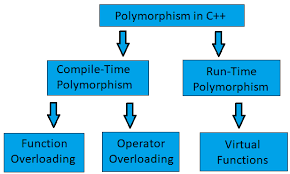
C++ policies polymorphism can be divided into two broad categories namely compile-time
polymorphism and runtime polymorphism.
Compile-Time Polymorphism
The compile-time polymorphism, which was also referred to as a static polymorphism or early
binding is a result which is performed by the compiling program. This kind of polymorphism
decides how an operation or function will behave depending on the situation and such
polymorphism is reached by way of the overloading of functions and overloading of operators.
The correctness of the function or operator applied is determined by data types and number
of parameters at the compile time.
Function Overloading
Function overloading enables a group of different functions to share a name however acting
differently depending on the parameters. Overloading functions may occur in alteration
of the number of arguments accepted, or the type of arguments accepted. This has the
effect of allowing the same name to be used in different functions depending on the
parameters it has been given. As an example, one might declare a type-generic add()
function to add two integers or two floating-point numbers, and the compiler decides the
version to invoke depending on the types of arguments. In the same way, print() could
manage all types of information : an integer, a double, or a string.
Operator Overloading
Operator overloading provides special meanings of the particular data types with
operators. This offers operators the opportunity to execute various operations
depending on the kind of operands. As an example, in order to concatenate two strings,
or to add two Complex objects that are user-defined, operator + can be overloaded. This
facility provides the operators with extended functionality which is not specific to built
in types, but it is with user defined classes.
Runtime Polymorphism
Dynamic polymorphism; also called late binding and sometimes runtime binding, is a technique
of resolving calls to a function at run time instead of at compile time Function
overriding with the use of virtual functions is the main way to achieve it. This is
more flexible since during runtime the type of specific implementation of the function is
decided on the actual type of object. A class that contains a declaration of
inheritance of a virtual function is called a polymorphic class.
Function Overriding
Overriding of functions is the process that takes place to derive a class where a member with
a certain specific implementation exists already in the base class, and the derived class
then implements a different definition on its own. The base class function should be
treated as a virtual function in order to make runtime polymorphism to occur. In the
case where a pointer or reference to a base class object refers to an object of a derived
class, and where a virtual function is called using that pointer or reference, the derived
version of the function is called. This binding process of the choice of the function
gives objects of the derived type the ability to directly call their version of the function
giving it desired runtime polymorphism. As an example a display() method in a base
class may be overridden by derived classes and more than one output may be produced
according to the type of object at a runtime.
Virtual Functions
A virtual function is a member function of a base class which is meant to be redefined in a
derived-class or overridden. Making a base-class function virtual permits the derived
class to give its own flavor of the same, which is then invoked run time, depending on the
real type of the object. Dynamic binding is important to realize when a call of the
method is resolved at run time through virtual functions. This is what allows
polymorphic behavior such that objects of various derived classes can be handled in a
uniform manner via a shared-interface.This is declared in derived classes by using the
override keyword, indicating that a particular function is overriding a virtual function
within the base class. Pure virtual functions The pure virtual functions are the member
functions that are specified as virtual but not defined; they are identified using =0.
Abstract base classes may have pure virtual functions.
Uncodemy C++ Courses
Uncodemy is an information technology training center, which has different courses including
C++ programming. Although the search results do not show a list of Uncodemy courses
exactly named "C++ Polymorphism", it also states that there are exhaustive courses on C++
programming and higher skills on object-oriented programming methods presented through
Uncodemy. Polymorphism, as a key concept in the C++ and object-oriented programming,
would most probably be addressed in these courses. When it comes to the training and
development industry, Uncodemy is one of the market leaders in different areas of technology
that are being demanded.
Possible C++ classes at Uncodemy that would cover polymorphism could be:
C++: The course would probably form a solid background in the programming
language C++ by covering basic concepts in this programming language such as object-oriented
paradigms of polymorphism.
Advanced C++ Programming: In this course, more advanced concepts of C++
would be covered and would definitely involve in depth discussions along with practical
examples of polymorphism and virtual functions and inheritance as well.
Objection-Oriented Programming (OOP) in C++: Since polymorphism is one of
the key foundations of OOP, any OOP course offered with respect C++ would include large
amounts of information on polymorphism.
These courses offer non-replicable skills to those aspiring software engineers and they
include knowledge on basic concepts and advanced methods of developing software. It is
hoped that everyone will visit the free C++ tutorials and the software engineering courses
offered by Uncodemy and boost his or her studies in the world of programming.