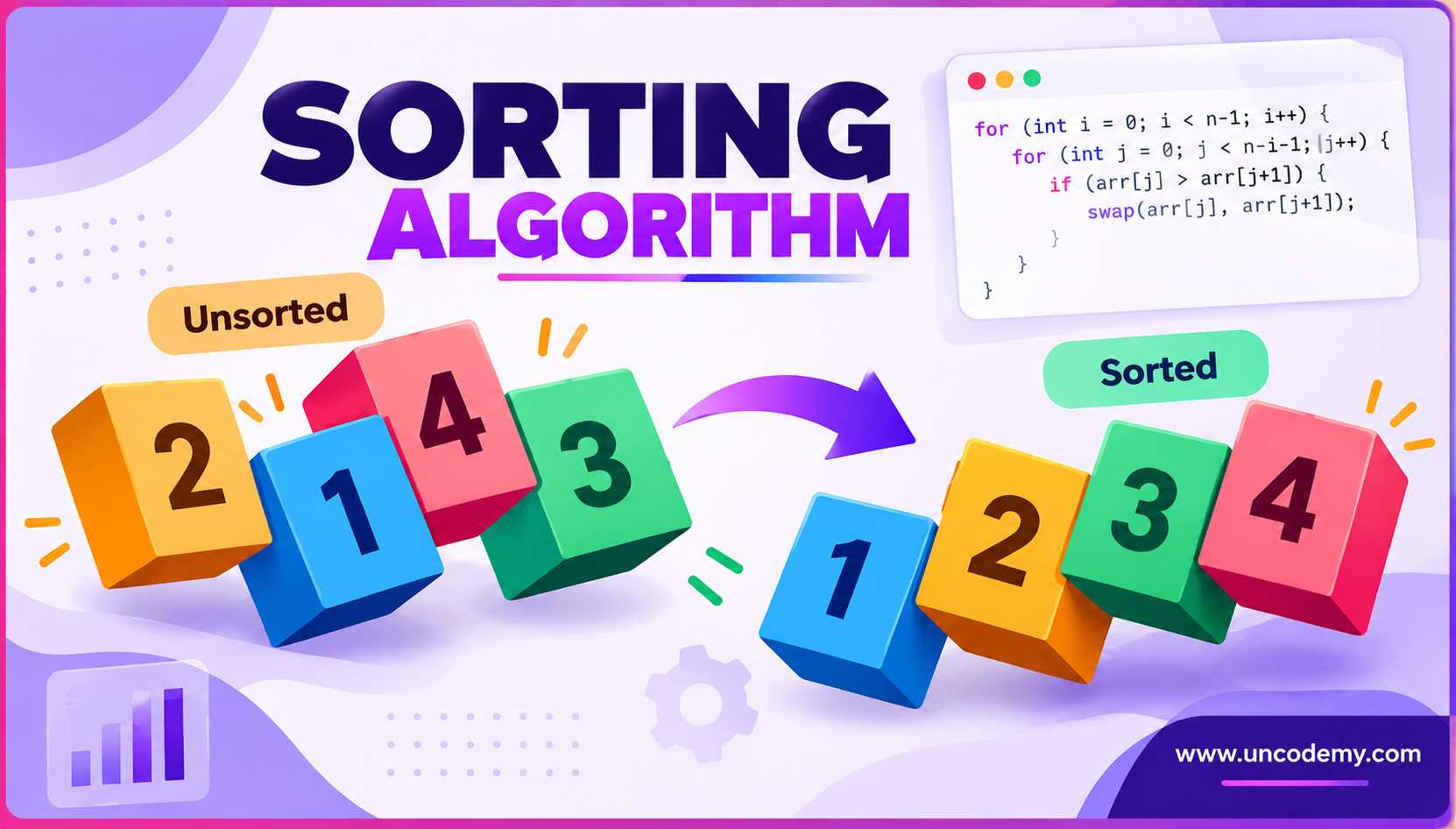
In this blog, we’ll dive into the various types of sorting algorithms, break down
how they function, compare their time complexities, and discuss where each one shines.
If you're looking to boost your skills in algorithms and data structures, we
highly recommend checking out Uncodemy’s Data Structures Course in Noida. This
all-encompassing course offers hands-on training, real-world challenges, and personalized
mentorship from industry professionals.
What Is Sorting?
-
Mr. Kunal Arora / 12
days
- 15
- 10 min read
Sorting is all about arranging data in a particular order—usually either
ascending or descending. The benefits of sorting include:
- Simplified searching
- Enhanced data presentation
- More efficient use of other algorithms like binary search
- Better performance in database queries and memory management
Why Learn Sorting Algorithms?
Grasping the different sorting algorithms empowers developers and programmers to:
- Maximize program speed and efficiency
- Tackle algorithm-based coding challenges
- Select the most effective algorithm for varying data sizes
- Prepare for technical interviews and coding assessments
Classification of Sorting Algorithms
| Criteria |
Types |
| Based on Technique |
Comparison-based, Non-comparison-based |
| Based on Stability |
Stable, Unstable |
| Based on Recursion |
Recursive, Non-recursive |
| Based on Space |
In-place, Out-of-place |
1. Bubble Sort
Concept: This method repeatedly compares adjacent elements and swaps them if
they’re out of order. It keeps going until no more swaps are needed.
Time Complexity:
- Best: O(n)
- Average/Worst: O(n²)
- Space Complexity: O(1) (in-place)
- Stability: Stable
Use Case: It works well for small datasets and is great for
teaching the basics.
2. Selection Sort
Concept: This technique splits the array into a sorted section and an unsorted
section. It repeatedly picks the smallest element from the unsorted section and swaps it with
the leftmost unsorted element.
Time Complexity:
- Best/Average/Worst: O(n²)
- Space Complexity: O(1)
- Stability: Unstable (though it can be adjusted to be stable)
Use Case: It’s straightforward to implement and often used in
educational settings.
3. Insertion Sort
Concept: This algorithm builds the sorted array one element at a time by
comparing each new element with those already sorted and placing it in the right spot.
Time Complexity:
- Best: O(n)
- Average/Worst: O(n²)
- Space Complexity: O(1)
Stability: Stable
Use Case: It’s particularly efficient for small or nearly sorted
datasets.
4. Merge Sort
Concept: This is a divide-and-conquer strategy. It splits the array into halves,
sorts each half recursively, and then merges the sorted halves back together.
Time Complexity:
- Best/Average/Worst: O(n log n)
- Space Complexity: O(n) (not in-place)
- Stability: Stable
Use Case: Ideal for large datasets where stable sorting is a
must.
5. Quick Sort
Concept: This algorithm uses a pivot to split the array into two halves, sorting
each half recursively.
Time Complexity:
- Best/Average: O(n log n)
- Worst: O(n²)
- Space Complexity: O(log n) (in-place with stack recursion)
- Stability: Unstable
Use Case: It's often faster for large datasets and is commonly
found in many standard libraries.
6. Heap Sort
Concept: This method transforms the array into a max heap, then repeatedly
extracts the largest element, placing it at the end of the array.
Time Complexity:
- Best/Average/Worst: O(n log n)
- Space Complexity: O(1)
- Stability: Unstable
Use Case: Ideal for large datasets and scenarios where memory is
limited.
7. Counting Sort
Concept: This is a non-comparison-based sorting technique that counts the
occurrences of each element and determines their positions in the sorted array.
Time Complexity:
- O(n + k), where k represents the range of the input
- Space Complexity: O(k)
- Stability: Stable
Use Case: Best suited for sorting integers or characters within
a known, limited range.
8. Radix Sort
Concept: This algorithm sorts numbers digit by digit, using a stable sort (like
counting sort) starting from the least significant digit.
Time Complexity:
- O(nk), where k is the number of digits
- Space Complexity: O(n + k)
- Stability: Stable
Use Case: Great for sorting long lists of integers or
fixed-length strings.
9. Bucket Sort
Concept: This technique divides elements into several buckets and sorts each
bucket individually, often using insertion sort or merge sort.
Time Complexity:
- O(n + k)
- Space Complexity: O(n + k)
- Stability: Depends on the sorting algorithm used for the
buckets
Use Case: Effective for sorting data that is evenly distributed
across a range.
Comparison Table: Sorting Algorithms
| Algorithm |
Time Complexity (Avg) |
Space |
Stability |
Best Use Case |
| Bubble Sort |
O(n²) |
O(1) |
Yes |
Teaching, small datasets |
| Selection Sort |
O(n²) |
O(1) |
No |
Simple, small programs |
| Insertion Sort |
O(n²) |
O(1) |
Yes |
Nearly sorted arrays |
| Merge Sort |
O(n log n) |
O(n) |
Yes |
Large datasets, stable sort |
| Quick Sort |
O(n log n) |
O(log n) |
No |
Fastest for general use |
| Heap Sort |
O(n log n) |
O(1) |
No |
Memory-critical applications |
| Counting Sort |
O(n + k) |
O(k) |
Yes |
Integer sorting in fixed range |
| Radix Sort |
O(nk) |
O(n + k) |
Yes |
Long integers, strings |
| Bucket Sort |
O(n + k) |
O(n + k) |
Depends |
Uniformly distributed data |
Real-World Applications of Sorting Algorithms
- E-commerce: Think about how online stores sort their product
listings by price or popularity to help you find what you want quickly.
- Databases: They rely on sorting for efficient query execution,
making data retrieval a breeze.
- Search engines: They organize ranked pages to deliver the most
relevant results right at your fingertips.
- Gaming: Ever checked out a high score leaderboard? That’s
sorting in action!
- Networking: It’s all about packet scheduling and managing
priorities to keep everything running smoothly.
How to Choose the Right Sorting Algorithm?
When it comes to picking the right sorting algorithm, keep these factors in mind:
- Size of the dataset – For large datasets, quick sort or merge
sort are your go-tos, while insertion sort shines with smaller ones.
- Need for stability – If you need to maintain the order of
equal elements, merge sort or bubble sort is the way to go.
- Memory limitations – In cases where memory is tight, opt for
in-place sorts like quick sort or heap sort.
- Input characteristics – If your data is nearly sorted,
insertion sort can really perform well.
Learn Sorting with Uncodemy
Sorting algorithms are fundamental to any computer science curriculum and are
essential for interview prep. If you’re serious about mastering data structures, consider
joining Uncodemy’s Data Structures Course in Noida.
You’ll dive into:
- Practical implementation of all sorting techniques
- Real-world applications and optimizations
- Live coding sessions and mentorship
- Interview questions focused on sorting algorithms
This course is perfect for both beginners and seasoned professionals.
Conclusion
Sorting algorithms are vital tools in every programmer’s toolkit. Each one has
its unique strengths, weaknesses, and ideal use cases. By understanding how they function, when
to apply them, and their performance traits, you’ll not only write better code but also feel
more confident during coding interviews and competitive programming challenges.
Mastering sorting isn’t just about memorizing time complexities; it’s about
developing the intuition to choose the right algorithm at the right moment.
For hands-on experience with sorting and other data structures, enroll in the
Data Structures Course in Noida by Uncodemy and lay a solid foundation in the algorithms that
drive today’s software and systems.
FAQs: Types of Sorting Algorithms
Q1. Which sorting algorithm is the fastest?
Quick sort is often seen as the speed champion for average cases because it has
low overhead, but merge sort is a reliable choice that guarantees consistent performance.
Q2. What’s the difference between stable and unstable sorting?
Stable sorting keeps the original order of elements that have the same key, while
unstable sorting doesn’t make any promises about that order.
Q3. Is merge sort faster than quick sort?
In the worst-case scenarios, absolutely. Merge sort consistently runs in O(n log
n), while quick sort can slow down to O(n²).
Q4. Which sorting algorithm is best for small data?
For small or nearly sorted datasets, insertion sort is quite effective.
Q5. Can I use Python’s built-in sort() method instead?
Definitely! Python employs Timsort, a hybrid sorting algorithm that combines
elements of merge sort and insertion sort, tailored for practical use.
Q6. When should I use counting or radix sort?
These are great options for sorting large lists of integers that fall within a
limited range or have a fixed length—think ID numbers or PIN codes.
Q7. How do sorting algorithms impact time complexity in real
applications?
Using efficient sorting can significantly enhance data retrieval, searching, and
reporting performance, ultimately lightening the overall computational burden.