Learning C programming often feels like learning the rules of a new language. One of the fundamental building blocks of this language is the operator system. Operators allow programmers to manipulate data and variables efficiently. Among the various types of operators, the unary operator in C holds a special significance. Though simple in appearance, unary operators are powerful tools in every programmer's arsenal. This article provides a comprehensive understanding of unary operators in C, their types, how they are used, and why they are important. For those pursuing a C Programming Course in Noida, mastering these concepts is essential to building a strong programming foundation.
As the name suggests, a unary operator is an operator that operates on only one operand. In other words, it performs operations using a single variable or constant. Unary operators are used to perform a variety of tasks such as increasing or decreasing a variable's value, negating a value, or simply returning the address of a variable.
Unlike binary operators that require two operands (e.g., a + b), unary operators streamline certain tasks using only one variable. Their simplicity often hides the complex operations they help optimize behind the scenes.
Why Learn Unary Operators?
Understanding unary operators is important for any beginner or intermediate C programmer because:
They are frequently used in loops and conditional statements.
They simplify expressions, especially when working with counters or boolean checks.
They are essential in memory management operations, especially when dealing with pointers.
Whether you are preparing for technical interviews or just trying to complete lab assignments, knowledge of unary operators is crucial. AC Programming Course in Noida often includes these operators in its early modules, ensuring that students develop logical fluency and accuracy.
Types of Unary Operators in C
C programming provides several types of unary operators, each serving a specific purpose. Let us understand them in detail.
1. Increment Operator (++):
The increment operator increases the value of a variable by 1. It comes in two forms:
Prefix form (++a)
Postfix form (a++)
In prefix form, the variable is incremented before it is used in an expression. In postfix form, the variable is used first, and then incremented.
Example:
                            int a = 5;
                            int b = ++a; // a becomes 6, b is assigned 6
                            int c = a++; // c is assigned 6, then a becomes 7
2. Decrement Operator (--):
This operator decreases the value of a variable by 1. Like the increment operator, it also has prefix and postfix forms.
Example:
                            int x = 10;
                            int y = --x; // x becomes 9, y is assigned 9
                            int z = x--; // z is assigned 9, then x becomes 8
These two operators are commonly used in loop control mechanisms such as for and while loops.
3. Unary Minus (-):
This operator is used to change the sign of a numeric value. If a value is positive, it becomes negative and vice versa.
Example:
                            int a = 10;
                            int b = -a; // b becomes -10
Unary minus does not change the actual variable unless it is reassigned. It is widely used in mathematical computations and algorithm implementations.
4. Logical NOT (!):
This operator is used to reverse the logical state of its operand. If a condition is true, the logical NOT operator makes it false and vice versa.
Example:
                            int a = 5;
                            if (!a) {
                                printf("a is zero");
                            } else {
                                printf("a is non-zero");
                            } // Output: a is non-zero
It is commonly used in conditional checks and logical statements.
5. Bitwise NOT (~):
This operator performs bit-level manipulation. It flips each bit of its operand, converting 1s to 0s and 0s to 1s.
Example:
                            int a = 5;     // Binary: 00000101
                            int b = ~a;    // Output: 11111010 (in 2's complement representation)
While it may seem intimidating at first, bitwise NOT is very useful in low-level programming and systems programming.
6. Address-of Operator (&):
This operator returns the memory address of a variable. It is widely used when working with pointers.
Example:
                        int a = 10;
                        int *p = &a; // p stores the address of a
Understanding the address-of operator is the first step toward mastering pointers in C programming.
7. Pointer Dereference Operator (*):
This operator is used to access the value stored at a particular memory address. It works in conjunction with the address-of operator.
Example:
                            int a = 20;
                            int *p = &a;
                            printf("%d", *p); // Output: 20
Dereferencing is key in dynamic memory allocation and complex data structures like linked lists and trees.
Real-Life Application of Unary Operators
Unary operators might look theoretical at first glance, but their applications span across many practical scenarios in C programming. For instance, in embedded systems programming, bitwise and pointer unary operators help control hardware components. Increment and decrement operators are used extensively in loops, data traversal, and algorithm optimization.
Consider a scenario where one is developing a timer application using C. Unary operators can be used to increment seconds and manage flag conditions using logical NOT. Similarly, in systems where memory constraints are tight, pointer operators help manipulate data efficiently without using extra space.
Use Cases in Student Assignments
Students learning C programming often work on tasks like calculating factorials, summing series, or managing arrays. Unary operators play a key role in all such problems. For example, to iterate through an array using a pointer:
                            int arr[] = {1, 2, 3};
                            int *ptr = arr;
                            for (int i = 0; i < 3; i++) {
                                printf("%d ", *ptr);
                                ptr++;
                            }
This simple example combines both dereferencing and increment operators to navigate through array elements.
Students enrolled in aC Programming Course in Noida are frequently exposed to such real-time exercises that enhance logic-building and programming fluency.
Common Errors to Avoid with Unary Operators
While unary operators are relatively easy to understand, there are a few common mistakes beginners tend to make:
Confusing prefix and postfix behavior: Many bugs in loops arise due to a misunderstanding of how prefix (++i) and postfix (i++) differ.
Improper use of pointer dereferencing: Accessing a memory address that has not been initialized can lead to segmentation faults.
Overusing unary minus for formatting:Using -variable when not necessary can make code harder to read.
Bitwise NOT on signed numbers:This can give unexpected results due to 2's complement representation.
Debugging and Testing
One of the best ways to master unary operators is to test them using small code snippets. Debugging tools like gdb can help visualize pointer manipulations and bitwise operations. Students should be encouraged to test different scenarios such as nested unary operations or using unary operators in function calls.
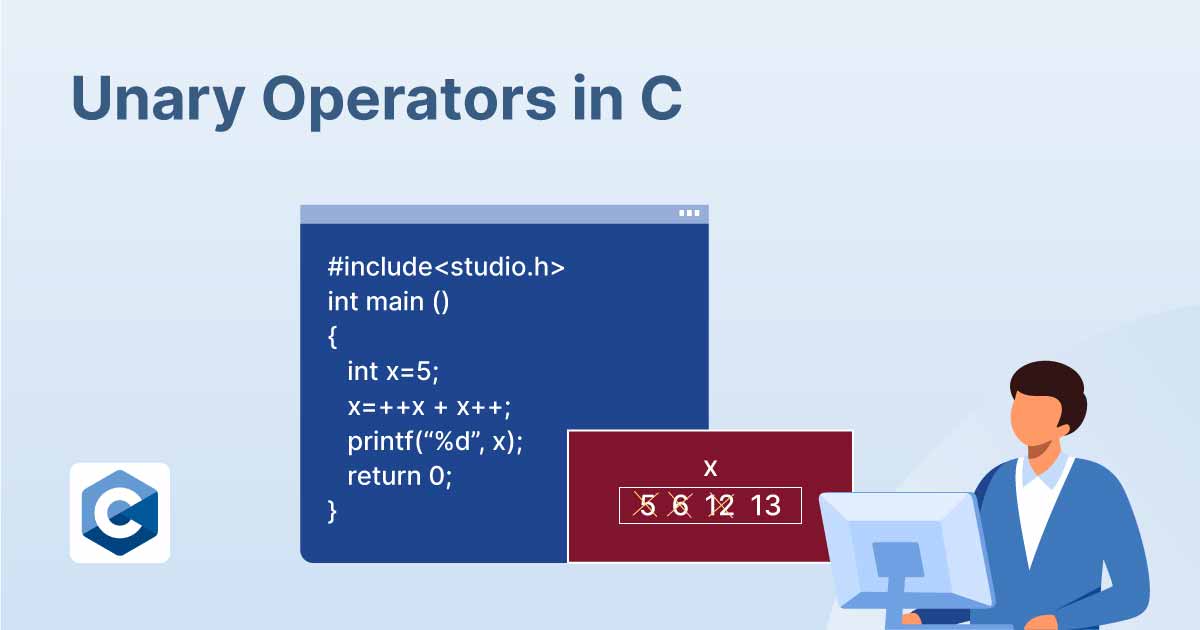
For example:
                            int a = 3;
                            int result = ++a + a++;
                            printf("%d", result); // Understanding how values change step-by-step is key
Understanding how the value of a changes through each step helps grasp operator precedence and evaluation order, both of which are core to writing efficient code.
Summary and Conclusion
Unary operators are foundational to writing expressive and optimized C programs. Their simplicity belies their power—each unary operator has a specific role in program execution, memory management, or control logic. From incrementing loop counters to managing memory through pointers, unary operators form an essential part of everyday programming.
Students, especially those pursuing aC Programming Course in Noida, must pay close attention to these operators. They are not just tools for convenience but are often essential for writing clear, efficient, and error-free code. Mastering unary operators enhances logical thinking and opens the door to understanding more advanced topics like dynamic memory, file handling, and data structures in C.
Whether used in educational projects, system-level programming, or technical interviews, unary operators continue to hold their ground as one of the most important concepts in C programming. Anyone who wishes to grow into a proficient programmer must understand not just what these operators do, but also how they behave under different scenarios. This clarity forms the backbone of writing solid C programs and contributes to long-term programming success.