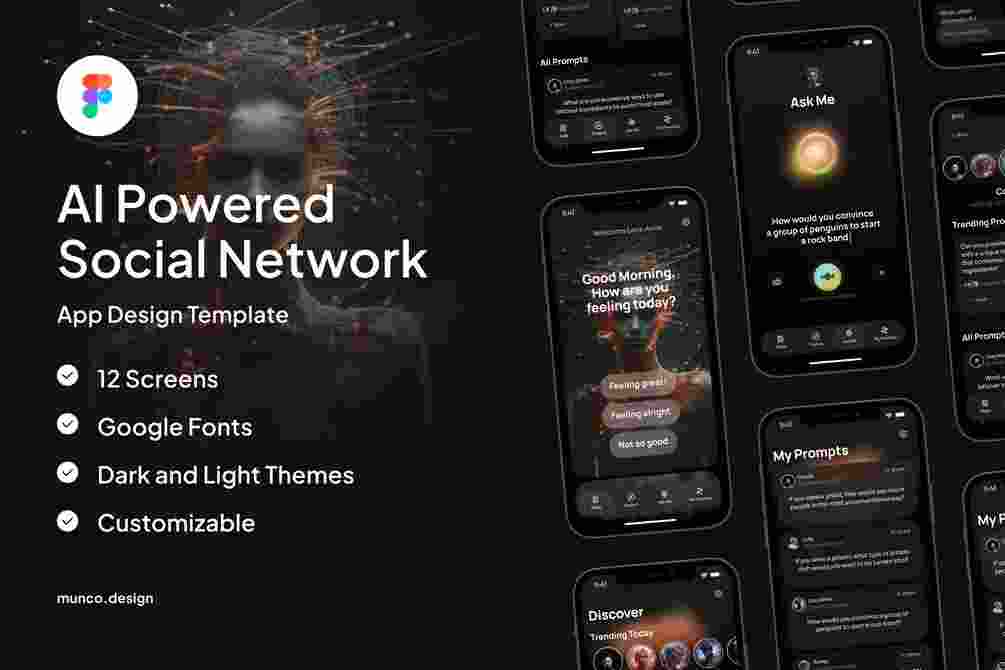
This is where artificial intelligence (AI) steps in. By integrating AI into the design and functionality of social networking app UIs, developers can make interfaces more intelligent, adaptive, and user-friendly. Instead of being static, AI-driven UIs learn from user behavior, predict needs, and adapt in real time, creating seamless experiences. Let’s explore how AI can help design smarter UIs for social networking apps and what makes this approach so revolutionary.
The Role of UI in Social Networking Apps
The UI of a social networking app is not just about attractive buttons or colorful layouts–it is about usability, personalization, and engagement. Users stay longer on platforms that make it easier to navigate, highlight relevant content, and reduce unnecessary friction. If the UI feels cluttered or overwhelming, people quickly lose interest and move to competitors.
Since users range from tech-savvy youth to less experienced older generations, UI must serve diverse needs while maintaining simplicity. AI helps bridge this gap by making design dynamic instead of fixed.
How AI Enhances UI in Social Networking Apps
1. Personalized User Experience
One of the strongest contributions of AI in UI design is personalization. Instead of showing the same layout or content arrangement to every user, AI learns individual preferences through interactions, likes, shares, and time spent on features.
For example:
If someone prefers watching videos, the app can adjust to prioritize video-based content on the feed.
If another user focuses on group discussions, the UI can highlight communities and messaging features more prominently.
This ensures that each person’s interface feels unique, keeping them engaged longer.
2. Adaptive Navigation
Traditional apps follow fixed menus and tabs, which sometimes feel cluttered. With AI, navigation can adapt dynamically to what a user frequently uses.
For instance:
If you often check stories, the shortcut could move to a prominent position on your screen.
If you rarely use “Marketplace,” AI might minimize its visibility to reduce noise.
Such adaptive navigation makes the app feel cleaner, reducing cognitive load.
3. Smarter Content Recommendations
AI-powered recommendation engines not only suggest content but also design how it is presented. For instance, instead of just filling your feed with random posts, AI can analyze your interests and showcase layouts designed to keep you scrolling.
Some examples include:
Grouping similar types of posts together for easy browsing.
Highlighting trending hashtags in a visually appealing manner.
Offering “quick reply” buttons in comments based on your language style.
This makes the UI feel more intelligent and responsive.
4. Conversational Interfaces
Chatbots and AI-powered assistants within social apps can simplify UI interaction. For example, instead of manually searching through menus, a user could type or speak, “Show me my unread messages” or “Find trending reels in my city,” and the AI assistant could instantly adjust the UI.
This conversational layer reduces the need for traditional navigation, making the app feel smarter and more accessible.
5. Accessibility Features
Social networking apps are global and used by people of all abilities. AI can improve accessibility through features like:
Voice-to-text and text-to-speech for messaging.
Automatic captioning on videos.
UI resizing based on user difficulty in reading small text.
Color adjustments for users with visual impairments.
This creates inclusivity, ensuring no one is left behind.
6. Emotion Recognition for Better Interaction
AI-powered emotion recognition is emerging as a game-changer. Using facial expressions or typing patterns, the app can detect moods and adjust the UI accordingly.
For example:
If a user is stressed or upset, the app might recommend calming communities or uplifting content.
If someone is excited, the app could highlight celebration-based stickers, emojis, or camera effects.
This gives the UI a human-like sensitivity, building deeper connections.
7. Predictive Search and Smart Suggestions
Instead of typing long queries, AI can offer predictive search. For example, when you start typing “beach,” the app might suggest “beach photography groups,” “beach travel stories,” or “friends who visited the beach.”
Such predictive UI elements save time and make the interface more efficient.
8. Fraud and Spam Detection Through UI Alerts
AI also contributes to making social networking safer. When suspicious activity is detected, the UI can present alerts in a user-friendly manner, such as warnings for fake accounts or scam links. Smart pop-ups can guide users to avoid risks while not overwhelming them.
9. Gamification and Engagement
AI can design personalized gamified elements in the UI. For instance, awarding badges, streaks, or engagement scores tailored to each user’s interests can make the interface feel fun. If someone enjoys contributing to discussions, the app can highlight “community leader” rewards directly on their profile UI.
10. Real-Time Optimization
AI doesn’t stop at initial design–it constantly learns from ongoing usage. This allows the app to optimize UI in real time. If a new feature is not being used, AI can automatically redesign its placement or presentation to increase visibility.
Key AI Technologies Used in Smarter UI
To understand how all this works, let’s look at some core AI technologies that drive smarter UI in social networking apps:
1. Machine Learning (ML): Learns user habits and adapts the interface.
2. Natural Language Processing (NLP): Powers chatbots, predictive text, and search features.
3. Computer Vision: Enables image recognition, emotion detection, and smart filters.
4. Reinforcement Learning: Helps AI continuously optimize UI based on feedback loops.
5. Recommendation Systems: Suggest content, friends, or groups relevant to each user.
Benefits of AI-Driven UI
Increased Engagement: Users spend more time when the UI feels personalized.
Higher Retention: Adaptive layouts make people less likely to uninstall.
Accessibility: AI ensures the app caters to all users, regardless of ability.
Efficiency: Faster navigation and predictive tools reduce effort.
Safety: Smarter alerts build trust by minimizing spam and scams.
Challenges in Designing AI-Powered UI
While AI brings many opportunities, it also comes with challenges:
Privacy Concerns: Collecting behavioral data must be balanced with user consent.
Over-Personalization: Too much AI control might make the interface predictable and boring.
Bias in AI Models: If not trained well, AI can unintentionally create unfair experiences.
Complexity in Implementation: Developing adaptive UIs requires strong technical resources.
User Skepticism: Some users may prefer simple static designs and find AI-based adjustments confusing.
Future of AI in Social Networking UI
The future holds exciting possibilities. With technologies like augmented reality (AR) and virtual reality (VR), AI-driven UIs could create immersive social spaces. Imagine an app where your feed appears as a virtual room, and AI arranges posts like paintings on a wall based on your mood. Or a VR community where AI personalizes the environment to reflect your interests.
As AI becomes more advanced, UIs will likely evolve from being just tools to being companions–understanding users better, predicting needs, and providing proactive support.
Final Thoughts
At the end of this discussion, it becomes clear that AI is not just an add-on for social networking apps–it is the very force reshaping how users interact with digital platforms. Traditional UIs relied on fixed layouts and static experiences, but with AI, interfaces are becoming dynamic, adaptive, and personalized in real time. This shift is not about flashy design; it is about making apps truly responsive to human behavior, emotions, and needs.
One of the strongest advantages of AI-driven UI is personalization. In a world where millions of people use the same platform, every individual wants to feel that the app understands them. AI makes this possible by learning user habits, predicting preferences, and curating experiences that feel tailor-made. From adaptive navigation to predictive search and smart content recommendations, the interface transforms into a personal companion rather than just a tool. This not only improves engagement but also fosters loyalty, ensuring that users keep coming back.
Another major takeaway is accessibility. Social networking apps are global, catering to people of different abilities, languages, and age groups. With AI, UIs can become inclusive–offering voice-based commands, auto-captioning, and adaptive text sizes. This reflects the principles of Human-Centered Artificial Intelligence, where technology is designed to serve diverse user needs. This ensures that technology remains a bridge, not a barrier, making social apps more democratic and human-centered.
However, the journey is not without challenges. Privacy concerns, bias in algorithms, and the risk of over-personalization are genuine issues that designers and developers must address carefully. These challenges are central to Ethical AI and Intelligent User Interfaces, where balancing innovation with transparency is key to building user trust. After all, an intelligent UI is only effective if users feel safe and respected while using it.
Looking ahead, the future of social networking UI will likely merge AI with immersive technologies like AR and VR, taking personalization to entirely new levels. Imagine virtual social spaces where the design adapts instantly to your mood or preferences. That is not far away–it is the natural next step.
At Uncodemy, the vision is to prepare learners, developers, and innovators to embrace this AI-driven shift with confidence. By equipping individuals with the right skills, tools, and mindset, Uncodemy empowers the next generation to not only design smarter UIs but also to create social platforms that are ethical, inclusive, and impactful. The future of social networking apps is intelligent, human-centered, and limitless–and AI is the driving force behind it.