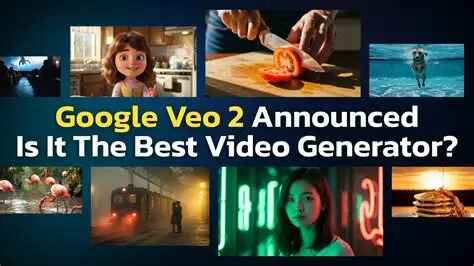
This guide explores what Veo 2 is, how it works, its unique features, and its real-world applications. By the end, you will understand why this AI model is being called a potential game-changer in the field of video production.
What is Veo 2?
Veo 2 is Google’s next-generation AI video generation model. It is part of Google DeepMind’s broader efforts to build multimodal AI systems that can handle not just text, but also visuals, audio, and complex creative tasks. Simply put, Veo 2 allows users to input a text description (called a “prompt”), and from that, the model generates a realistic video clip.
Unlike earlier video models that produced blurry or unstable results, Veo 2 focuses on producing high-definition, coherent, and natural-looking videos that can match real-world camera motions, object interactions, and scene transitions. For example, if someone types, “A drone shot of waves crashing against a rocky shore at sunset,” Veo 2 can create a smooth, cinematic clip that looks like it was filmed by a professional videographer.
The Evolution from Veo to Veo 2
Google’s earlier version, simply called Veo, was already capable of producing decent video clips. However, it had limitations in length, resolution, and realism. Veo 2 improves on this in several ways:
1. Higher Resolution – Veo 2 can generate videos in higher quality, making them suitable for professional use.
2. Longer Video Duration – While older models struggled with very short clips, Veo 2 produces longer sequences with consistent detail.
3. Better Scene Understanding – It can understand complex prompts and translate them into realistic settings with correct lighting, perspective, and camera angles.
4. Improved Motion Realism – Human movements, animal actions, and even environmental effects like rain or fire look smoother and more believable.
This progress shows Google’s commitment to making AI video generation not just a toy for experimentation, but a practical tool for content creation.
How Does Veo 2 Work?
At its core, Veo 2 uses a type of AI called a generative diffusion model, similar to what powers image-generation tools like Google’s Imagen or OpenAI’s DALL·E. However, instead of working with static images, Veo 2 has been trained to handle time-based sequences–essentially predicting not just what an image looks like, but also how it changes frame by frame.
Here’s a simplified breakdown of how Veo 2 generates videos:
1. Prompt Processing – The model takes a text input (e.g., “a snowboarder performing tricks on a snowy mountain”).
2. Scene Construction – It uses its training data to imagine what elements belong in the scene (snow, mountains, snowboarder, camera angle).
3. Motion Generation – The model then creates smooth transitions over multiple frames, ensuring that objects move naturally.
4. Rendering – The final video is output at high resolution, with accurate textures, colors, and environmental effects.
Because it was trained on millions of hours of video footage and paired with advanced AI architectures, Veo 2 can generate results that feel close to real filmed footage.
Key Features of Veo 2
Veo 2 isn’t just about generating random clips; it has a range of advanced features that make it powerful for different use cases.
1. High-Quality Video Output
Veo 2 can produce videos in resolutions up to 1080p and beyond, with consistent frame rates and minimal distortion. This makes its output usable in professional settings.
2. Cinematic Camera Control
Users can specify camera movements–like zooms, pans, or aerial shots–directly in their prompts. The model understands terms like “slow-motion,” “time-lapse,” or “tracking shot.”
3. Realistic Motion and Physics
Unlike earlier models where movements looked robotic, Veo 2 handles fluid actions. Whether it’s a dancer spinning or water splashing, the motion looks convincing.
4. Style Adaptation
Users can request videos in specific artistic or cinematic styles. For example: “a painting-style animation of a medieval castle” or “a Hollywood-style action sequence.”
5. Long-Form Video Generation
Veo 2 supports longer clips compared to its predecessors, maintaining consistency across scenes and avoiding the “reset” problem where objects suddenly change between frames.
Use Cases of Veo 2
The power of Veo 2 lies in how versatile it is. Here are some key areas where it is already making an impact:
1. Filmmaking and Storyboarding
Directors and scriptwriters can use Veo 2 to create visual storyboards quickly. Instead of hiring illustrators or filming test shots, they can simply input descriptions and get a cinematic preview.
2. Marketing and Advertising
Brands can create eye-catching promotional videos without the need for expensive shoots. A campaign idea can be tested and refined quickly with AI-generated clips.
3. Education and Training
Teachers and trainers can produce explanatory videos in seconds. Imagine a history teacher typing, “The Great Wall of China being built in ancient times,” and Veo 2 generates a short reenactment.
4. Gaming and Virtual Reality
Game developers can generate cinematic cutscenes or prototype visuals for new worlds, saving time and costs in production.
5. Social Media Content Creation
Influencers and creators can instantly generate creative content that stands out on platforms like YouTube, Instagram, or TikTok.
6. Journalism and News
Reporters can create visual representations of stories where no footage exists, such as visualizations of climate change effects or reconstructions of historical events.
Challenges and Limitations
While Veo 2 is impressive, it isn’t perfect. Some challenges remain:
1. Accuracy Issues – Sometimes, details may not perfectly match the prompt, especially with very complex instructions.
2. Ethical Concerns – Realistic video generation raises fears of misinformation and deepfakes. Google has to build safeguards to prevent misuse.
3. Resource Intensity – Training and running Veo 2 requires huge amounts of computing power, which limits accessibility.
4. Bias in Training Data – Like all AI models, Veo 2 reflects the data it was trained on. This can lead to unintentional cultural or social biases in outputs.
Google is working to address these challenges by setting responsible usage policies, watermarking AI-generated videos, and making the model available only through controlled platforms.
Veo 2 vs Other Video AI Models
Veo 2 is not the only player in AI video generation. OpenAI’s Sora, Runway’s Gen-2, and Pika Labs are all strong competitors. However, Veo 2 has a few advantages:
Integration with Google Ecosystem – Since Google owns YouTube and other creative tools, Veo 2 could be tightly connected to existing platforms.
Stronger Scene Understanding – Veo 2 tends to produce more coherent scenes compared to some competitors.
Scalability – With Google Cloud infrastructure, Veo 2 has the potential to be widely deployed for businesses and creators.
Still, competition in this space is fierce, and each company is pushing boundaries rapidly.
The Future of Veo 2
Looking ahead, Veo 2 could play a massive role in reshaping how we approach video content. Imagine:
AI-powered movie studios where scripts are instantly visualized.
Personalized video assistants that create content based on user preferences.
Democratization of video production so that anyone, even without technical skills, can create professional-quality films.
As the technology matures, Veo 2 and similar models could become as common as video editing software is today. The key will be balancing innovation with responsibility, ensuring these powerful tools are not misused.
Final Thoughts
Veo 2 represents a huge step forward in AI-powered content creation. Google has not just built a tool for generating videos; it has created a model that blends creativity, technology, and accessibility in ways we have only imagined until now. What sets Veo 2 apart from previous models is its ability to understand complex text prompts and turn them into visually coherent, realistic, and high-quality videos. This capability is a game-changer for filmmakers, educators, marketers, and content creators, allowing them to produce professional-grade visuals without the usual costs, time, and resources required for traditional video production.
The potential applications are vast. In education, Veo 2 can bring history, science, and abstract concepts to life, making learning more immersive and engaging. In business, marketers can generate promotional content faster, testing ideas and campaigns in a fraction of the time. For social media creators, Veo 2 provides a tool to stand out in a crowded space, enabling unique and visually captivating content with minimal effort. Even journalists and storytellers can use it to visualize events where actual footage is unavailable, bridging the gap between imagination and reality.
Of course, Veo 2 is not without its challenges. Ethical considerations like deepfakes, misinformation, and bias in AI outputs are real and require vigilance. Additionally, the computational requirements of running such an advanced model are significant, meaning that access could be limited for smaller creators or organizations. Yet, these limitations are not roadblocks—they are areas for improvement and responsibility. Google’s approach, including controlled access, watermarking, and research into bias reduction, shows that the company is aware of these concerns and is taking steps to mitigate them.
For students, developers, and aspiring AI enthusiasts, Veo 2 highlights the importance of understanding multimodal AI and its growing relevance across industries. Platforms like Uncodemy encourage learners to explore these innovations through an artificial intelligence course, not just as observers but as active participants. Learning how models like Veo 2 operate, their strengths and limitations, and their practical applications can prepare the next generation of creators and technologists for a future where AI and human creativity work hand in hand.
In essence, Veo 2 is more than just a video generation tool—it’s a glimpse into the future of creative AI. It combines speed, accuracy, and imagination in ways that make video production accessible and scalable. While we must approach this technology thoughtfully, its possibilities are breathtaking. From personal projects to professional studios, Veo 2 has the potential to reshape how we create, consume, and interact with video content.
For learners and creators engaging with platforms like Uncodemy, understanding Veo 2 means being at the forefront of AI innovation. It’s not just about creating videos—it’s about unlocking new ways to think, design, and communicate in a digital-first world. The future of video, creativity, and storytelling is here, and Veo 2 is leading the way.