Circular linked list Introduction
A linked list is one type of data structure that is a linked list; a circular linked list is
a linked list with nodes, all of which are bound in a circle. In an ordinary linked
list hence, the node that contains the last element would usually be linked to a NULL value
indicating the end of this list. But, in the circular structure of the linked list, the
reference pointer of the last node points ahead to the first one maintaining a
loop. The advantage of this design is that it allows traversing the list in any
direction without hitting on a NULL value. Circular linked lists have one application
in particular, in tasks like scheduling tasks or managing media playlists, where it is
preferable to have never-ending (non blocking), continuous navigation.
Circular Linked list types
Circular linked lists are mainly of the two types namely singly and doubly linked lists
referring to the underlying structure.
Cyclic Single Linked List
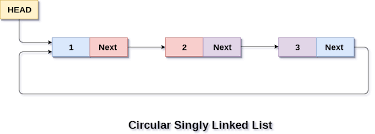
In a singly, circular linked list, every node has one pointer, referred to as the pointer to
the next node in the list. The next pointer of the last node in the list will point to
the first node hence forming the circular structure. Only one way of travelling is
possible in this arrangement. Using a circular singly linked list would be equivalent
to using a singly linked list except that there is the difference of circularities.
The node type of singly circular linked list is usually composed of data and a next pointer
and this next pointer is initialized as null. The SinglyCircularLinkedList class
usually sets head and tail pointers to null. In an empty list, adding a new node makes
it the head and the tail, having its next pointer to itself.
In a singly circular linked list to insert at the start of a non-empty list we simply update
the next pointer of the node to the current head pointer of the list and the next pointer of
the tail pointer of the list and change the tail pointer to be pointing to the new node,
which had become the new head. Likewise to do the insertion at the end we change the next
pointer to the tail with the next pointer of the new node, the next pointer of the new node
with the head and the tail is changed to the new node.
Deleting a node is done in a certain procedure to ensure the integrity of the circulations.
In case the head node is removed then the head pointer is repositioned to the next node and
the tail next pointer is changed to the new head. In other nodes, the linked list is
traversed to locate the node to be deleted, and an update to the next(predecessor) node is
updated to skip the removed node. In case the deleted node was a tail, the tail pointer is
set to the previous node.
Walking through a singly circular linked list starts at the head position and continues till
the start position becomes reached in that order.
Circular Doubly Linked List
A circular doubly linked list is constructed on the same basis of doubly linked list but with
the structure consisting of circular form. Every node in this sort of list contains two
elements, prev, and next. The prev pointer refers to the prior node and the next pointer
refers to the next node. A circular doubly linked list has its last node, pointed to by its
next pointer, back to the first node and the first node reverse-pointed to the last node,
creating a circular pair of links. This structure is bi-directional, in terms of traversing.
To insert at the first of a circular doubly linked list, a new node next refers to the
current head and prev the current tail. This prev of the current head is updated to the new
node and likewise the tail next is updated to the new node, thus becoming the current head.
To insert at the end, the prev of the new node is set as the current tail and next points to
the head and then the current tail next and the current head prev are updated to point to
the new node thus making the new node the new tail.
In case of deletion in a doubly linked list, which is circular, both prev and next pointers
of the neighboring nodes must be updated to reflect connectivity. The head or the tail has
to be handled in a special way.
Circular Linked List operations
Circular linked lists are just like singly and doubly linked lists, various operations can be
carried out. These are insertions, deletion and searches.
Insertion
Insertion entails insertion of new nodes on the list. There are a number of ways that this
can be done:
Insertion into an empty list: A new node is created and its next pointer is
put equal to itself and it is now the last node (or the head and tail).
Insertion head: The next of the new nodes is set to the existing head and
the new node is now the newly formed head.
Append at end: The last node next pointer is set to the new node and the new
node next is set to prev head (which is last->next) and the new node is the new last (or
tail).
Insertion in a particular location: It is a technique, which involves a
search of the list in order to identify the location where the data is to be inserted with
subsequent modifications of the next pointers in order to accommodate the new node.
Deletion
Deletion deals with removal of a node in the linked list by maintaining the linked list
circular.
Deleting of the first node: When the node to be removed is not the only
node, the next pointer of the last node would be changed to skip over the head and the head
will be discarded. When it is the only node both the head and the tail are set to null.
Deleting a particular node: This needs the locating of the node followed by
modification of the next position of the preceding node which points to the next node
instead of the target node. When the last node is deleted, then the last pointer should be
updated as well.
Removal of the final nodes: The list is iterated on to get the penultimate
node where the next pointer is changed to arrive at the first node and the previous node
becomes the new last.
Searching
A circular linked list search is like a regular linked list. The list is followed starting
with a particular node until a match is obtained or until the initial node is reentered
implying that the value does not exist. It is also important not to lose track of the state
initialization to avoid chain rule.
Flaws of Circular Linked Lists
Circular linked lists will have the following advantages:
No Null References: Because the final node has the first node as a previous
node, there are no null references at the end of the list, which make it easier and reduce
the amount of null pointer exceptions thrown when iterating through the list.
Continuous Traversal: Capability to traverse the list at any node
continuously and end up at the same node without beginning with the head, this is important
to applications that demand circular traversal.
Easy to implement Circular Queues: Circular queues are also easy to
implement and the last element will link to the first which leads to the ability to manage
resources efficiently.
Locating Previous Node: It is possible to find the previous node even when
there is not a direct reference to the previous node (or prev; such as in singly circular
lists), by searching the list.
Circular Linked Lists Disadvantages
Like any other data structure, one may find some drawbacks of circular linked lists:
Greater Complexity: They tend to be more complex to execute as opposed to
singly linked lists.
Possibility of Infinite Loops: Unless termination conditions are carefully
treated, an infinite loop can be very easily entered into as one traverses a circular linked
list.
Diagnostic difficulty: Debugging can be more challenging due to circular
nature whereby the common step by step debugging methods might not be pertinent in a
straightforward manner.
Circular Linked List Usages
Circular linked lists are used in many real life applications:
Time-Sharing Operating Systems: It is implemented where there is
time-sharing among more than one user where a Round-Robin mechanism of scheduling is a
common implementation.
Multiplayer Games: Multiplayer games can control the player turns, and the
last player hand goes back to the starting player.
Buffering Applications: Buffering application, where data is continuously
generated and provides data, which is also consumed.
Media Players: Playlists in media players can be handled by circular linked
lists, to allow looping songs.
Management of Browser Cache: Circular linked lists are utilized to
manage the cache of browsers, this allows browsers to easily navigate backwards in browsing
history, via the use of the "BACK" button.
Uncodemy Learning More
Uncodemy also has training in more detail about data structures and algorithms including
circular linked lists. Uncodemy will offer Data Structure and Algorithm courses in Noida, in
which you will get practical training on the latest advanced tools and technologies to
sharpen your skills. Also, Uncodemy provides a C With Data Structure certification programme
in Delhi under professional trainers. Uncodemy is the place that allows someone to dictate
their own success stories by offering an extensive list of career-oriented IT educational
programs, such as Data Science, Full Stack Development, and others and placing them in
capable hands with the help of professional mentors and real-life experiences.