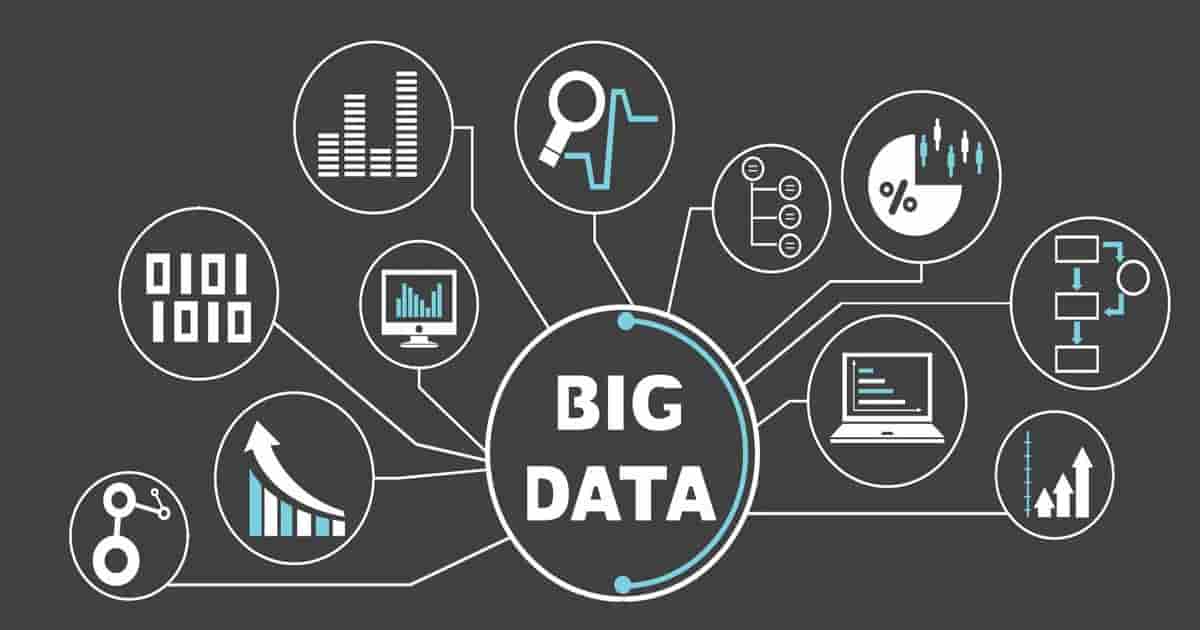
Big data is an informational collection too large, complicated, or diverse to be managed with common tools such as spreadsheets or typical databases. In contrast to the previous periods when information could easily be stored in the form of structured tables, data is multifaceted today. It may be text, pictures, videos, audio, clickstreams, or even real-time sensor values of devices connected to the Internet of Things. Vying alongside this diversity is velocity, whereby data is produced lightning fast, whether through social media interactions, monetary transactions, or live streaming sites. Most importantly, this amount of information is mind-boggling, with billions of users worldwide generating data each second of the day. The volume, velocity, and variety are three dimensions that capture the main characteristics of big data and explain why traditional systems cannot meet their demands.
Big data is significant because of what can be achieved with it. Information is no longer warehoused merely as a record-keeping exercise; it is processed to deliver usable value. Companies leverage big data to learn about customer patterns and anticipate trends. Through it, governments are able to enhance their public services, and through it, researchers are able to make discoveries that are considered to be groundbreaking. You see it when you get product suggestions on a shopping site or playlists on a music application, which is a product of big data analysis. By analysing thousands of transactions simultaneously, banks identify fraudulent activity in real time, and hospitals use this data to treat patients better and personalise their treatment plans. Big data literally transforms crude information into knowledge that can inform decision-making in all sectors.
Data science offers methods and techniques to address the challenge of big data, which is characterised by having large and complicated datasets. Data science refers to the activity of using statistical methods, computer code, and contextual knowledge to gain insight through data. It enables organisations to shift beyond just accumulating piles of information to employing it in useful ways. Data science is the refinement process of big data, which transforms the raw material into something usable. An illustrative analogy is that big data can be thought of as a massive library containing books in infinite languages and formats. The library would be intimidating without the ability to sort, understand, and identify the right information. Data science resembles a librarian who sorts out this huge pile and provides what is most helpful.
Big data and data science have developed at a remarkable rate in recent years and have grown to become synonymous with one another. During the early days of digital expansion, companies relied on the services of traditional relational databases to host and process their data. These systems were good to go with when the data was not much and was mostly structured, but with the increased digital activity, they proved to be inadequate. The development of social media, mobile phone applications, and Internet of Things devices, and electronic commerce has led to a phenomenal increase in both the volume and the variety and speed of data. New solutions to this end were becoming desperately needed as the traditional systems were indeed never designed in a fashion to support such free-flowing, unstructured and high-velocity volumes of information.
The advent of game-changing tools, like Hadoop, Spark, and high-scale cloud computing platforms, took this challenge head-on. The distributed file system provided by Hadoop allowed one to store large volumes of data in clusters of computers, whereas Spark provided the opportunity to process data in real-time and with blistering speed. Cloud platforms also disrupted the scene with scalable, affordable storage and compute resources that could be expanded as required. Out of nowhere, organisations lost their hardware constraint; they now can hold terabytes or even petabytes of unstructured data (reading social media posts and transaction logs to sensor readings and satellite imagery) and efficiently process them.
Meanwhile, the progress made in artificial intelligence and machine learning altered the way in which data was processed. Algorithms were advanced to the point that they could identify patterns, make forecasts, and learn new things without any specific programming. These algorithms were provided with the speed and capacity to handle huge amounts of data by hardware developments, specifically GPUs and high-performance processors. Machine learning delivered as cloud-based services opened these advanced technologies to not just tech giants but also small and medium-sized businesses
The technologies that underpin big data and data science today are dynamic and advanced. The use of distributed storage systems and cloud storage allows for storing huge amounts of information with high security and at a relatively low cost. Apache Spark and Kafka can be used to process data in real time, whereas NoSQL databases work with unstructured data, which is becoming more popular. On the data science end, Python and R tend to prevail due to the sheer length of statistical and machine learning libraries. Scientists can use frameworks such as TensorFlow and PyTorch to develop predictive models, and visualisation tools such as Tableau and Power BI can explain the findings to business leaders and the layperson. Collectively, these tools promise the creation of a seamless connection between data collection and analysis and finally into actions.
The presence of big data and data science is also felt on a very personal level that is not always seen. Navigation apps can determine the optimal route through analysis of live traffic data collected using millions of devices. Fitness trackers and smartwatches track heart rate, sleep patterns, and activity to give individual recommendations toward health. The smarter thermostats that are put in residential properties even adapt to the household routines in order to maximise energy utilisation. The use of big data has emerged as a significant part of finding solutions to global issues like the COVID-19 crisis. Data-informed mathematical models facilitated monitoring the dynamics of virus spread, informed the decision of policymakers, and were used to create vaccines. Some of the uses of big data are agriculture and environmental research, whereby farmers are able to predict weather conditions and optimise their yield and organisations can be aware of climate changes and conservation activities. These illustrations demonstrate how tremendously these technologies have now entered our lives and will be utilised beyond what we can imagine.
The promises of big data and data science are enormous, but so too are the challenges that are difficult to overlook. On the one hand, they offer new sources of innovation, effective working, and wiser choices. The industries can serve the customers in a better way, the governments can formulate better policies, and the individuals can avail personalised services. On one hand, the concerns of privacy, security and bias are still serious issues. The fact that so much personal information is collected poses questions about consent and abuse. Discriminative results may arise in hiring, lending, or even policing because of biased datasets. In addition, large-scale data systems are expensive and sophisticated to implement and need infrastructure and expertise to invest in. Societies are going to have to capitalise on the power of big data and data science by balancing between technological advances, ethical responsibility and regulation.
Moving forward, the interaction between big data and data science will only become more defined as technology moves further into the future. Within the context of the emergence of the Internet of Things, artificial intelligence, and 5G connectivity, even more chaotic flows of information will be created. Quantum computing, which is at an early development level, presents the potential to process data at unheard-of speeds using existing systems. Data science is itself changing, and automation is making numerous tasks possible that used to require specialised training. Meanwhile, explainability and transparency of AI models are on the rise as organisations and individuals alike want to know not only the result of data analysis but also the rationale behind it. The years ahead will not simply be about the production of additional data but rather about how to be responsible and creatively use such data to tackle some of the most critical issues faced by the world.
In conclusion, in a world where the force of data, statistics, measurements, and facts is gaining pace, those with the wisdom to harness these powerful resources will be best positioned to solve real-world challenges and shape a more informed future. Whether you are an aspiring data professional or an experienced learner looking to upskill, Uncodemy's Data Science Course in Noida equips you with the practical knowledge, industry-relevant tools, and hands-on experience needed to thrive in the evolving data-driven landscape. Big data and data science are not just about numbers and algorithms—they are about understanding our world more deeply, making smarter decisions for tomorrow, and building innovative solutions that create lasting impact.