This will help you build a strong foundation in programming logic and get ready for
coding interviews. Whether you are a student, an aspiring software engineer, or someone
trying to understand how computers organize data, this guide will make the concept clear and
simple.
If you are just starting with coding or looking to revise core topics, consider checking out
the Data Structures and Algorithms course at Uncodemy. It provides
practical explanations, real life projects, and expert mentorship to boost your coding
journey.
What Is Bubble Sort?
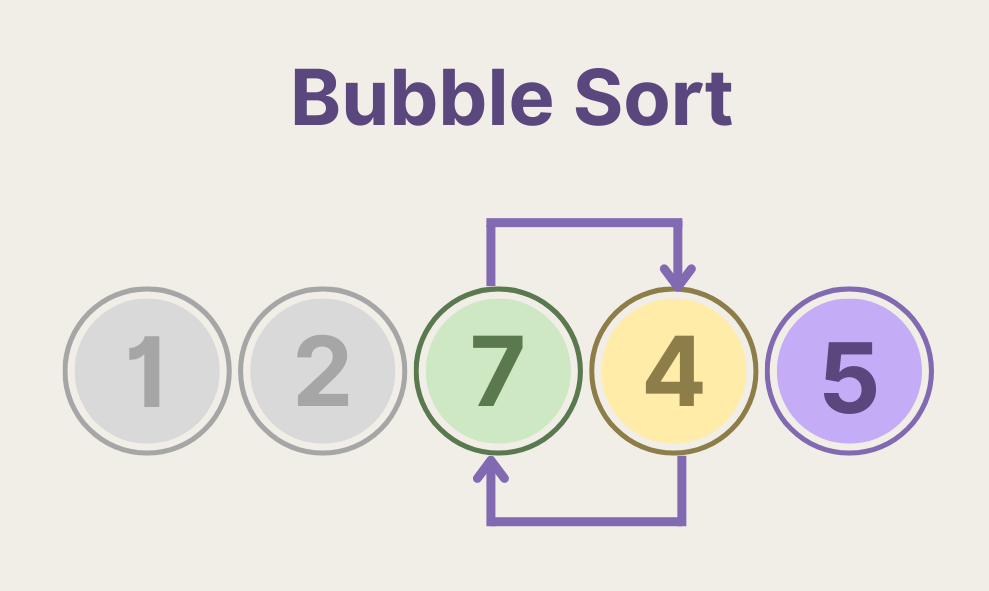
Bubble Sort is a simple sorting algorithm that compares adjacent elements in a list and swaps
them if they are in the wrong order. This process continues repeatedly until the entire list
is sorted.
Imagine you are holding a bunch of playing cards and you want to arrange them in ascending
order. You begin by looking at the first two cards, swap them if needed, then move to the
next two, and so on. This process is repeated multiple times until all the cards are in the
correct order. That is exactly how Bubble Sort works, and just like bubbles in water, the
largest values rise to the top of the list with each pass.
Why Is It Called Bubble Sort?
The term “Bubble” refers to the way larger elements gradually rise to the top of the list
after each pass through the array. Smaller values sink to the bottom while larger ones float
upward, just like bubbles in a glass of soda. Although it is not the most efficient method,
it is one of the easiest to understand, especially for those new to algorithms.
Understanding Bubble Sort with a Simple Example
Let us say we have the following list of numbers:
Copy Code
csharp

CopyEdit

[5, 3, 8, 4, 2]
We want to sort them in ascending order using Bubble Sort. Here is how it works step by step:
First Pass
- Compare 5 and 3 → swap → [3, 5, 8, 4, 2]
- Compare 5 and 8 → no swap
- Compare 8 and 4 → swap → [3, 5, 4, 8, 2]
- Compare 8 and 2 → swap → [3, 5, 4, 2, 8]
The largest number 8 is now at the end. One bubble has reached the surface.
Second Pass
- Compare 3 and 5 → no swap
- Compare 5 and 4 → swap → [3, 4, 5, 2, 8]
- Compare 5 and 2 → swap → [3, 4, 2, 5, 8]
- 8 is already in place
Third Pass
- Compare 3 and 4 → no swap
- Compare 4 and 2 → swap → [3, 2, 4, 5, 8]
- Compare 4 and 5 → no swap
- Last two elements are already in order
Fourth Pass
- Compare 3 and 2 → swap → [2, 3, 4, 5, 8]
- Rest is already sorted
Now the list is completely sorted in ascending order.
The Bubble Sort Algorithm
Here is the general logic of Bubble Sort written in simple language:
- Start from the first element
- Compare the current element with the next element
- If the current element is greater, swap them
- Move to the next pair and repeat
- Continue this process for every element in the list
- Repeat the entire pass as many times as needed until the list is sorted
Bubble Sort Pseudocode
Copy Code
css

CopyEdit

for i from 0 to length of array - 1

    for j from 0 to length of array - i - 1

        if array[j] > array[j + 1]

            swap array[j] and array[j + 1]
This double loop structure ensures the list is sorted after each full pass, with the largest
remaining unsorted element moving to the end in each round.
Bubble Sort in C
Here is an example of how Bubble Sort is written in the C programming language:
Copy Code
c

CopyEdit

#include <stdio.h>


void bubbleSort(int arr[], int n) {

    for(int i = 0; i < n - 1; i++) {

        for(int j = 0; j < n - i - 1; j++) {

            if(arr[j] > arr[j + 1]) {

                int temp = arr[j];

                arr[j] = arr[j + 1];

                arr[j + 1] = temp;

            }

        }

    }

}


void printArray(int arr[], int size) {

    for(int i = 0; i < size; i++)

        printf("%d ", arr[i]);

    printf("\n");

}


int main() {

    int data[] = {5, 3, 8, 4, 2};

    int size = sizeof(data) / sizeof(data[0]);


    bubbleSort(data, size);

    printf("Sorted array: ");

    printArray(data, size);


    return 0;

}
This simple code shows how Bubble Sort is implemented and how arrays are sorted by repeatedly
comparing and swapping elements.
Bubble Sort in Python
For those who prefer Python, here is how it looks:
Copy Code
python

CopyEdit

def bubble_sort(arr):

    n = len(arr)

    for i in range(n):

        for j in range(0, n - i - 1):

            if arr[j] > arr[j + 1]:

                arr[j], arr[j + 1] = arr[j + 1], arr[j]


data = [5, 3, 8, 4, 2]

bubble_sort(data)

print("Sorted array:", data)
This version is compact and easier to read, thanks to Python’s clean syntax.
Optimized Bubble Sort
The basic Bubble Sort always performs n passes even if the list is already sorted. This can
be optimized using a simple trick. If no swaps happen in a particular pass, it means the
list is already sorted, and we can exit early.
Copy Code
python

CopyEdit

def optimized_bubble_sort(arr):

    n = len(arr)

    for i in range(n):

        swapped = False

        for j in range(0, n - i - 1):

            if arr[j] > arr[j + 1]:

                arr[j], arr[j + 1] = arr[j + 1], arr[j]

                swapped = True

        if not swapped:

            break
Adding this swapped flag makes the algorithm smarter and helps reduce unnecessary
operations.
Time and Space Complexity
Time Complexity
- Worst Case: O(n²) — when the list is in reverse order
- Average Case: O(n²)
- Best Case: O(n) — when the list is already sorted and optimized version is
used
Space Complexity
- O(1) — no extra space is used, making it an in place sorting
algorithm
When Should You Use Bubble Sort?
Bubble Sort is not used in production level systems or competitive programming where
performance matters. However, it is still a great educational tool. Here are some situations
where it can be helpful:
- Learning sorting concepts for the first time
- Teaching programming to school or college students
- Understanding how nested loops and comparisons work
- Solving very small datasets where performance is not critical
Advantages of Bubble Sort
- Simple to understand and implement
- No additional memory is required
- Helpful for educational purposes
- Can be optimized for nearly sorted lists
Disadvantages of Bubble Sort
- Very slow on large datasets
- Not practical for real world applications
- Has better alternatives like Merge Sort, Quick Sort, and Insertion Sort
Real Life Analogy
Imagine standing in a queue with people randomly arranged by height. You go from person to
person and if the one in front is taller than the one behind, you ask them to switch places.
You repeat this process again and again until the shortest person is at the front and the
tallest person is at the back. That is Bubble Sort in action, just with people instead of
numbers.
Learn Sorting Algorithms with Uncodemy
If you found Bubble Sort interesting and want to explore more efficient algorithms like Merge
Sort, Quick Sort, or Heap Sort, the Data Structures and Algorithms course from
Uncodemy is a great place to start. You will get access to expert instructors,
real life examples, and interactive coding problems that help you master sorting and
searching in a fun and structured way.
Whether you are preparing for interviews at top tech companies or improving your college
grades, learning these concepts from a trusted platform can save you hours of confusion and
give you a clear advantage.
Final Thoughts
Bubble Sort may not be the fastest algorithm, but it holds a special place in the world of
programming. It is often the first step in the journey of learning how computers sort and
compare data. Its simplicity, clarity, and step by step nature make it perfect for beginners
who want to develop logical thinking.
By practicing Bubble Sort and understanding how each pass affects the array, you strengthen
your fundamentals and become ready to tackle more complex algorithms. So next time you sort
a list of numbers, try visualizing the bubbles rising to the top.
And remember, coding is not just about writing efficient code. It is also about understanding
how things work under the hood. If you want to dive deeper, explore Uncodemy’s learning
paths and start building your algorithmic intuition today.