Imagine you're building a calculator application and need to use the value of Pi (3.14159) throughout your code. You could type 3.14159 wherever you need it. But what happens if you realize you need more precision? You would have to find every instance and update them one by one. This is where constants help, offering a cleaner and more manageable solution.
Understanding constants in C is essential for writing solid, clear code. Constants may seem straightforward, but they have complex uses that can greatly affect your programming effectiveness. This is why programs like Uncodemy's C programming course in Noida stress the importance of using constants correctly from the start. It’s not just about the rules; it’s about building good programming habits that will benefit you throughout your career.
Defining What Is Constant in C
When developers ask what constants are in C, they want to understand values that do not change during program execution. A constant is a named value that cannot be modified after it's defined. You can think of it as a labeled box that holds a specific value, and once you place something in that box, you can't alter its contents.
Constants have many uses in C programming. They make code easier to read by giving meaningful names to values. They also help prevent accidental changes to important values and simplify maintenance by providing one place to update values used throughout the program.
The concept of constants in C becomes clearer when you realize they are not just about stopping changes. They also help create self-documenting code. When you see MAX_STUDENTS instead of the number 50 scattered throughout your code, you immediately understand what that value means and why it is there.
Types of Constants in C
Understanding what is constant in C requires knowing the different types available. C provides several ways to define constants, each with its own use cases and characteristics.
Integer constants are the simplest type. These are whole numbers that can be decimal, octal, or hexadecimal. When you write 42, 0755, or 0xFF in your code, you're using integer constants. The compiler treats these as fixed values that cannot change.
Floating-point constants represent decimal numbers with fractional parts. Examples include 3.14, 2.5, or 1.0e-10. These constants are important for mathematical calculations and scientific applications where precision is key.
Character constants represent single characters enclosed in single quotes, like 'A', '7', or '\n'. These are useful for ASCII values and character manipulation operations.
String constants are sequences of characters enclosed in double quotes, such as "Hello, World!" or "Enter your name:". These constants are automatically null-terminated in C, making them ready for string manipulation functions.
The const Keyword
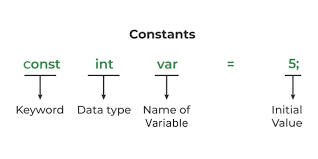
When exploring what is constant in C, the const keyword deserves special attention. This keyword allows you to create variables that cannot be modified after initialization, providing a way to declare constants with specific data types.
Here's how you can use the const keyword effectively:
                    c
                    #include

                    int main() {
                        const int MAX_SIZE = 100;
                        const float PI = 3.14159;
                        const char GRADE = 'A';
                        const char* MESSAGE = "Welcome to C programming!";

                        printf("Maximum size: %d\n", MAX_SIZE);
                        printf("Value of PI: %.5f\n", PI);
                        printf("Grade: %c\n", GRADE);
                        printf("Message: %s\n", MESSAGE);

                        // MAX_SIZE = 200;  // This would cause a compilation error

                        return 0;
                    }
The const keyword creates truly immutable values within their scope. Once initialized, attempting to modify a const variable results in a compilation error, helping prevent bugs and making your intentions clear to other programmers.
Students in programs like Uncodemy's C programming course in Noida learn that const is particularly powerful when working with function parameters. It signals to both the compiler and other developers that the function will not modify the passed values.
Preprocessor Constants with #define
Another crucial aspect of what is constant in C involves preprocessor directives. The #define directive creates symbolic constants that are replaced by their values during preprocessing, before actual compilation begins.
                    c
                    #include

                    #define MAX_STUDENTS 50
                    #define PI 3.14159265359
                    #define WELCOME_MESSAGE "Welcome to our program!"
                    #define SQUARE(x) ((x) * (x))

                    int main() {
                        printf("Maximum students allowed: %d\n", MAX_STUDENTS);
                        printf("Area of circle with radius 3: %.2f\n", PI * SQUARE(3));
                        printf("%s\n", WELCOME_MESSAGE);

                        int numbers[MAX_STUDENTS];
                        printf("Array size: %lu bytes\n", sizeof(numbers));

                        return 0;
                    }
The #define directive offers flexibility that const variables cannot provide. Since #define constants are replaced during preprocessing, they can be used in contexts where const variables cannot, such as array size declarations in older C standards.
Understanding what is constant in C includes recognizing when to use #define versus const. Generally, const is preferred for type safety and scope control, while #define is useful for compile-time constants and simple macros.
Constants in Different Contexts
Understanding what is constant in C extends beyond basic variable declarations. Constants play important roles in various programming contexts, each with specific considerations and best practices.
Function parameters often use const to indicate that the function will not modify the passed values. This is particularly important when working with pointers, as it prevents accidental modification of data:
                    c
                    #include
                    #include

                    void print_string(const char* str) {
                        // str[0] = 'X';  // This would cause a compilation error
                        printf("String: %s\n", str);
                    }

                    int calculate_area(const int length, const int width) {
                        // length = 10;  // This would cause a compilation error
                        return length * width;
                    }

                    void process_array(const int arr[], const int size) {
                        for (int i = 0; i < size; i++) {
                            printf("%d ", arr[i]);
                            // arr[i] = 0;  // This would cause a compilation error
                        }
                        printf("\n");
                    }

                    int main() {
                        const char* message = "Hello, World!";
                        print_string(message);

                        int area = calculate_area(5, 3);
                        printf("Area: %d\n", area);

                        int numbers[] = {1, 2, 3, 4, 5};
                        process_array(numbers, 5);

                        return 0;
                    }
Global constants provide application-wide values that should remain consistent throughout the program's execution. These are particularly useful for configuration values, system limits, and mathematical constants.
Best Practices and Common Pitfalls
Learning what is constant in C involves understanding not just the syntax, but also the best practices that lead to maintainable code. Programs like Uncodemy's C programming course in Noida emphasize these practices because they're crucial for professional development.
Naming conventions for constants typically use uppercase letters with underscores separating words. This makes constants easily identifiable and distinguishable from variables. Instead of writing const int maxsize = 100, use const int MAX_SIZE = 100.
Scope consideration is crucial when defining constants. Global constants should be used sparingly and only for truly application-wide values. Local constants within functions or blocks are often preferable as they limit the scope of the constant to where it's actually needed.
Type safety becomes important when choosing between #define and const. The const keyword provides type checking, while #define performs simple text replacement. Consider this example:
                    c
                    #include

                    #define MULTIPLIER 2
                    const int CONST_MULTIPLIER = 2;

                    int main() {
                        int value = 5;

                        // Both work, but const provides type safety
                        printf("Using #define: %d\n", value * MULTIPLIER);
                        printf("Using const: %d\n", value * CONST_MULTIPLIER);

                        // #define doesn't respect scope
                        {
                            #define LOCAL_DEFINE 10  // This affects the entire file
                            const int LOCAL_CONST = 10;  // This is truly local
                        }

                        printf("LOCAL_DEFINE: %d\n", LOCAL_DEFINE);  // Works
                        // printf("LOCAL_CONST: %d\n", LOCAL_CONST);  // Error: out of scope

                        return 0;
                    }
Memory and Performance Considerations
Understanding what is constant in C requires knowing the different types available. C provides several ways to define constants, each with its own use cases and characteristics.
Integer constants are the simplest type. These are whole numbers that can be decimal, octal, or hexadecimal. When you write 42, 0755, or 0xFF in your code, you're using integer constants. The compiler treats these as fixed values that cannot change.
Floating-point constants represent decimal numbers with fractional parts. Examples include 3.14, 2.5, or 1.0e-10. These constants are important for mathematical calculations and scientific applications where precision is key.
Character constants represent single characters enclosed in single quotes, like 'A', '7', or '\n'. These are useful for ASCII values and character manipulation operations.
String constants are sequences of characters enclosed in double quotes, such as "Hello, World!" or "Enter your name:". These constants are automatically null-terminated in C, making them ready for string manipulation functions.
Conclusion
Mastering constants in C is crucial for writing professional and maintainable code. Whether you are learning on your own or through structured courses like Uncodemy's C programming course in Noida, understanding constants will improve your programming skills and help you develop stronger applications. Constants do more than prevent changes; they help create clear, self-documenting code that lasts.
The journey from basic constant definitions to complex constant structures shows how fundamental ideas in C programming build on each other. When you truly understand what is constant in C, you’re not just learning syntax; you’re developing a mindset that values code clarity, maintainability, and error prevention.
As you continue your programming journey, remember that constants express intent. They indicate to future developers, including yourself, which values should stay the same and why. This clarity is especially valuable in team settings and long-term projects, where code needs to be understood and changed months or years after it was written.
The concepts discussed here lay the groundwork for more advanced C programming topics. Understanding constants readies you for working with complex data structures, system programming, and embedded development, where precise control over values and memory use becomes vital. Whether you’re building simple applications or complex systems, properly using constants will be a key part of your programming skills.
Frequently Asked Questions (FAQs)
What's the difference between const and #define in C?
A: const creates typed constants with scope rules and memory allocation, while #define creates preprocessor macros that are replaced with their values before compilation.
Can you change a const variable indirectly?
A: While you cannot directly modify a const variable, it's possible to change it indirectly through pointer manipulation, though this leads to undefined behavior and should be avoided.
Why use constants instead of hardcoded values?
A: Constants improve code readability, make maintenance easier, prevent accidental modifications, and provide a single point of change for values used throughout the program.
Do constants affect program performance?
A: const variables require memory access and may have slight performance overhead, while #define constants are compiled inline and generally have no runtime overhead.
Can you declare constants inside functions?
A: Yes, constants can be declared with local scope inside functions, limiting their visibility and lifetime to that specific scope.
What happens if you try to modify a const variable?
A: Attempting to modify a const variable results in a compilation error, preventing the program from building until the error is resolved.