Introduction
C language control statements are prominent in determining the way a program operates. They also enable you to manage the sequence of your program by making some decisions, repeating some operations or skipping to another block of the code.
What are C Control statements?
Control statements in the C language are statements that govern how a program goes to be executed depending on some conditions or repetitions. They assist in determining when a block of code is run, repeat or skipped. These statements render programs dynamic by introducing the ability to make decisions, loop and jump which is of essence in solving practical problems.
Let us learn it with the example of real life:
Control statements are like traffic lights. A green light enables vehicles to be in motion (actualization), red light makes them stay put (no abatement), and the yellow light sets them in anticipation of action (transition).
C Control Statements Types
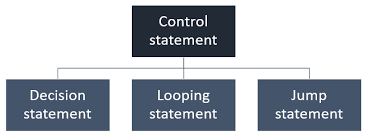
C programming language has three kinds of control statements:
1. Decision-Making Statements: Decision-making statements enable the program to take decisions and to run certain blocks of code on the condition of other blocks.
2. Loop Control Statements: These statements repeat executing a series of codes a number of times as long as a set condition holds true.
3. Jump Statements: The latter statements move the control of a program to another part of the program conditionally or without conditions.
Control statements in C
Decision-Making
C decision-making statements enable the program to make decisions and carry out certain blocks of codes. These assertions may allow a program to act in dynamic ways and respond to various situations adequately.
Now let us talk about the various types of decision control statements in C:
1.if Statement
C has an if statement that executes a block of code only when there is a particular condition that is true.
Syntax:
if (condition) {
// Code to execute if condition is true
}
Example:
Copy Code
#include <stdio.h>

int main() {

    int number = 10;

    if (number > 0) {

        printf("The number is positive.");

    }

    return 0;

}
Use the if statement when you want to do something depending on one condition.
2. conditional (conditional) Statement
The count graph in C runs one code completion in case the condition is valid and another in case it is false.
Syntax:
if (condition) {
// Code if condition is true
} else {
// Code if condition is false
}
Example:
Copy Code
#include <stdio.h>

int main() {

    int number = -5;

    if (number >= 0) {

        printf("The number is non-negative.");

    } else {

        printf("The number is negative.");

    }

    return 0;

}
Use: You need to use an if-else control statement in C programming when you have to execute one statement when your condition is true and execute another statement when the condition is false.
3. nested if Statement
It is one kind of if statement within another and it is used to determine two or more statements.
Syntax:
if (condition1) {
if (condition2) {
// Code if both conditions are true
}
}
Example:
Copy Code
#include <stdio.h>

int main() {

    int number = 5;

    if (number > 0) {

        if (number % 2 == 0) {

            printf("The number is positive and even.");

        } else {

            printf("The number is positive and odd.");

        }

    }

    return 0;

}
When to Use: Nested if is used when one has several interconnected conditions that have to be tested.
4. if-else-if Ladder
The following conditional in C goes through the various conditions until the truthy one is encountered.
Syntax:
if (condition1) {
// Code if condition1 is true
} else if (condition2) {
// Code if condition is true
} else {
// Code if none of the conditions are true
}
Example:
Copy Code
#include <stdio.h>

int main() {

    int marks = 85;

    if (marks >= 90) {

        printf("Grade: A");

    } else if (marks >= 75) {

        printf("Grade: B");

    } else if (marks >= 50) {

        printf("Grade: C");

    } else {

        printf("Grade: F");

    }

    return 0;

}
When Used: You should use the if-else-if ladder in a situation that requires testing of more than one condition in succession.
5. case switch Statement
The switch case in C compares a variable with several values (cases) and runs the corresponding block of code.
Syntax:
switch (variable) {
case value1:
// Code for case 1
break;
case value2:
// Code for case 2
break;
default:
// Code if no case matches
}
Example:
Copy Code
#include <stdio.h>

int main() {

    int day = 3;

    switch (day) {

        case 1:

            printf("Monday");

            break;

        case 2:

            printf("Tuesday");

            break;

        case 3:

            printf("Wednesday");

            break;

        default:

            printf("Invalid day");

    }

    return 0;

}
When to use: Apply switch when you have to test a variable against a fixed set of values.
C loop control statements
C loop control statements are used to incrementally run a block of codes until a particular condition is satisfied. They make the repetitive tasks easier and contribute to the development of concise programs.
Let us suppose that you fill bottles with water. You fill bottles one each at a time until they all lack available bottles to fill. In a similar way, in programming, statements used in looping keep repeating actions until some condition is created.
1. for loop
A C for loop is a loop which runs a block of code a number of times specified by an initialization, test, and increment/decrement.
2. while Loop
Depending on the condition given inside the while loop in C, the code inside the loop will be executed repeatedly until the condition variable is true.
3. do-while Loop
The do-while statement in C language executes a block of code once at least and then, it keeps on executing as long as the condition is true.
C Jumping Control Statements in C
C statements are used to pass control of a program from one place to another through what is known as jumping statements. These assertions allow conditional or unconditional jumps providing flexibility of program flow.
Real-Life Example:
Just suppose you read a book:
° You have an opportunity to jump over the pages you do not need (continue).
° It is possible to give up reading (break).
° It is possible to jump to a particular page (goto).
Jumping statements in the C programming have the same effect as they transfer control in the code.
In C language jump control statements are four:
1. break
A break statement in C breaks the closest enclosing loop or switch statement and proceeds to the next statement after the latter.
2. continue Statement
The continue command in C continues to next loop skipping the current iteration.
3. goto Statement
The C goto statement passes control to a marked statement in a program.
4. return statement
In C, the return statement ends the currently executing function and may also return an value to the function that it is called by.
What Are C Control Statements Best Practices?
Too Complex a Logic: You should not use too complex conditions or abysmally deep nested control statements in C because they make reading the program very difficult.
Apply Proper Indentation: proper indentation has to be maintained so as to have an user friendly code structure.
Add Comments: Tell what is meant by the critical control statements or complex conditions using comments in the C program.
Avoid Unwarranted Nesting: Seek to minimize the nesting of loops and control statements: split them into functions when necessary.
Use switch case Instead of multiple instances of if-else: Switch case in case the variable has too many values to follow it better and to improve performance.
Reduce Application of goto: Limiting the use of the goto statement is recommended and only used when essential because it complicates the program debugging and maintenance.
Avoid Infinite Loops: Loop conditions should be well defined and they should not lead to infinite loops unless this is intentionally required.
Make Conditions Useful: Write conditions which are self-explanatory and logical.
Test Edge Cases: Test boundary and edge cases control structures to check that they work correctly.
Separate Long and Complex Logic: Divide complex and long logic into small functions which can be easily maintained.
Validate Inputs: The user input or variables should be validated before processing in the C control statements since the program can crash.
Excessive break and continue: Do not use these jump statements too much, as that will make the flow of a program appear confusing.
Use return to Simplify Flow: Return to Simplify Flow when the conditions arise in the middle of the program, it is likely that the dereferencing of the pointer is done. The more the conditions are met the earlier the functions get out of it rather than the use of nested if blocks.
default cases: In switch statements, one should always include default cases by which one can address unexpected results.
How to learn Control Statements using Uncodemy Courses
Uncodemy has different courses that could guide a person to master the basics of programming down to control statements. Uncodemy is an educational body based in Delhi, Noida, offering training in other fields of technology including, data science, machine learning and Python program.
C: Data Structure Certification Training
Language of Programming Python: Course Module
Java Full Stack Using React Training Course
Uncodemy is focused on training quality experts and has tie-ups with the Fortune 500 companies and provides personalized grooming time. They offer opportunities of live sessions and distance classes to working professionals and distance students which are aimed at being similar to classroom training. Specific batches are also available in Uncodemy to students who would want to fast track their careers.