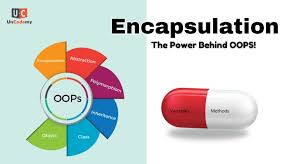
What is encapsulation of data?
Encapsulation of data refers to grouping the data (variables) that the program operates over
and the methods (functions) to work on that data into one unit which is usually a class. It
also includes not giving people direct access to certain elements of the object which is
commonly known as data hiding.
An analogy of encapsulation to a capsule would fit best here, its contents are visible and
accessible as much as the inside processes are unable to be observed or accessed. This
abstraction stops the external world in tampering and relying on intrinsic features of an
object.
Python example:
Copy Code
```python

class BankAccount:

    def __init__(self, balance):

        self.__balance = balance  non-public variable

    def deposit(self, amount):

        in case amount>0:

            self.__balance =self.__balance + amount

    define withdraw(self, amount):

        provided that 0 < amount <= self.__balance:

            self.__balance = self.__balance - amount

    def get_balance(self):

        return self.__balance

```
Here in this example:
The variable `balance` is a non-public variable.
It can be changed and reached only with the help of actions such as `deposit()`,
`withdraw()`, and `get_balance()`.
What makes Data Encapsulation Important?
1. Improved Security
The encapsulation prevents access and unwarranted modification of data, since it keeps the
internal state of an object hidden. As an example, variables can be tagged as private and,
in this case, cannot be modified directly by developers but should be modified through other
defined methods that can make specific rules or validation.
2. Control on information
Encapsulation guarantees the control of the access and changes to important data. In getter
and setter approaches developers are able to apply business logic and business rules (e.g.
preventing negative account balances).
3. Flexibility and Flexibility in the Code Maintenance
In the case that internal implementation details are obscured, it is possible to alter the
internal structure of a class without disturbing other aspects of your program. Such
isolation allows easily maintaining and extending the code.
As an example, you might alter what a balance consists of within `BankAccount`, and as long
as the public API (`deposit`, `withdraw`, etc.) is unmodified, any consuming code will not
be damaged.
4. Reduces Complexity
The result of encapsulation is modular code. The implementers of a class are not required to
have knowledge of any low-level implementation detail of a class--they just have to know how
a class may be used by using its public interface. This abstraction simplifies the code and
makes it easy to read and to understand.
5. Promotes Reusability
Code that is well encapsulated is simplified to reuse. As all the classes are independent
modules, you are free to reuse any of them in the remaining areas of your application, or
even in projects.
Encapsulation v Abstraction
Encapsulation and abstraction are talked about hand-in-hand though; they are not identical.
Encapsulation makes internal state invisible and all communication should be done through the
methods of an object.
Abstraction masks implementation information and only presents something necessary about an
object.
In other words, it is encapsulation of data that hides the data and abstraction that is the
reason why data is hidden.
Real-World Analogy
Take an example of a vending machine.
You only see buttons, displays and a place where to put your money.
You will not have to understand how the machine identifies coins, gives things out, and
monitors stock.
And this is encapsulation. To you, there is a basic interface that you deal with, with
everything on the inside being obscured and not supposed to be touched.
Best Practices On how to encapsulate data
Use access modifiers (private, protected and public) when needed.
Reveal Data only using getter and setter when needed.
Fields should not be declared to be public in absence of a substantial rationale.
Make classes concise and united- the one class has to contain one idea or functionality.
Conclusion
Data encapsulation as a thought process is not only within programming, but also within a
pattern of thought. With the wrapping of data and behavior in one package and concealment of
the details inside, you have constructed safer, more robust, and more controllable software.
This encapsulation may be related to either a small app or a system/big deployment when
mastered it will allow you to write better and cleaner and more sustainable code.
Good encapsulation is something which a user never notices but which is priceless to a
developer.
Keywords: OOP, Encapsulation, data hiding, OOP, object-oriented programming, software design,
access modifiers, abstraction, class
And just to be clear, feel free to add a particular language (e.g., Java, C++, Python), and a
particular audience (e.g.: both beginners and experienced developers) specific version.