This article will walk you through what is data type in C, the
different types available, real-world examples, and why it all matters. We’ll also give you
the inside scoop on how you can learn this and much more through the Data
Structures and C Programming Course by Uncodemy.
What is Data Type in C?
Let’s answer the question directly:
What is data type in C?
In C programming, a data type tells the compiler what kind
of data a variable is intended to store. It defines the size of memory
allocated to that variable and how the bits will be interpreted — as numbers, characters, or
floating-point values.
Think of it this way: when you tell a friend to store an item, they need to know if it’s a
book, a fruit, or a USB drive — because the container depends on the item. Similarly, in C,
your computer needs to know what type of data you're storing, so it can choose the right
“container” or memory format.
Why Are Data Types Important?
If C didn’t have data types, every value would just be a meaningless pile of bits. You
wouldn't know whether 65 represents a character, a number, or something else. Data types
bring clarity, structure, and predictability to your program.
Here’s what they help you with:
- Efficient memory use: Only the required memory is allocated.
- Error prevention: Type mismatches are flagged by the
compiler.
- Improved readability: Helps other developers understand what your
variable is meant for.
- Performance: Correct types help the system perform better by avoiding
unnecessary conversions.
Categories of Data Types in C
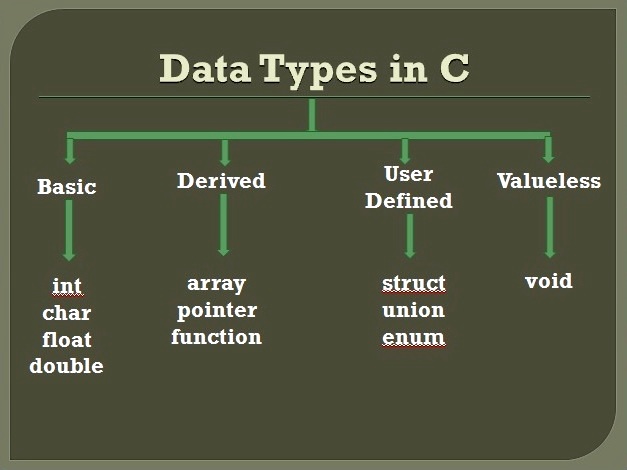
C provides a range of data types, categorized into:
- Primary (or Built-in) Data Types
- Derived Data Types
- User-Defined Data Types
- Void Data Type
Let’s look into each category in detail.
1. Primary (Built-in) Data Types
These are the foundational types C offers. You’ll use these 90% of the time.
a. int (Integer)
Stores whole numbers, both positive and negative.
Copy Code
c

CopyEdit

int age = 25;
- Size: Typically 4 bytes
- Range: -2,147,483,648 to +2,147,483,647
b. float (Floating Point)
Used for numbers with decimal points.
Copy Code
c

CopyEdit

float height = 5.9;
- Size: 4 bytes
- Precision: Up to 6 decimal places
c. double (Double Precision Floating Point)
Used when higher precision is needed than float.
Copy Code
c

CopyEdit

double pi = 3.1415926535;
- Size: 8 bytes
- Precision: Up to 15 decimal places
d. char (Character)
Stores a single character. Characters are stored as ASCII values.
Copy Code
c

CopyEdit

char grade = 'A';
- Size: 1 byte
- Range: -128 to 127 (ASCII)
2. Derived Data Types
These are derived from the built-in types and allow complex storage.
a. Array
An array stores a fixed-size sequential collection of elements of the same data type.
Copy Code
c

CopyEdit

int scores[5] = {90, 80, 70, 85, 75};
b. Pointer
Stores the memory address of another variable.
Copy Code
c

CopyEdit

int x = 10;

int *ptr = &x;
c. Function
In C, functions are technically derived data types because they return values of some
specific type.
Copy Code
c

CopyEdit

int add(int a, int b) {

    return a + b;

}
3. User-Defined Data Types
C lets you define your own data types using these constructs:
a. struct (Structure)
Used to group different data types under a single name.
Copy Code
c

CopyEdit

struct Student {

    char name[50];

    int age;

    float gpa;

};
b. union
Similar to structures, but all members share the same memory space.
Copy Code
c

CopyEdit

union Data {

    int i;

    float f;

};
c. typedef
Gives a new name to an existing type to improve code readability.
Copy Code
c

CopyEdit

typedef unsigned int age;
Now age is an alias for unsigned int.
d. enum (Enumeration)
Used for variables that can take one of a few predefined constants.
Copy Code
c

CopyEdit

enum day {Mon, Tue, Wed, Thu, Fri};
4. Void Data Type
This type indicates no value or empty. It’s
commonly used in two places:
- Function return type when nothing is returned.
- Generic pointer (i.e., void *).
Copy Code
c

CopyEdit

void greet() {

    printf("Hello!");

}
Data Type Modifiers in C
C allows modification of data types
using short, long, signed,
and unsigned. These modifiers adjust the size or the range.
a. short int
Takes less memory.
Copy Code
c

CopyEdit

short int x = 100;
b. long int
Used for larger numbers.
Copy Code
c

CopyEdit

long int population = 1000000;
c. unsigned int
Only stores positive values, doubling the positive range.
Copy Code
c

CopyEdit

unsigned int age = 30;
d. signed int
Default. Stores both positive and negative values.
Examples and Use Cases
Let’s look at how different data types are used in real-life programming.
Example 1: Age Calculator
Copy Code
c

CopyEdit

int currentYear = 2026;

int birthYear = 2000;

int age = currentYear - birthYear;
Here, all values are whole numbers, so int is the best choice.
Example 2: Temperature Logger
Copy Code
c

CopyEdit

float temperature = 36.7;
For storing temperatures, float is perfect due to decimal precision.
Example 3: Student Grade Record
Copy Code
c

CopyEdit

char grade = 'A';
Characters like grades are stored using char.
Example 4: Complex Data
Copy Code
c

CopyEdit

struct Book {

    char title[100];

    float price;

    int pages;

};
To manage a book’s info, a struct groups different types.
Mistakes to Avoid When Choosing Data Types
- Using float for currency: Always use double for financial
calculations due to precision.
- Not using unsigned for always-positive values: Like age or
count.
- Forgetting memory limits: A char can’t store a number like
300.
- Using wrong type in loops: Always match the counter type with the loop
requirement.
How to Practice Data Types Effectively?
Knowing the theory is just half the job. To really grasp data types:
- Write programs that involve different types.
- Mix types in functions and see how typecasting works.
- Use debuggers to view how values are stored in memory.
And if you're serious about learning C the right way, check this out:
Learn C Programming with Uncodemy
If you want to dive deep into C, explore advanced data types, work on real-time projects, and
build a solid programming foundation, then the C Programming Course by
Uncodemy is for you.
🎓 Course Highlights:
- Beginner to Advanced topics
- Real-world examples and assignments
- Interview-focused modules
- Certificate on completion
🔗 Explore Uncodemy’s C Programming Course in Noida
Whether you're prepping for an internship, a coding competition, or your college exams, this
course makes data types — and the rest of C — easy to master.
Final Thoughts
Understanding what is data type in C is more than just learning some
definitions. It’s about learning how your program thinks, stores, and manipulates data. Each
data type brings its own strengths and limitations — and the better you understand them, the
cleaner and more efficient your code becomes.
From managing memory smartly to avoiding silly bugs, data types play a role in every aspect
of programming. So next time you write int or char, remember — you're telling your
computer exactly how to think about that variable.
Choose wisely, code wisely.