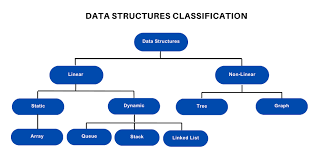
What is DSA?
The abbreviation DSA stands for Data Structures and Algorithms.
Data Structures are methods of storing and organizing information so that it can be accessed and modified efficiently.
Algorithms are step-by-step instructions for solving a problem.
Together, DSA gives you a toolkit and a set of methods for writing optimal, streamlined code.
What Is the Importance of DSA?
These are some of the main reasons why learning DSA is important for anyone working in software development:
1. Problem-Solving
DSA teaches you to simplify complex problems and solve them in a manageable way.
2. Performance Optimization
Good knowledge of DSA helps you write code that runs faster and uses less memory.
3. Technical Interviews
Most software engineering interviews, particularly at top tech companies, include intense coverage of DSA-related problems.
4. The Construction of Real-World Applications
Depending on the scale of the work, DSA is essential in building systems, from search engines to social media apps.
Basic Ideas on DSA
DSA has two major components. Let us look at each of them.
📦 1. Data Structures
A data structure is a way of arranging information in terms of how it is stored, retrieved and accessed. The common ones are:
| Data Structure | Description | Example Use Case |
|---|
| Linked List | A linear structure of nodes where each node references the next node. | Creating dynamic lists. |
| Stack | Last In, First Out (LIFO) ordering. | Undo/Redo, function call management. |
| Queue | First In, First Out (FIFO) ordering. | Print job scheduling. |
| Hash Table (Map) | Key-value pairs for fast retrieval. | Caching, dictionary implementations. |
| Tree | Hierarchical parent-child relationship. | File systems, decision-making models. |
| Graph | A set of nodes connected with the help of edges. | Social networks, GPS navigation. |
| Heap | Special tree which provides fast priority access. | Priority queues, scheduling. |
⚙️ 2. Algorithms
An algorithm is a method or a set of directions to solve a problem. The major types of algorithms are:
| Algorithm Type | Description | Example |
|---|
| Sorting | Rearranges elements in a particular sequence. | Bubble Sort, Merge Sort |
| Searching | Locates an element in a data structure. | Linear Search, Binary Search |
| Recursion | A function that solves a sub-problem by calling itself. | Tower of Hanoi, Fibonacci |
| Greedy Algorithms | Makes the optimal decision at each step. | Dijkstra Algorithm, Kruskal |
| Dynamic Programming (DP) | Solves problems by combining solutions of subproblems. | Knapsack, Longest Common Subsequence |
| Backtracking | Explores all possible solutions and backtracks when needed. | Sudoku solver, N-Queens problem |
| Divide and Conquer | Divides the problem, solves the parts, and combines them. | Merge Sort, Quick Sort |
| Graph Algorithms | Search or traverse nodes in graphs. | BFS, DFS, Dijkstra, Prim |
Applications of DSA in Real Life
1. Google Search: It uses algorithms such as PageRank and data structures such as hash maps.
2. Maps & Navigation: Graph algorithms such as Dijkstra's are used to find shortest paths.
3. Social Media: Graphs are used to suggest friends and find relationships.
4. Gaming: In game AI, backtracking and trees are used for decision-making.
5. E-commerce: Search and sort algorithms organize product listings.
Step-by-Step Guide to Learn DSA
Step 1: Learn a Programming Language
Use a language such as Python, C++ or Java. These are the most common choices for DSA.
Step 2: Begin with the Basics
- Practice arrays, strings and simple sorting/searching.
- Solve basic problems on websites such as LeetCode, GeeksforGeeks and HackerRank.
Step 3: Learn Recursion and Patterns
- Understand the concept of recursion.
- Apply backtracking and divide and conquer to problems.
Step 4: Go Deep into Core Data Structures
- Stacks, queues and linked lists.
- Hash maps, trees, graphs and heaps.
Step 5: Study Algorithms
- Sorting and searching.
- Greedy algorithms, DP, backtracking and graph algorithms.
Step 6: Practice, Practice, Practice
- Participate in contests on Codeforces, AtCoder or CodeChef.
- Solve problems by type (e.g. arrays, DP, trees).
How to Master DSA
1. Visualize Problems: Sketch them on paper or use online visualizers.
2. Understand Time and Space Complexity: Learn Big O notation.
3. Build Intuition: This is not about memorizing answers, but about the reasoning behind them.
4. Use Online Resources: YouTube channels (e.g. Abdul Bari, freeCodeCamp), blogs and free courses.
5. Join a Community: Study groups, forums like Reddit and Discord groups are very useful.
DSA during Interviews
This is how DSA typically shows up in a coding interview process:
| Round | What to Expect |
|---|
| Online Coding Test | MCQs and DSA-type questions. |
| Technical Interview | You solve problems on a whiteboard or in a shared editor. |
| System Design | You may be asked how to use data structures to achieve scalability. |
| Behavioral + HR | May include some logical and analytical thinking tests. |
Most interview questions are related to arrays, strings, linked lists, trees and graphs.
Common Mistakes to Avoid
- Jumping too early into difficult problems.
- Learning by rote, without understanding the logic.
- Not revisiting past problems, lessons and errors.
- Ignoring time and space complexity.
- Skipping basics such as recursion and hashing.
Top Resources to Learn DSA
Free Platforms:
Paid Courses:
- DSA Masterclass by Abdul Bari or Kunal Kushwaha on Udemy
- Data Structures courses by the University of California on Coursera
- Coding Ninjas, Unacademy, Scaler Academy
In Conclusion
DSA forms the foundation of good programming, whether you are a novice or a skilled programmer. It not only increases your coding proficiency but also makes you think more logically and helps you crack well-paying tech jobs.
Think of DSA as the grammar of programming. Once you know it, you can create efficient, streamlined solutions to almost any problem.
Programs must be written for people to read, and only incidentally for machines to execute.
Harold Abelson
To get started, solve one problem today. Stay consistent, stay curious, and success will follow.