So what is Express.js?
Express.js also commonly referred to as express is a lightweight and unopinionated web framework implemented on top of Node.js that enables structuring of the backend of web development by offering a wide range of characteristics that aid in managing HTTP requests, routing, middleware, and many more. It is basically an intermediary between the Node.js server and your application logic; a developer who carries out the process of managing the routes, requests as well as responses easily and clearly. Express does not impose a particular project structure since it is unopinionated and allows developers to organizationally structure their apps in the manner in which it best fits their requirements.
Indicative of its utility and popularity, Express is the de facto standard web framework of Node.js, one which has gained wide usage in the creation of single-page web applications, multi-page web applications, and hybrid web applications, and even APIs. It is possible to create complicated routing, include built-in middleware to incorporate functions, such as authenticating, logging, and error handling, and generate a dynamic web page using a templating system.
Important Parts of Express.js
Express has a lot of inbuilt functions which serves the purpose of fast development and time to market benefits.
Middleware Support: Middleware functions can be used to process any request before it is handled by the routes, which allows performing of modular practices, such as logging, authentication, or request validation.
Routing: Express has an effective and configurable routing engine that can answer the requests of different HTTP methods on individual URLs with static and dynamic route parameters.
Template Engines: It has popular templating engines i.e. EJS, Pug or Handlebars and with the help of this developer can create dynamic HTML using the server.
Static File Serving: Express has done the simplest of tasks, which is serving of statics like images, CSS or JavaScript files to the client without much configuration.
Compatibility: It is compatible with other databases such as MongoDB, MySQL, and much compatible with the ecosystem of Node.js.
The Significance of Express.js on the MERN stack
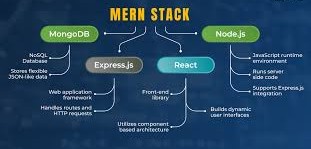
MERN stack is a common full stack JavaScript framework that contains MongoDB, Express.js, React, and Node.js. Every element has a certain part to play:
MongoDB: Non relational database, JSON like document storage.
Express.js: Backend library to process the API routes and the server-side logic.
React: Library of front end development.
JavaScript: Node.js: backend runtime environment.
Express.js forms the core of the server-side platform in MERN, which handles API routes, middleware, HTTP request-response cycle and allows the frontend React app to connect to the backend services and databases without hitch.
The Pros of an Express.js MERN Stack
JavaScript Everywhere: JavaScript is a language that can be used on the back-end and on the front-end, increasing the efficiency of development and decreasing the context switching of the developers.
Efficient Routing and Middleware: Express routes client requests to server-side functions, making request and response routing efficient and middleware parts can make modularity and code reuse crucial in constructing scalable MERN applications.
Fast: The framework minimizes boilerplate and speeds up the process of setting up the server, an important requirement in the development of quick and savvy MERN apps.
Responsive and Scalable Express can also be used with every kind of project and has very good scalability because of the event-driven architecture of Node.js.
Community and Ecosystem: The advantages of the Express are the large ecosystem and community support, which ensures continuous improvement and incorporation within mainstream middleware, libraries and tools that expand on MERN stack functionality.
The Working of Express.js in MERN
The common characteristics of a MERN backend that uses Express.js are:
Server Configuration: Express sets up a node.js server that will be waiting to receive HTTP requests on a port specified by the user.
Routing: APIs endpoints will be specified to manage CRUD (Create, Read, Update, Delete) operations and other functionality and communicate with the MongoDB database.
Middleware Stack: Middleware itself is used during requests processing, CORS, authentication, and data parsing and during passing to the route handlers.
Response Processing: The server accepts the response and processes the response in JSON or HTML which will be consumed by React to render the dynamic user interfaces.
Data Management: The mongoose or MongoDB libraries use the immediate communication with MongoDB to load and access data.
By this architecture, Express can facilitate the seamless synchronization of React frontend and MongoDB database using Node.js.
Practical Example - beginners Express Server
Copy Code
let  = require( 'express' );

const bodyParser = require("body-parser"); or const express = require('express'); or const app = express();

const port = 3000

app.get('\',(req, res) => {

res.send(' Hello World!');

});

app.listen(port, function(){

console.log(`Server listening in http://localhost:${port}`);

});
This sample demonstrates how trivial an operation it is to launch a bare-bones Express.js server, a prerequisite skill one requires to be a MERN developer.
Uncodemy Courses on Learning Express.js and MERN Stack.
Uncodemy will provide intense training to make developers ready to conquer the real world of Express.js, MERN stack development.
MERN Stack Bootcamp: It is an extensive industrial skilling program on MongoDB, Express, React and Node.js and has an on-job learning experience in developing full-stack applications.
Full Stack with Node.js Training: This training will concentrate more on Node.js and express to enable learners to develop scalable backend services in the process comprehending concepts of the server-side of MERN development.
Such courses focus more on project-oriented learning, new tools in the development field, and standards in the industry where a learner gets knowledge and experience to practice in the current web development industry.
Conclusion
Another important component of the MERN stack is Express.js, which facilitates the backend functionality and routing and middleware required to create the modern web application. It is a powerful and yet minimalistic design that boosts development and is highly scalable and flexible.Express.js used in MERN stack is essential to anyone who wants to be a good full stack JavaScript developer. Websites such as Uncodemy offer the best courses to help you fast track your learning experience and become qualified as professional web developers.
The ease and simplicity of complex backend development, and the compatibility of Express.js with other components render it to be a framework that does indeed matter to any developer working on MERN stack development.
You can freely visit Uncodemy and start the new MERN development career and with strong confidence, develop performant and even scalable web applications.