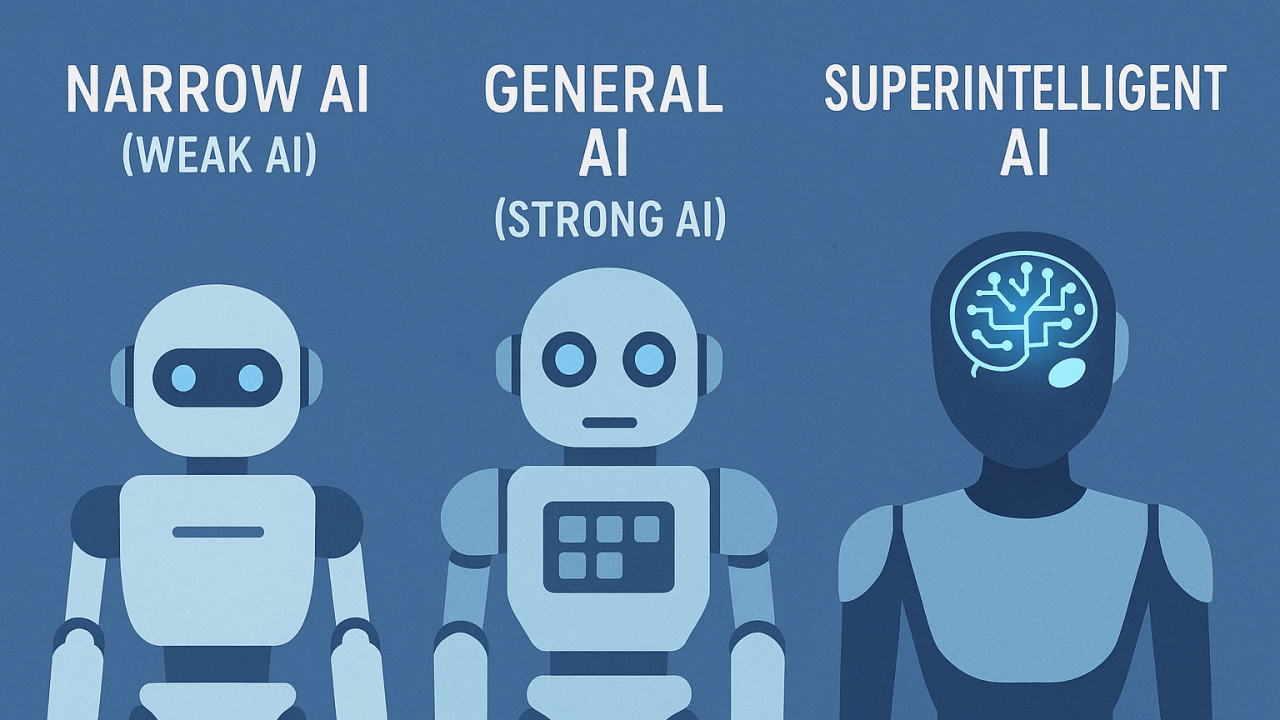
What Is Narrow, General and Super AI? Explained Simply
Artificial Intelligence (AI) has transitioned from the realm of science fiction into our daily lives. Whether it’s voice assistants like Siri and Alexa, sophisticated language models, or self-driving cars, AI is shaking up industries faster than ever before. As we encounter terms like Narrow AI, General AI, and Super AI, it’s crucial to grasp what they mean and how they influence our digital landscape.
In this blog, we’ll break down the three main types of AI—Narrow AI, General AI, and Super AI—into easy-to-understand concepts, highlighting their capabilities, real-world uses, and potential impacts. By the time you finish reading, you’ll have a solid grasp of where technology stands today and where it’s headed tomorrow.
If you’re eager to dive deep into the world of Artificial Intelligence and make your mark in this booming field, don’t miss the Artificial Intelligence Course in Noida offered by Uncodemy.
Table of Contents
1. Introduction to Artificial Intelligence
2. Classification of AI: Overview
3. What is Narrow AI?
4. What is General AI?
5. What is Super AI?
6. Key Differences Between Narrow, General, and Super AI
7. Real-World Applications
8. Challenges and Risks
9. Future of AI
10. Conclusion
11. FAQ
Introduction to Artificial Intelligence
Artificial Intelligence is all about machines simulating human intelligence processes, particularly through computer systems. These processes encompass learning (the ability to gather and apply knowledge), reasoning (using rules to draw conclusions), and self-correction.
AI comes in many forms, ranging from rule-based systems to deep learning models. As we progress, AI is becoming increasingly adept at handling tasks that were once thought to be the exclusive domain of humans.
Classification of AI: Overview
AI can be broadly categorized into three types based on its capabilities:
- Narrow AI (Weak AI)
- General AI (Strong AI)
- Super AI (Artificial Superintelligence)
Each of these categories varies significantly in terms of functionality, scope, and the ability to replicate human intelligence.
What is Narrow AI?
Definition:
Narrow AI, often called Weak AI, is built to tackle a specific task. These systems function within a defined set of rules and limitations.
Examples:
- Voice assistants like Siri, Alexa, and Google Assistant
- Spam filters in your email
- Recommendation engines on platforms like Netflix and YouTube
- Facial recognition technology
- Customer service chatbots
Capabilities:
- Excels at performing single tasks with impressive accuracy
- Utilizes machine learning or follows set rules
- Lacks any form of consciousness or self-awareness
- Can’t learn beyond its intended function
Real-World Use Case:
Take Google Translate, for example. It employs narrow AI to translate text from one language to another, drawing on a wealth of linguistic data. It does a fantastic job, but don’t expect it to solve math problems or whip up a recipe.
What is General AI?
Definition:
General AI, or Strong AI, represents the next frontier in AI evolution. This type of AI can understand, learn, and apply intelligence across a broad spectrum of tasks, much like a human being.
Characteristics:
- Mimics human cognitive abilities
- Exhibits self-awareness and adaptability
- Capable of logical reasoning, emotional insight, and creative thought
- Learns from experiences and applies knowledge in various situations
Current Status:
As of now, General AI is still a dream. While researchers and companies are striving to make it a reality, it remains a theoretical idea for the time being.
Theoretical Example:
Imagine an AI that can consistently pass the Turing Test and handle any intellectual task a human can do—like writing poetry, solving complex scientific problems, and navigating personal relationships.
What exactly is Super AI?
Definition:
Super AI, also known as Artificial Superintelligence, takes intelligence to a whole new level, far beyond what humans are capable of. It doesn’t just mimic human thought processes; it actually exceeds them.
Capabilities:
- Tackles complex problems at lightning speed, outpacing any human
- Has a high level of emotional intelligence
- Innovates and creates on its own
- Makes decisions with a precision that humans can only dream of
- Hypothetically, it could even be self-aware and conscious
Current Status:
As of now, Super AI remains a concept rooted in theory and speculation. There aren’t any real-world examples of superintelligence, but it’s definitely a hot topic among futurists and philosophers alike.
Possible Scenario:
Picture an AI that comprehends every field of science better than the most brilliant scientists combined, effortlessly solving global challenges like climate change, pandemics, or even space exploration.
Key Differences Between Narrow, General, and Super AI
Feature
Narrow AI
General AI
Super AI
Intelligence Level
Limited to specific tasks
Equivalent to human
Beyond human
Self-awareness
No
Partial/Theoretical
Yes (Theoretical)
Learning Capability
Pre-programmed or limited
Learns and adapts freely
Learns, adapts, and creates
Status
Existing
Experimental/Conceptual
Hypothetical
Examples
Chatbots, Siri, Spam Filters
None (Yet)
None (Speculative)
Real-World Applications
Applications of Narrow AI:
- Self-driving cars, like Tesla’s autopilot
- Medical diagnosis tools, such as IBM Watson
- Personalized recommendations in e-commerce
- Image and speech recognition technologies
Future Applications of General AI:
- Advanced robotics that can understand human emotions
- AI-driven research and development in the pharmaceutical industry
- Fully autonomous machines capable of making ethical decisions
Super AI Potential:
- Tackling unsolved physics challenges
- Predicting and preventing natural disasters
- Creating complex technologies that go beyond human understanding
Challenges and Risks
Narrow AI Challenges:
- Issues with data bias
- Concerns about privacy
- Limited ability to understand context
General AI Risks:
- Ethical dilemmas that arise
- Unpredictable behaviors
- Ensuring alignment with human values
Super AI Concerns
- The risk of losing human control
- Potential existential threats to humanity
- Decision-making processes that exceed human comprehension
Prominent researchers like Stephen Hawking and Elon Musk have raised alarms about the dangers of unchecked superintelligence. While AI has the potential to tackle significant challenges, it’s essential that we develop it responsibly.
Future of AI
As we keep advancing our algorithms and training larger models, we’re getting closer to achieving General AI. However, it’s still a long road ahead, requiring breakthroughs in neuroscience, cognitive science, and machine learning.
Establishing ethical frameworks, safety protocols, and fostering global cooperation will be vital in ensuring that AI serves the best interests of humanity.
Conclusion
Grasping the distinctions between Narrow, General, and Super AI is crucial for anyone eager to dive into the AI world or keep up with the latest tech trends. While Narrow AI is already making waves across various industries, General AI and Super AI are still on the horizon, goals for future innovators. As we embark on this exciting journey, it’s our commitment to responsible innovation and solid ethical principles that will shape how AI benefits humanity.
If you’re thrilled about being part of this fast-paced field, why not kick things off with the Artificial Intelligence Course in Noida offered by Uncodemy? You’ll learn everything from the fundamentals of AI to advanced applications, getting you ready for the job market.
FAQs on Narrow, General, and Super AI
Q1. What’s the key difference between Narrow AI and General AI?
Narrow AI is tailored for specific tasks and works within a limited scope, whereas General AI has the potential to tackle any intellectual challenge a human can handle.
Q2. Is General AI a reality today?
Not yet! General AI remains a theoretical idea and is currently the focus of ongoing research and experimentation.
Q3. Can you give examples of Super AI?
At this point, there are no real-world examples of Super AI. It’s a concept for the future, envisioning an AI that exceeds human intelligence in every way.
Q4. Is Narrow AI a threat?
Narrow AI can be risky if not developed with ethics in mind, such as spreading false information or infringing on privacy, but it doesn’t pose an existential danger.
Q5. Why is Super AI seen as a potential threat?
Because it could outstrip human comprehension and control, making its decisions hard to predict or manage, which could lead to negative consequences.