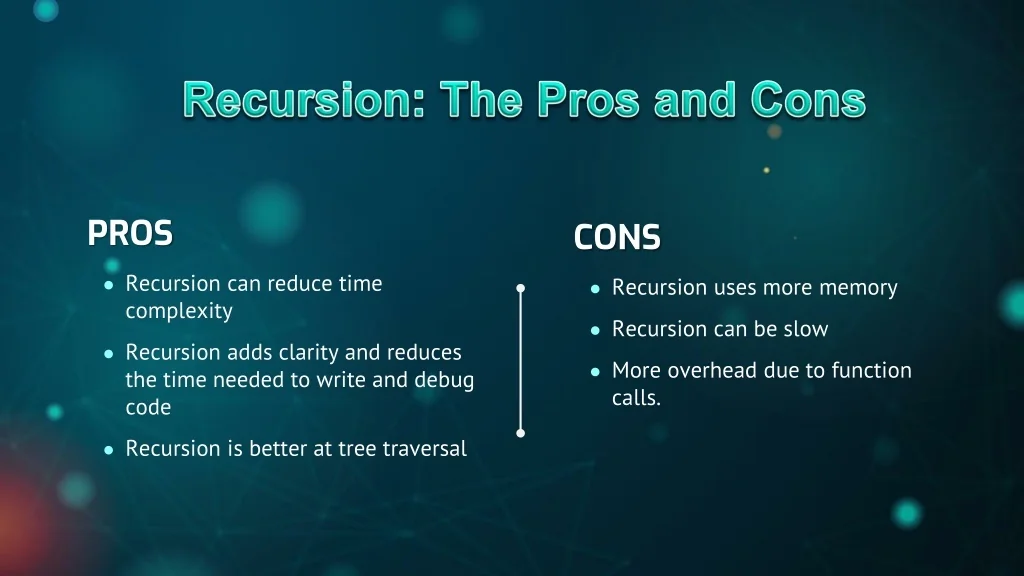
In programming, recursion is a concept that is as elegant as it is challenging. It involves a function calling itself in order to break down complex problems into simpler ones. While recursion is known for its clean and expressive code, it sometimes struggles with performance issues, especially when dealing with large inputs. That is where tail recursion steps in.
Tail recursion is a refined version of recursion. It allows certain languages to optimize recursive calls in a way that consumes less memory.
In this article, we will explore what tail recursion is, understand how it works, compare it with regular recursion, and discover when and where to use it. We will also introduce you to an excellent resource from Uncodemy for mastering recursion and data structures with hands-on Python training.
Starting with Recursion
Recursion is the process where a function calls itself until it reaches a base case. Each call solves a smaller part of the original problem. Once the base case is met, the function begins to return values back up the call stack.
Here is an example of a recursive function that calculates the factorial of a number:
Copy Code
python

CopyEdit

def factorial(n):

    if n == 0:

        return 1

    else:

        return n * factorial(n - 1)
If you call factorial(5), the process unfolds like this:
Each call is stacked on top of the previous one. This means a large number like factorial(1000) may crash the program due to stack overflow.
To solve this memory issue, developers often prefer a different style of recursion known as tail recursion.
Understanding Tail Recursion
Tail recursion is a type of recursion where the recursive call is the last action in the function. After this call, the function returns the result directly without performing any additional operations. This structure allows the interpreter or compiler to optimize the function by reusing the same memory frame instead of creating a new one for each call.
Here is how you can write the factorial function in a tail recursive way:
Copy Code
python

CopyEdit

def tail_recursive_factorial(n, accumulator=1):

    if n < 0:

        raise ValueError("Factorial is not defined for negative numbers")

    if n == 0:

        return accumulator

    else:

        return tail_recursive_factorial(n - 1, accumulator * n)
In this version, the function carries the result along using an extra parameter called accumulator. The recursive call is the final step, making it tail recursive.
Characteristics of Tail Recursion
Tail recursion has a few distinct features:
The recursive call is the final operation in the function.
No computation takes place after the call returns.
An accumulator or helper parameter is often used to keep track of the ongoing result.
It allows the function to behave more like a loop internally.
When tail call optimization is applied, the function uses constant memory regardless of input size.
Comparing Regular Recursion and Tail Recursion
To understand the benefits of tail recursion, it helps to compare it with regular recursion.
Aspect
Regular Recursion
Tail Recursion
Final Operation
Computation follows recursive call
Recursive call is the final step
Memory Usage
Grows with each call
Reuses memory if optimized
Risk of Stack Overflow
High with deep recursion
Low in optimized environments
Loop Behavior
No
Yes, mimics loops
Accumulator Usage
Not required
Usually required
Even in languages that do not optimize tail calls, writing in this style helps in understanding logic flow and improving clarity.
Advantages of Tail Recursion
Tail recursion is not just a theoretical concept. It offers practical benefits for writing safer and more efficient code.
Memory Efficiency
Because tail recursive functions do not need to keep previous states, they are more memory friendly. In languages that optimize tail calls, this results in better performance.
Avoids Stack Overflow
Tail recursion makes it easier to handle large input values without hitting the recursion limit that is common in regular recursive functions.
Loop Like Behavior
Tail recursion brings the readability of recursion and the reliability of loops into one clean pattern. This makes it ideal for writing functions that behave iteratively.
Clearer State Management
Using an accumulator allows you to see how the function evolves its state with each call, which can make your logic easier to trace and debug.
Use Cases of Tail Recursion
Tail recursion is ideal in scenarios where the problem can be expressed in terms of a single result passed along recursively. Let us explore some common examples.
Calculating Factorials
Here is the tail recursive version of the factorial function again, now with proper error handling.
Copy Code
python

CopyEdit

def tail_recursive_factorial(n, accumulator=1):

    if n < 0:

        raise ValueError("Factorial is not defined for negative numbers")

    if n == 0:

        return accumulator

    return tail_recursive_factorial(n - 1, accumulator * n)


# Example

print(tail_recursive_factorial(5))  # Output: 120
This works efficiently for reasonably large values.
Fibonacci Sequence
The Fibonacci sequence is another example that is often written inefficiently using regular recursion. Here is a better version:
Copy Code
python

CopyEdit

def fibonacci(n, a=0, b=1):

    if n == 0:

        return a

    return fibonacci(n - 1, b, a + b)


# Example

print(fibonacci(7))  # Output: 13
This version avoids redundant computations and is structured in a tail recursive style.
Searching in a List
Tail recursion works well for linear searches where you check each element one by one.
Copy Code
python

CopyEdit

def search(lst, target, index=0):

    if index == len(lst):

        return -1

    if lst[index] == target:

        return index

    return search(lst, target, index + 1)


# Example

print(search([5, 8, 12, 16], 12))  # Output: 2
You track the index as an accumulator of sorts.
Countdown Function
Here is a fun way to count down using tail recursion.
Copy Code
python

CopyEdit

def countdown(n):

    if n == 0:

        print("Done")

    else:

        print(n)

        return countdown(n - 1)

# Example

countdown(5)
It behaves like a loop but follows recursive logic.
Limitations in Python
Despite all these advantages, Python does not support tail call optimization. This means that even tail recursive functions in Python will still use a new stack frame for each call. If you use very large input values, you can still run into a recursion limit error.
However, the style is still valuable. It helps in structuring clean logic and prepares you for using languages that do support this optimization, such as Scheme, Haskell, Scala, and even JavaScript in some engines.
If you absolutely need to handle very large inputs in Python, consider switching to an iterative version instead of recursion.
Why Tail Recursion Matters in the Real World
Tail recursion is not just something taught in computer science classrooms. It is used in real world systems that require efficient, reliable, and clean recursive solutions.
Here are some practical applications:
Algorithms that need to process very large datasets, such as logs or user data, often use tail recursion for performance.
In game development, tail recursion is used in simulating repeated actions or recursive physics computations.
In data science and artificial intelligence, tail recursion is often part of recursive search algorithms or tree traversal techniques.
Finance software uses recursive formulas for compound interest, amortization schedules, and more, where performance matters.
Thinking in terms of tail recursion helps you write more thoughtful and scalable code.
Learn Tail Recursion and More with Uncodemy
If you are looking to gain confidence in recursion and build your data structure foundation, look no further than Uncodemy’s course on “Mastering Data Structures and Algorithms in Python”.
This course offers:
Clear explanations of recursion, including tail recursion
Visual breakdowns to help you understand recursion trees
Real coding exercises to strengthen problem solving skills
Structured guidance for preparing for technical interviews
Practical use cases to help you apply your skills in projects
Whether you are a student, a job seeker, or someone who loves clean code, this course is an excellent next step in your journey.
You can explore the course on Uncodemy’s official website and start transforming your approach to coding today.
Final Thoughts
Tail recursion is a powerful concept that makes recursion safer and more efficient. It helps you avoid memory issues, simulates loop behavior, and keeps your logic neat and readable. While Python does not optimize tail recursive calls, understanding and applying the concept is still a valuable skill.
From computing factorials and Fibonacci numbers to searching and countdowns, tail recursion has its place in every coder’s toolkit. Writing tail recursive functions trains you to think clearly and write code that is both logical and scalable.
And if you are serious about learning how to write these types of functions with confidence, consider taking the Mastering Data Structures and Algorithms in Python course from Uncodemy. It is practical, engaging, and designed to help you master recursion and so much more.
Now that you understand what tail recursion is and how it works, why not try converting one of your old recursive functions into a tail recursive one? It may just become your new favorite coding style.