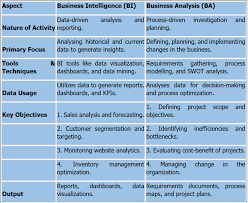
Although such terms appear together most often in a more or less interchangeable way, they actually reflect two different but closely related ways of operating data. Learning the distinction between them is significant to companies eager to utilise their data-driven strategies to the full.
Business Intelligence may be perceived as the act of accumulating, storing, and arranging data so as to develop meaningful implications. It is concerned with what has already occurred in the business; it informs historically and presently with ease of comprehension. As an example, a BI system may create dashboards that illustrate historical sales performance over the last quarter, revenue comparison between the regions, or customer satisfaction ratings during the prior year. Such insights enable decision-makers to monitor performance, detect trends, and understand how they are progressing relative to objectives. BI is focused on simplicity and readability. It enables those managers without technical knowledge to gain speedy comprehension of data based on visualisations and reports. In its very essence, BI offers a reflection of the present and the past, which is why BI is the essential tool to track business health.
Data Analytics, on the other hand, is more general and usually extended in scope. Whereas BI can provide answers on what is happening or has happened, Data Analytics takes a step further to provide answers on why it is happening, what might happen in the future and what ought to be done next. It applies statistical analysis, machine learning algorithms, and prediction models to explore deeper into the data. As an example, a data analytics project not only will indicate that sales declined in a specified region, but it also will perform an analysis of customer behaviour, external factors and marketing campaigns to identify why sales declined. Besides, it can forecast the future trends of sales or advise a particular course of action, including the modification of price strategies or the appeal to a different client segment. It is on this basis that Data Analytics enables a shift in the use of data as a record-keeping instrument to a strategic asset that is proactive in determining decision-making and innovation.
The one disparity that is most evident between BI and Data Analytics is the purpose. BI is mostly descriptive and assists an organisation in knowing what it is. It is stable, reliable and accurate in reporting. The executives use the BI tools to audit KPIs, compliance enforcement and outcome measurement. It is also supposed to be easy to use and available (the tool does not require advanced technical expertise; a marketing manager or HR executive can access dashboards by simply calling them up). Nonetheless, Data Analytics is diagnostic and predictive. It involves expert skills in topics such as statistics, programming and data modelling. Analysts analyse the vast data sets and find connections between variables and create models that reveal unknown information. Analytics tends to demonstrate the causes of the issue, not only prove that a problem exists.
The other main distinction can be attributed to the manner of usage of these tools in organisations. BI systems are usually constructed on structured sources of information such as 1CRM systems, transactional databases or ERP databases. They largely rely on the data warehouses, which clean, standardise and store the information in such a manner that it is optimised to use it in reporting. Whether Tableau, Power BI, or QlikView, these so-called BI tools should be plugged into such warehouses to create dashboards or reports. In contrast, Data Analytics usually has a more significant variety of sources of information, such as unstructured data, like social media posts or customer reviews, sensor data, or images. It is based on the concept of technologies such as Hadoop, Spark and cloud-based systems to process large and complex datasets. The algorithms applied to analytics, i.e. regression analysis, clustering or machine learning, can reveal data patterns that would not be identified using conventional BI techniques.
The two orientations of BI and Data Analytics greatly differ when it comes to time. BI is rear-view, and it is intended to present information about the past and current situations. The value of this backwards-looking approach is in the ability to quantify success and gauge performance and determine accountability by businesses. It is just like a scoreboard that informs you about how the team is performing. Data Analytics is more future-oriented, however. It can forecast future performance by establishing patterns and patterns on the basis of data and provide insight into risk or potential opportunities. Taking the example of a retail company, it can use BI to report the number of units of any particular product that the company sold in the last month, whereas Data Analytics can report which products are likely to sell more in the next festive season and why. Analytics possesses this predictive ability, which is absolutely vital to both innovation and strategic planning in the long term.
Even though each has its differences, it is worth noting that BI and Data Analytics are not mutually exclusive. Actually they supplement each other. BI gives the initial staging ground through the collection and presentation of trusted data, and analytics builds on the ground and makes further discoveries and estimations. Collectively, they form a complete cycle of understanding: BI can illustrate what is going on, BI analytics can clarify why it is going on and what is likely to happen next and together they can inform both tactical and strategic decisions.
There is also a significant distinction in the skill sets in BI and Data Analytics. Those who work with BI tend to be preoccupied with data management, reporting, and visualisation. They should know BI platforms and know database basics, and they should be able to transform raw data into readable reports. The focus is on simplicity and precision and not on difficulty. Conversely, Data Analytics requires a technical background. Data scientists and analysts in the field need to have knowledge of programming, such as Python, R, or SQL, an understanding of statistical approaches, and an awareness of machine learning approaches. They are not simply report-writers; they are experiment designers, hypothesis testers and model builders. That is why the companies tend to create dedicated analytics squads and apply BI tools in each of the departments.
They also differ in terms of the business value created by they create. BI enhances operational efficiency by making sure that decision-makers are equipped with the information required in real-time. It takes out the guesswork, lowers inaccuracy, and gets all people in the organisation on the same measurement. This brings uniformity and openness. Instead, Data Analytics opens value by opening up new opportunities. It enables companies to be creative, exploit unexplored economic markets, enhance consumer experiences, and optimise the use and allocation of resources. As an example, an e-commerce business can track its performance on delivery using BI and make sure that it is not violating any service level agreements. Meanwhile, Data Analytics might assist it in understanding how its customers browse to suggest specific products, increasing its sales.
The difference in adoption also exists. BI is older and more widespread when it comes to implementation in industries. BI dashboards are already a part of daily activity at many companies. Data Analytics is more advanced and it has become more popular recently due to the emergence of big data technologies and greater computing capabilities. The aptitude to engage in analytics is not the same investment that every organisation is making and this process involves a lot more than simply equipping an organisation with half-baked tools, but focused and talented talent coupled with a cultural change towards being data-driven and experimenting. Nonetheless, with the growing competition and the more pressing need of digital transformation, an increasing number of companies are switching to the combination of BI with the incorporation of analytics as a foundational capability.
Over the past few years, the distinction between BI and Data Analytics has become slightly muddled. Analytics components, including predictive modelling and natural language processing, are finding their way into modern BI tools, with analytics platforms augmenting their appeal to users. This convergence implies that companies no longer need to work on them as discrete silos. Rather, they can use those tools which integrate descriptive, diagnostic, and predictive functions into a single system. Nevertheless, the conceptual difference does not lack significance in comprehending what each one implies. The BI is the trusted foundation of reporting, and analytics is the streamlined, sophisticated powerhouse of innovation.
To sum up, as information increasingly becomes a critical resource, organisations that will gain expertise and succeed with BI and Analytics will be the ones that will survive, adjust and prosper in a competitive and unpredictable world. Understanding their differences is the first step, but leveraging them together is the true key to unlocking the power of data.