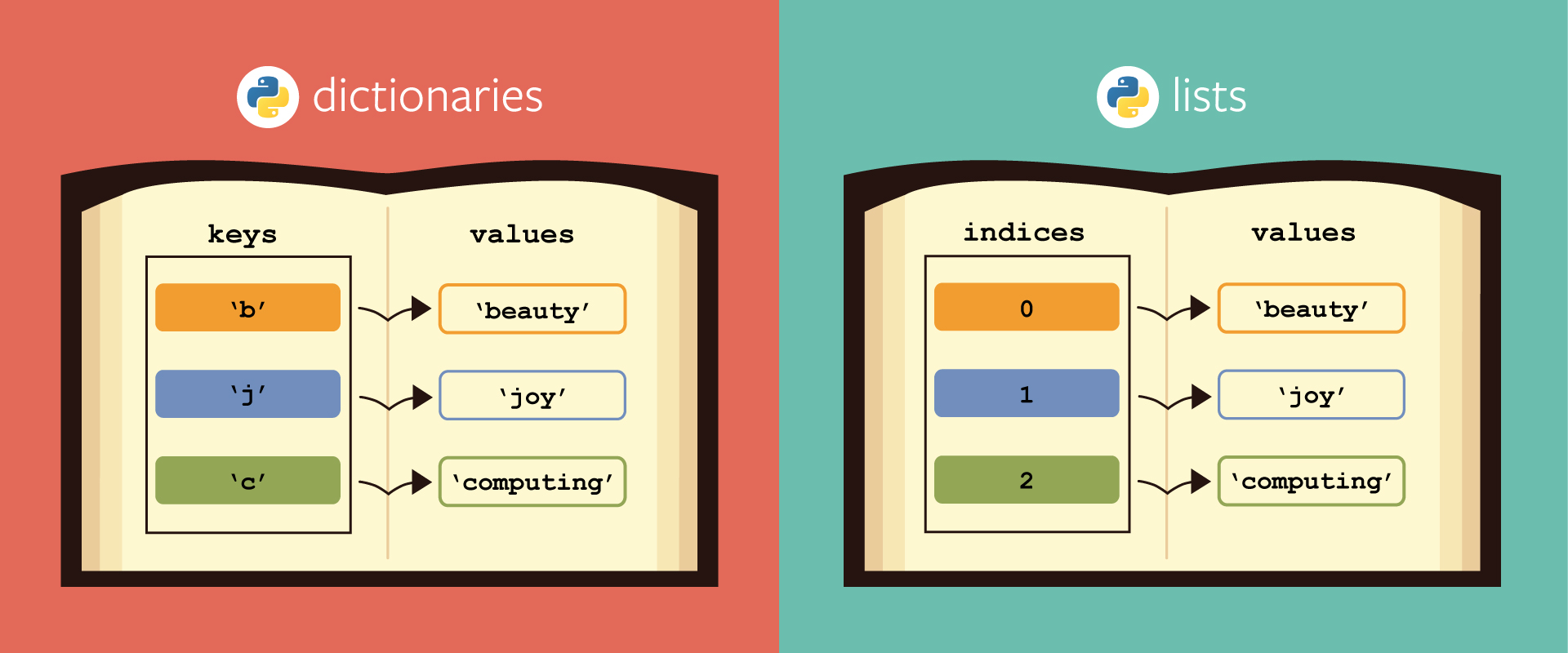
The meaning of Python Lists
A Python list is an ordered list of objects that support mutation. Square brackets are used to create lists and lists can also contain an item of any data type, including a list. Its characteristics are:
Ordered Collection: The item values are entered in the order in which they are entered to, and may be accessed in an order-dependent manner by integer indices with a predetermined zero-based value.
Mutable: you can add, remove or edit the elements of a list after creating it.
Allows Duplicates: It is possible to have duplicates in lists.
Indexing and Slicing: You can look up the elements or slices of a list effectively by using an index.
Dynamic Size: The size of a list is not fixed and increases or decreases dynamically as elements are inserted into a list or are removed from one.
The ordered collection should use lists when order is relevant, like sequence of user inputs, an array of objects, or when having to process data sequentially. Adding elements to lists is a common operation, which can be executed as an append, an insert, or a remove operation, as well as iteration and slicing of elements.
Examples of a python list:
Copy Code
fruits =

print(fruits) # Output: banana

fruits.append("orange")

print(fruits) # Output:
The Comprehension of Python Dictionary
Python dictionaries are unordered data structures that can be changed and are mutable, and are indexed using keyvalue pairs. They are created and have as core attributes the following using curly braces {} or dict() function:
The key-Value Pair Structure: An element is provided to a value.
Keys Should Be Unchangeable and Unique: Keys may be tuples, numbers, or strings but cannot be list-like structures since they can and will change.
Values Can Be Any Type Of Data: Values can be duplicates, they can be complex objects.
Effective search: It has a hash table that enables average constant time complexity O(1) search with look-ups, the insertion, and deletion of data keyed by this identifier.
Insertion Order Maintenance: Since Python 3.7 dictionaries maintain insertion order, but they are mostly used to be accessed very fast and not ordered.
When your need is to index unique identifiers (keys) and access them by value you should use dictionaries because they are faster and you do not have to have any kind of ordering. Possible use cases are user profiles using user IDs as a key, configuration settings, caching performance results or in any scenario that involves fast lookups.
Copy Code
Dictionary Python example:

student = {"name":"John", "age":21, "courses":}

print(student) # Output: John

student = 22

print(student) # ha454 {'name': 'John', 'age': 22, 'courses':}
List or Dictionary When to Use When
- Use lists when you mostly have a list of items in order where the order matters.
- If you want to have unique keys and fast access, insertion and deletion, use dictionaries where you have to assign unique values to their keys.
Performance Comparison
In general, dictionaries have good performance over lists when searching by hashing as the data becomes larger. The dictionary common operations, such as search, insert, and delete, take an average time of O (1) in contrast to lists whose common operations take an average time of O (n) and n is the number of elements. Lists, however, are quicker to access by index and occupy less memory, which causes them to be more suitable when working with consecutive data and tasks involving a considerable number of iterations.
Applications and Example
Lists:
- The data that has to be stored in order, like a sequence of user input.
- The maintenance of a list of shopping cart items.
- Permutations/combinations storage.
- Manipulation and modification of strings of information.
Dictionaries:
- Why you should map usernames to profiles.
- Cached results of computation.
- A conveyance of JSON-like structures.
- Real time access with distinctive name identifications.
Changeability and Changeability
Both Python lists and dictionaries are mutable and changeable. Nonetheless, where permanent side effects are important (i.e. to be used as keys in dictionaries or to avoid the possibility of accidental modification), Python provides immutable variants such as tuples to lists and special proxies to dictionaries.
Accessing Elements and Making Them Change
- Lists are able to read and change their elements using integer positions:
my_list =
my_list = 25 # Close element at index 1
print(my list)
- To access or modify dictionaries, dictionaries are used using keys:
my_dict = dict(a=1,b=2)
my_dict = { 3:b} # This will overwrite the current dictionary entry of key value pairs to 3
print(my_dict) # Output: 3
Ordering
Lists are defined to keep the insertion order due to its sequential natures. Since Python version 3.7, dictionaries were stored in order
But this is the implementation detail of the language and it should not be trusted in case order is important.
Space Complexity
Lists are more memory efficient since they will only keep the items that are in the list whereas dictionaries will have keys and values as well as hashing overhead.
Examples: the user, events to log, data-transformation pipes.
Lists:
- Keeping up with the merging lists of tasks or grocery carts.
- Caching objects to be processed next or over and over.
- Key-based configuration setting.
Dictionaries:
- Keyed storage of username or ID of user profiles.
- Caching of costly computations with input of a function serving as keys.
- Configuration settings which are key based.
- Using JSON-like data or structured records storage.
How to learn Python Lists and Dictionaries with Uncodemy
In python, Uncodemy provides entire courses of Python programming that have elaborate modules of lists, dictionaries, and other data structures. Such curriculums will assist learners to understand the basics as well as advanced concepts in practical training and project undertakings.
Applicable Uncodemy Courses
- Python Training Course in Noida revolves around the fundamental concept of python, such as lists and dictionaries, their creation, manipulation, and application.
- Data Science Certification 2026 presents the basics of Python in relation to data processing, and the lessons on data structure such as lists, dictionaries are detailed.
- The Mastering Python: A Journey to Become a Pro aims at including both beginning and advanced learners and focuses on learning the mastery of data structures such as lists and dictionaries and the practical methods of coding.
- The Python Full Stack Development Program has comprehensive training of Python programming language coupled with front and backend capabilities such as tools that facilitate handling of lists and dictionaries.
- Uncodemy Python Course in Kurukshetra discusses the fundamental modules of Python and advanced structures that boost an additional proficiency in Python programming languages like lists, dictionaries, and tuples.
The courses also include project-based learning, real-life applications, and advice of industry professionals to enhance your Python mastery with a meaningful purpose.
Some Other Recommendation Concerning Lists and Dictionaries
- Index-based access in lists is preferable in terms of performance.
- Mappings that require quick look ups should be using dictionaries.
- Pay attention to the key mutability of dictionaries so as not to make mistakes.
- Dictionaries will perform better than lists when dealing with large amounts of data that needs to be looked up a lot.
- Remember that you have memory implications when deciding to use lists versus dictionaries.
Conclusion
Python lists and dictionaries are very essential items which satisfy different programming requirements. Where lists are best applied is in sequential management of data, whereas dictionaries shine in key-based schemes of locating the associated data. The choice between them is determined by the particular cases of usages, performance requirements, data structure preferences.
Being skilled in both data structures not only makes you more efficient when coding but much more capable of designing pleasing, maintainable pieces of software. Studying resources that can help you learn this like the Python courses on Uncodemy will enhance your know-how and give you practical time to utilize these structures so that you are confident of using them.
And accept the power and flexibility of Python lists and dictionaries, and you can find your way through the world of coding with an informed design and a perfectly organized data management.
When you are keen to accelerate your Python knowledge, then look into the Uncodemy mastery classes on lists and dictionaries to get a firm establishment on the career of programming.