Which Is Not an Operation of Circular Queue? Explained with Reasoning
Bambam Kumar Yadav / 6 days - 0
- 9 min read
In this article, we’ll explore the operations of a circular queue and identify which is not the operation of circular queue. If that question made you pause, you're not alone. It often trips up both beginners and professionals during interviews and exams.
Understanding the Circular Queue First
Before we break down the operations, let’s quickly go over what a circular queue is.
Think of a standard queue—like people waiting in line. First come, first served. Now, imagine that once the last person is served, the line magically connects back to the front. That’s a circular queue. It’s like a regular queue that loops back on itself, making more efficient use of memory.
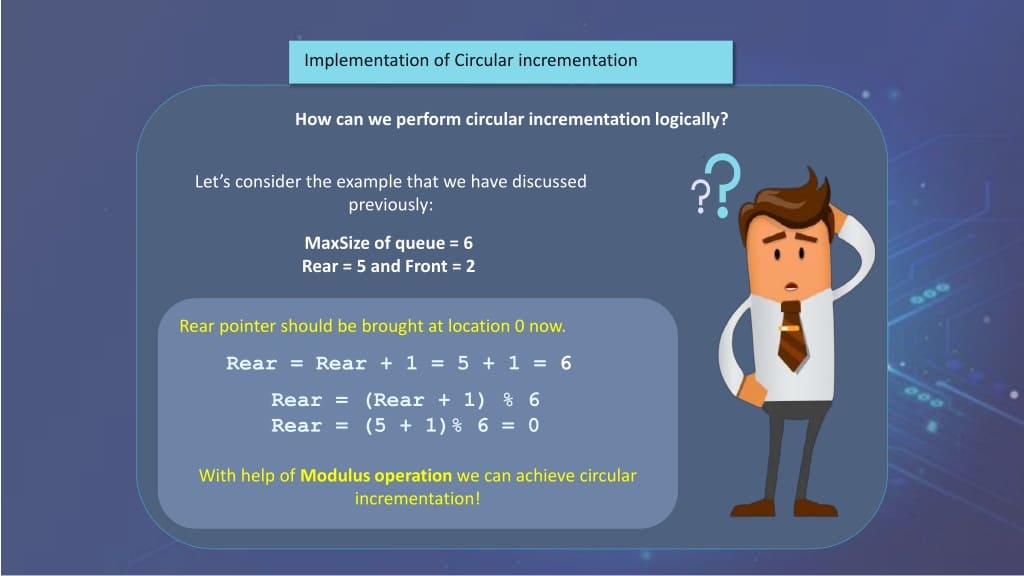
In linear queues, once the rear reaches the end of the array, you can't insert more elements—even if the front has moved forward. Circular queues solve this problem by wrapping around.
This structure is widely used in areas like CPU scheduling, memory management, and buffering systems.
Key Operations of a Circular Queue
To figure out which is not the operation of circular queue, it’s important to understand what operations are standard.
Here are the main ones:
- Enqueue (Insertion)
This operation adds an element to the queue. In a circular queue, if the end of the array is reached, the new element is inserted at the beginning, if space is available.
- Dequeue (Deletion)
This removes an element from the front of the queue. Again, it wraps around when it reaches the end.
- Peek or Front
This operation returns the element at the front of the queue without removing it. It’s useful when you need to know who’s next without altering the queue.
- isFull
Checks whether the queue is full. Since circular queues reuse space, this condition helps avoid overwriting data.
- isEmpty
Checks whether the queue has any elements or not.
These are the core operations that make circular queues function properly. Now let’s move to the key question.
So, Which Is Not an Operation of Circular Queue?
This is the question that often shows up in quizzes, technical tests, or Full Stack Developer Course interviews:
“Which is not the operation of circular queue?”
Here’s the simple answer:Sortingis not a standard operation of a circular queue.
Let’s be clear—while you can technically sort the elements of any data structure using custom logic, sorting is not a built-in or fundamental operation of the circular queue. It goes against the FIFO (First In First Out) principle that queues are built upon.
Think of it like this: a queue is meant to manage order, not rearrange it. Sorting would require accessing multiple elements out of order, which defeats the purpose of using a queue in the first place.
Why Sorting Doesn’t Belong
Sorting involves comparing and rearranging elements—something you don’t do in a queue. Queues, especially circular ones, are meant to operate in a streamlined, linear (or looped-linear) manner. Their main use is in time-sensitive applications where elements are processed in the exact order they arrive.
So, while you can extract the data from a circular queue, put it in a list, and sort it—that sorting is done outside the queue’s logic, not within it.
This makes sorting a non-queue operation and therefore, the correct answer to our question.
Why This Matters in a Full Stack Developer Course
Now, if you're studying data structures as part of a Full Stack Developer Course, you might wonder how this small technical detail fits into the bigger picture.
Here’s why it’s crucial:
- Backend Efficiency: When building scalable back-end systems, understanding data structures like circular queues can improve performance in areas like task scheduling or resource allocation.
- Memory Management:Circular queues are a big deal in optimizing memory usage, especially when working with fixed-size buffers or handling concurrent requests.
- Interview Edge: Questions like “which is not the operation of circular queue” are favorites among interviewers. Not just for the answer, but for how you explain your reasoning.
Real-World Use Cases of Circular
Let’s quickly go over where circular queues show up in real-world development:
- CPU Scheduling
In round-robin scheduling, processes are queued in a circular fashion, ensuring fair usage of CPU time.
- Traffic Systems
Managing signal cycles at intersections often uses circular queues to handle predictable, repeating patterns.
- Streaming Media Buffers
Audio/video streams rely on circular buffers to maintain consistent playback without hiccups.
- Network Routers
Packets are stored temporarily in circular queues to avoid data loss during transmission.
As a full-stack developer, even if you mostly deal with high-level frameworks and APIs, knowing how such systems work at the foundational level gives you a serious advantage.
Recap: What We’ve Learned
To wrap things up, here’s a summary:
- A circular queueis a smart way to manage data efficiently, especially when working with limited memory.
- The core operations of a circular queue include enqueue, dequeue, peek, isFull, and isEmpty.
- Sorting is not an operation of a circular queue because it doesn’t align with the queue’s FIFO behavior.
- Knowing these details can give you an edge in technical interviews and coding assessments.
- If you’re enrolled in a Full Stack Developer Course, mastering data structures like these will make you a stronger, more confident developer.
Final Thought
Data structures aren’t just theoretical concepts—they shape the way applications function behind the scenes. Understanding what belongs in a queue, and what doesn’t, may seem like a small detail. But often, it's the small details that separate a beginner from a pro.
So, next time you're asked “which is not the operation of circular queue?”, you’ll not only know the answer—you’ll know why.
Frequently Asked Questions (FAQs)
Q1: What is a circular queue?
A: A circular queue is a linear data structure that connects the end of the queue back to the beginning, forming a circle. It allows efficient use of memory by reusing spaces freed by dequeued elements.
Q2: What are the main operations of a circular queue?
A:The standard operations include:
- Enqueue: Insert an element.
- Dequeue: Remove an element.
- Peek/Front: View the front element without removing it.
- isFull: Check if the queue is full.
- isEmpty: Check if the queue is empty.
Q3: Which is not an operation of a circular queue?
A: Sortingis not an operation of a circular queue. Queues follow the First-In-First-Out (FIFO) principle and are not designed to rearrange data internally.
Q4: Why is sorting not part of circular queue operations?
A: Sorting involves comparing and reordering elements, which goes against the queue’s FIFO behavior. Circular queues are designed to maintain order—not change it.
Q5: Can you sort the data inside a circular queue if needed?
A: Technically yes, but not directly. You’d need to extract the elements into another data structure (like an array), sort them there, and then reinsert if necessary. The queue itself doesn’t support sorting.
Q6: What is the benefit of using a circular queue over a linear queue?
A: A circular queue makes better use of space by reusing slots freed by removed elements, unlike a linear queue where those slots remain unused unless the entire structure is reset.
Q7: Where are circular queues used in real-world applications?
A: Common applications include:
- CPU scheduling
- Traffic light systems
- Media streaming buffers
- Network packet buffering
Q8: How is a circular queue implemented?
A: It’s usually implemented using arrays or linked lists, with special handling to "wrap around" when indices reach the end of the structure.
Q9: Is understanding circular queues important for full stack development?
A:Yes. While high-level languages abstract most of this away, understanding circular queues helps with:
- Optimizing performance
- Handling real-time data
- Preparing for technical interviews
Q10: What type of interview questions can be asked about circular queues?
A: You might be asked to:
- Implement a circular queue
- Identify which operation is invalid (e.g., sorting)
- Optimize memory usage with circular logic
- Solve scheduling or buffering problems using queues