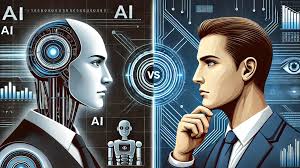
Artificial intelligence (AI) is no longer a concept confined to one of the sci-fi movies. All this is transforming the sector from finance, healthcare, education, and entertainment. With this rapid evolution and a pressing question is what there ahead that will echo across the industry. Everybody is worried - "Will AI replace human jobs?".
The answer to this question is not a straightforward yes or even a no. All this lies deep. Understanding of how AI works, what all jobs it will affect, and how humans can simply adapt to these changing dynamics. In this blog, we will particularly explore the main truth about AI and employment. This will strip away the hopes and also dive into facts, trends, fears, and the future.
All AI systems, particularly ones powered by machine learning, natural language processing, and deep learning, can perform tasks that just require human intelligence. You can analyse data, identify patterns, automate processes, and also analyse data by even hold conversations. Some of the examples of automation at work are as follows :
Financial analysts are being replaced by robo-advisors nowadays.
Customer service agents are being replaced by chatbots.
Self-checkout machines are just replacing cashiers.
All AI design tools are reducing the demand for junior graphic designers.
The other side: AI will create jobs
Here is a twist like AI will disrupt jobs, but it will also create many more jobs. According to WEF reports, about 97 million new roles will emerge by 2026, which are adapted to the division of labour between 3 humans, machines, and algorithms.
Prompt engineers
Machine learning engineers
Cybersecurity analysts
AI trainers
Data annotators
Human-AI collaborative designers
All the above jobs didn't even exist a few years ago, but the landscape has changed now. All these roles are quite the fittest ones in the job market now
Which jobs are most at risk?
But we can't deny the fact that some jobs are more vulnerable to AI automation compared to others. Routine, repetitive, and rule-based tasks are at major risk.
Data entry clerks
Bookkeepers
Factory lineworkers
Basic customer support agents
Skills required in an AI-driven world are :
If you are worried you will be replaced, then reskill and upskill is the only solution that lies ahead
Digital literacy
Adaptability & agility
Data analysis & AI basics
Communication & Emotional Intelligence
Creativity & innovation
Critical thinking & problem solving
Marketing professionals - AI-driven analytics is simply used instead of manually analysing data. This helps in creating personalized content strategies. The role is simply shifting from tactical to strategic.
Journalists - AI will help with writing basic reports, but investigative journalism, storytelling, and editorials require a human touch.
Generational impact - Who is most affected
Judgment of Gen AI replaces humans.Younger professionals as well. Some entry-level employees just face short-term disruption, particularly in roles that may be automated.
But they also have some flexibility to learn new technologies and also adapt early.
Mid-career professionals are required to reskill on a quicker basis to avoid the risk of being obsolete. Executive leaders must rethink all business models to stay competitive in this AI-powered economy.
We all know that AI is powerful, but at times, we forget that it is not perfect. These models are trained on historical data and often lack real-world context, ethical grounding, and emotional nuance.
Some of the cases in point are :
AI can help in legal research, but it can't argue in court with both morality and compassion.
AI can just generate job disruptions, but it won't understand team culture.
AI can just assist with medical scans, but difficult diagnoses with empathy can't be done by them.
Psychological impact on workers
Fear of losing a job can lead to anxiety, stress, and a resistance to change. It is quite important to shift the mindset from. Job security to skill security.
Some of the tips to cope :
Try to stay updated on trends in your field.
Strategic networking with tech-forward peers.
Take some online courses.
Focus on building some of the human-centric strengths.
In short, humans who work with AI will just replace those who do not work with it.
The role of government and companies in this
The government must invest in below :
Digital infrastructure
Reskilling programs
Some of the inclusive policies are to prevent large-scale displacement.
The organization must :
Support employee transitions uniquely.
Ensure ethical. A choice of AI.
Just foster a culture of lifelong learning.
So will this AI replace human jobs?
So let's be quite honest, AI will replace some jobs, but also do things like below.
Create new jobs
Transform some of the existing jobs
Open up some of the creative and strategic possibilities
Free humans from repetitive work.
The real question is not whether AI will replace humans, but it is about whether humans are ready to adapt as well as evolve with AI.
Future of work :
The future is neither going to be AI-dominated nor human-centric. It is a place where both coexist, co-create, and complement each other.
The most successful person is not one who fears AI but is the one who understands it, embraces it, and collaborates with it.
A simple example of AI disruption explained through code with output. This will show us how traditional human job is replaced by AI job disruption.
Program code :
import time
import random
# Simulating the time taken by human jobs
def simulate_human_effort(task):
print(f"Human is performing: {task}")
time.sleep(0.5)
return f"{task} completed by Human"
# Simulating fast AI performance
def simulate_ai_effort(task):
print(f"AI is performing: {task}")
time.sleep(0.1)
return f"{task} completed by AI"
# Human job system
class JobSystem:
def content_writer(self, topic):
result = []
result.append(simulate_human_effort("Researching on " + topic))
result.append(simulate_human_effort("Creating Outline"))
result.append(simulate_human_effort("Writing Article"))
result.append(simulate_human_effort("Proofreading"))
return result
def data_entry(self, file):
result = []
result.append(simulate_human_effort("Reading " + file))
result.append(simulate_human_effort("Typing data into spreadsheet"))
return result
def customer_support(self, query):
return simulate_human_effort("Responding to: " + query)
# AI model that disrupts jobs
class AIModel:
def content_writer(self, topic):
return [simulate_ai_effort(f"Auto-generating article on {topic}")]
def data_entry(self, file):
return [simulate_ai_effort(f"Auto-extracting data from {file}")]
def customer_support(self, query):
return simulate_ai_effort(f"Chatbot handling query: {query}")
# Main simulation
if __name__ == "__main__":
job = JobSystem()
ai = AIModel()
print("\n--- Human vs AI Job Execution ---\n")
# Human workflow
print("\n[Human Job Execution]")
human_result = job.content_writer("Climate Change") + \
job.data_entry("invoice.pdf") + \
[job.customer_support("How to reset my password?")]
# AI workflow
print("\n[AI Job Execution]")
ai_result = ai.content_writer("Climate Change") + \
ai.data_entry("invoice.pdf") + \
[ai.customer_support("How to reset my password?")]
print("\n--- Output Comparison ---\n")
print("Human Output:")
for r in human_result:
print("👩💼", r)
print("\nAI Output:")
For r in ai_result:
print("🤖", r)
Output :
--- Human vs AI Job Execution ---
[Human Job Execution]
Human is performing: Researching on Climate Change
Human is performing: Creating Outline
Human is performing: Writing an Article
Human is performing: Proofreading
Human is performing: Reading invoice.pdf
Human is performing: Typing data into a spreadsheet
Human is performing: Responding to: How to reset my password?
[AI Job Execution]
AI is performing: Auto-generating an article on Climate Change
AI is performing: Auto-extracting data from invoice.pdf
AI is performing: Chatbot handling query: How to reset my password?
--- Output Comparison ---
Human Output:
👩💼 Researching on Climate Change completed by a Human
👩💼 Creating Outline completed by Human
👩💼 Writing Article completed by Human
👩💼 Proofreading completed by a Human
👩💼 Reading invoice.pdf completed by Human
👩💼 Typing data into a spreadsheet completed by a Human
👩💼 Responding to: How to reset my password? Completed by Human
AI Output:
🤖 Auto-generating article on Climate Change completed by AI
🤖 Auto-extracting data from invoice.pdf completed by AI
🤖 Chatbot handling query: How to reset my password? Completed by AI
Conclusion :
AI is not here to replace humans entirely—it’s here to redefine how we work. As seen through the simulations and real-world trends, AI significantly speeds up repetitive tasks and automates predictable workflows, allowing humans to focus on creativity, empathy, strategy, and innovation. While it’s true that some roles will be displaced, many more will be transformed or newly created. The future belongs to those who adapt by learning digital skills, embracing change, and working alongside AI rather than against it. Governments, organizations, and individuals must all contribute to building a future where technology augments human potential. Job security is no longer about holding one position for life—it’s about building skills that evolve with the times. Ultimately, humans who understand and collaborate with AI will not only survive but thrive in the AI-powered future of work. The question isn't “Will AI replace you?”—it’s “Are you ready to evolve with AI?” Start embracing AI. You can also take AI career guidance and enroll in some training courses to understand industry demands and be job-ready, like Artificial Intelligence. Intelligence training and certification to excel