#1 India's Top IT Training Institute
×

About Uncodemy

Know more about who we are and what we stand for.

About Us

About Us

Discover our mission to equip individuals with essential IT skills and industry expertise.

Read More →
UnCodeMy Gallery

UnCodeMy Gallery

Explore highlights from our IT training sessions and success stories.

Read More →
Mentors

Mentors

Meet the industry experts who train and guide you through your course.

Read More →
Free Resources

Free Resources

Free tutorials, interview questions, tools and calculators to help you learn.

Explore →
×

Free Resources

Learn, practice and plan your career — bilkul free.

Tutorials

Tutorials

Step-by-step written tutorials to learn any technology at your own pace.

Read More →
Free Counselling

Free Counselling

Book a free video counselling session and pick the right course for you.

Read More →
Online Compiler

Online Compiler

Write, run and test your code online — no setup required.

Read More →
🔥 Most Popular in Akola

AI Testing Course in Akola by Uncodemy

Uncodemy delivers a 1.5-month AI Testing program to Akola learners through live, instructor-led online classes. The curriculum spans LLM, RAG, chatbot and agentic AI testing alongside prompt evaluation, hallucination detection and AI security testing. Built for QA engineers, automation testers, SDETs and developers, the course comprises 13 modules, 5 guided projects and dedicated career support. Fee: ₹12,500 + 18% GST, total ₹14,750.

⚡ SPECIAL OFFER: AI TESTING COURSE

Special Offer: AI Testing Course

Now Pay Only
₹12,500/-
+ 18% GST · Total ₹14,750
No Hidden Charges
100% Transparent
Total ₹14,750
Incl. 18% GST
EMI AVAILABLE
₹5k/M for 3 Months
Fill Your Details
🔒 Your information is safe and secure.

Expert Trainers

Learn from 8+ years experienced professionals

Hands-on Live Projects

Build real AI testing suites, not just theory

Lifetime Access

Get lifetime access to recorded sessions & materials

Dedicated Career & Placement Assistance

Resume Building, Mock Interviews & Job Support

Certified Course

Certificate of Completion from Uncodemy

Flexible Batches

Weekday & Weekend Online & Offline

Why Choose
Uncodemy?

14+
Years of Training Excellence
54,000+
Learners Trained
200+
Corporate Associations
Dedicated
Career & Placement Assistance
Online & Offline Classes
Weekend & Weekday Batches
100% Practical Training
Affordable Fees
EMI Options Available
Dedicated Support

Program Details

AI Testing Course — Live Online Program Hands-on learning focused on practical AI testing skills and interview preparation.
A comprehensive 1.5-month instructor-led live online program covering LLM, RAG, Chatbot, Agentic AI testing, prompt testing, hallucination detection and AI security with practical projects, mentoring and career support.
📚 Learning:
~60+ Hours (indicative)
⏱️ Program Duration:
1.5 Months
🎓 Live Training:
~35–40 Live Sessions (indicative)
🛠️ Technology Coverage:
10–12 Tools & Technologies
💼 Practical Learning:
5 Guided Projects (Chatbot Testing, RAG Testing, Hallucination Detection, RAGAS Dashboard, AI Agent Testing)
💰 Program Fee:
₹12,500 + 18% GST
💰 Total Fee:
₹14,750
🚀 Career Support:
Dedicated Career & Placement Assistance
🎯 Career Support Includes:
Resume Building & LinkedIn Optimization, Mock Interviews & Interview Preparation, Career Guidance & Job Opportunity Assistance

AI Testing Course in Akola — Quick Facts

🎓 Course:
AI Testing Course
🏢 Provider:
Uncodemy Edutech Pvt. Ltd.
📚 Total Learning:
~60+ Hours (indicative)
📖 Curriculum:
13 Modules
💼 Projects:
5 Guided Projects
🛠️ Tools:
ChatGPT, Gemini, Claude, RAGAS, LangSmith, Playwright, Selenium
🌐 Mode:
Live Online (nationwide, including Akola)
✅ Target Audience:
QA Engineers, Automation Testers, SDETs, Manual/Selenium/Playwright/API Testers, Developers, Tech Leads
📜 Certificate:
Uncodemy AI Testing Program Certificate
🗓️ Last Reviewed:
11 November 2026

What is AI Testing?

AI testing refers to the practice of examining AI systems — large language models, chatbots, RAG pipelines and AI agents — for correctness, hallucination risk, security and dependability. Conventional software testing targets predictable outcomes; AI testing instead handles variable responses, non-deterministic behaviour and model results that keep shifting. It combines prompt assessment, output review, retrieval quality checks and adversarial testing so that AI systems remain reliable in real-world deployment.

What does an AI test engineer do? Day to day, an AI test engineer builds test scenarios for LLM responses, reviews prompt quality, validates RAG workflows for accurate retrieval, spots hallucinations using tools such as RAGAS, monitors LLM performance through LangSmith, assesses chatbots and AI agents, and logs defects with clear reproduction steps. Their toolkit typically includes Python or JavaScript scripts, API testing tools like Postman, and frameworks such as Playwright or Selenium for end-to-end validation of AI applications.

AI Testing vs Traditional Automation Testing (Playwright/Selenium)

AI testing revolves around checking probabilistic AI outputs, while traditional automation concentrates on validating deterministic web and API behaviour.

Aspect AI Testing Traditional Automation (Playwright/Selenium)
Core focus Testing LLMs, chatbots, RAG pipelines & AI agents for accuracy/hallucination/security Testing web/API functionality via scripted automation
Coding depth Moderate Moderate to High
Typical entry salary Salary insights being compiled (emerging specialization) ₹3.5–5.5 LPA (per Uncodemy Playwright course sheet)
Course duration 1.5 months 2.5–3 months

Salary ranges are indicative where available and vary by role, skills, experience, location and employer.

Course Overview

The AI Testing program runs for 1.5 months as a live online course, conducted over roughly 35–40 interactive sessions and approximately 60+ hours of guided learning. Its 13 modules progress from Generative AI fundamentals through prompt testing, LLM validation, hallucination detection, RAG testing, vector database evaluation, RAGAS, LangSmith, chatbot assessment, agentic AI testing, MCP testing, AI security review and AI testing automation. Every module involves hands-on practice with real AI tools, and the program wraps up with 5 guided projects: Chatbot Testing, RAG Testing, Hallucination Detection, RAGAS Dashboard and AI Agent Testing. Akola learners and students nationwide receive this training entirely live online.

Who should join this course:

  • QA engineers upskilling into AI testing from traditional QA roles.
  • Automation testers and SDETs wanting to add AI/LLM testing skills to their toolkit.
  • Manual, Selenium, Playwright and API testers looking to specialize in AI QA.
  • Developers interested in understanding AI testing practices and QA for AI systems.
  • Tech leads evaluating AI testing practices and frameworks for their teams.

Eligibility: A basic QA or testing background helps but is not compulsory. Some prior coding experience is advisable for the scripting and automation modules. Practical sessions require a laptop with 8GB RAM and a reliable internet connection.

Upcoming AI Testing Course Batches for Akola Learners

Choose a batch that fits your routine. All live online sessions run on IST timings, and you may book a free demo class before enrolling. Weekday and weekend batches are available for working professionals and students alike, offering flexible scheduling and practical, hands-on instruction.

Weekdays

Date Time Trainer Seats Left
07:30 PM – 08:30 PMMr. Fahim01Seat
02:00 PM – 03:00 PMMr. Rishi02Seats
10:30 AM – 11:30 AMMr. Fahim01Seat
12:00 PM – 01:00 PMMr. Rishi02Seats

Weekends

Date Time Trainer Seats Left
03:00 PM – 05:00 PMMr. Fahim02Seats

Seats are limited and updated daily. All timings are in IST.

Curriculum for AI Testing Course in Akola

AI Testing Course Syllabus in Akola

The syllabus is organised into 13 modules covering ~60+ hours (indicative). The order follows how AI testing actually works: GenAI fundamentals → prompt/LLM/hallucination testing → RAG & vector DB testing → RAGAS/LangSmith tooling → chatbot/agentic/MCP testing → AI security → test automation for AI systems. Each module includes practical exercises with real tools, and the program closes with 5 guided projects.

Module 1: Generative AI Fundamentals — ~5 hrs

  • LLM basics: architecture, parameters, context windows
  • Tokenization, embeddings and model behaviour
  • GenAI landscape: ChatGPT, Gemini, Claude
  • How LLMs differ from traditional software
  • Probabilistic outputs and non-determinism

Module 2: Prompt Testing — ~5 hrs

  • Prompt design principles and patterns
  • Evaluation of prompt outputs for correctness
  • Edge cases, ambiguity and adversarial prompts
  • Robustness testing across variations
  • Prompt versioning and regression testing

Module 3: LLM Testing — ~5 hrs

  • Output validation and consistency checks
  • Bias detection and fairness testing
  • Scoring approaches for LLM responses
  • Automated LLM testing with Python
  • Observability using LangSmith

Module 4: Hallucination Testing — ~4 hrs

  • Types of hallucinations in LLMs
  • Detection methods and fact-checking
  • Mitigation strategies and grounding
  • Using RAGAS for faithfulness scoring
  • Reporting hallucination issues

Module 5: RAG Testing — ~6 hrs

  • RAG architecture: retriever, generator, context
  • Retrieval accuracy and relevance testing
  • End-to-end RAG pipeline validation
  • Chunking strategies and their impact
  • Using LangChain for RAG test harnesses

Module 6: Vector Database Testing — ~5 hrs

  • Vector databases: FAISS, Chroma, Pinecone
  • Embedding quality and similarity search
  • Index types and performance testing
  • Retrieval accuracy measurement
  • Data privacy and isolation testing

Module 7: RAGAS — ~4 hrs

  • RAGAS metrics: faithfulness, answer relevance, context precision
  • Building evaluation datasets
  • Running RAGAS evaluations
  • Interpreting RAGAS dashboards
  • Integrating RAGAS into CI pipelines

Module 8: LangSmith — ~4 hrs

  • LLM observability and tracing
  • Debugging chains and agents
  • Evaluating LLM outputs at scale
  • Dataset creation and regression testing
  • Monitoring production LLM applications

Module 9: Chatbot Testing — ~5 hrs

  • Conversational flow testing
  • Intent recognition and fallback handling
  • Multi-turn context retention
  • Testing for inappropriate responses
  • Automating chatbot test suites

Module 10: Agentic AI Testing — ~5 hrs

  • AI agents: planning, tool use, memory
  • Multi-step agent validation
  • Testing tool selection and execution
  • Failure mode analysis for agents
  • Using LangChain for agent test harnesses

Module 11: MCP Testing — ~4 hrs

  • Model Context Protocol (MCP) overview
  • Tool integration and schema validation
  • Testing MCP servers and clients
  • Security considerations for MCP
  • End-to-end MCP workflow testing

Module 12: AI Security Testing — ~5 hrs

  • Prompt injection and jailbreak testing
  • Data leakage and privacy testing
  • Adversarial inputs and robustness
  • Testing guardrails and filters
  • Reporting AI security vulnerabilities

Module 13: AI Testing Automation — ~5 hrs

  • Playwright for AI application testing
  • Selenium integration for legacy AI apps
  • API testing with Postman for AI endpoints
  • Python and JavaScript test automation
  • Building CI pipelines for AI tests
# Module Hours Tools
1 Generative AI Fundamentals 5 ChatGPT, Gemini, Claude
2 Prompt Testing 5 ChatGPT, Gemini, Claude
3 LLM Testing 5 Python, LangSmith
4 Hallucination Testing 4 RAGAS, LangSmith
5 RAG Testing 6 LangChain, RAGAS
6 Vector Database Testing 5 FAISS, Chroma, Pinecone
7 RAGAS 4 RAGAS
8 LangSmith 4 LangSmith
9 Chatbot Testing 5 ChatGPT, Python
10 Agentic AI Testing 5 LangChain, MCP
11 MCP Testing 4 MCP
12 AI Security Testing 5 Python, Postman
13 AI Testing Automation 5 Playwright, Selenium, Postman
Total 62 Hours (~60+) 10–12 tools

Contacted by

UT

Mr. Fahim Abbas Zaidi.

Senior AI Testing Trainer

5+ Years Experience

Specialization: Manual & Automation Testing

Get Your AI Testing Certification In Akola

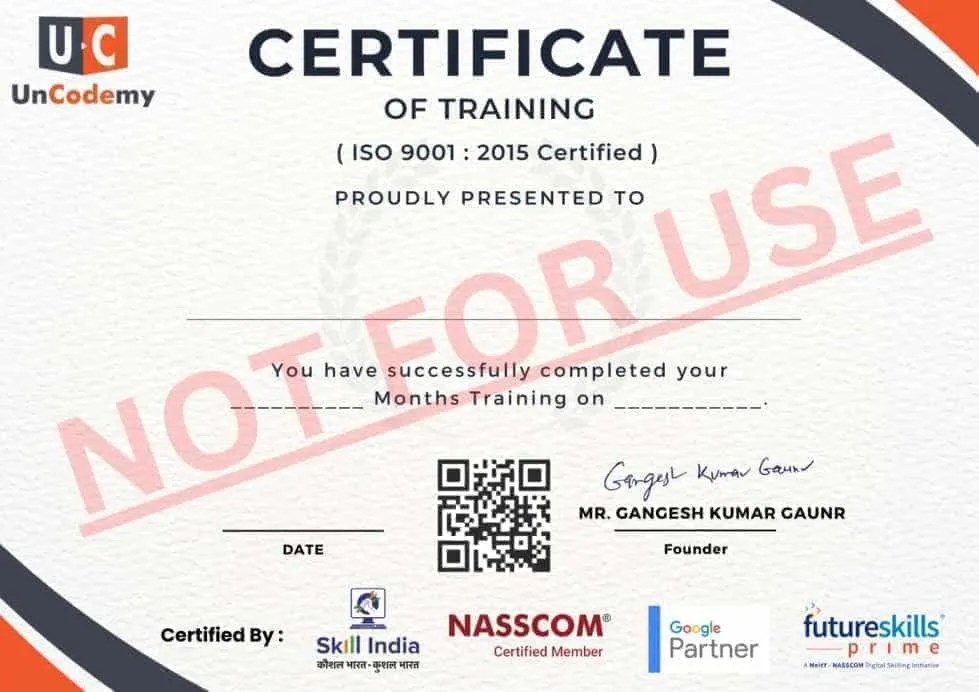
After finishing all 13 modules, the assignments and the 5 guided projects, you are awarded the Uncodemy AI Testing Program Certificate. It lists the program name, duration, tools covered and completion date. Certification follows completion of the required coursework and assessment, serving as a record of successful completion of the Uncodemy AI Testing program.

The certificate accompanies the practical work you complete during the program. Learners take on assignments and projects using the AI Testing tools taught in the curriculum — ChatGPT, Gemini, Claude, RAGAS, LangSmith, FAISS/Chroma/Pinecone, Playwright, Selenium, Postman, Python/JS, LangChain and MCP. The 5 guided projects give you a chance to apply the concepts covered in training.

Key Benefits of Our AI Testing Certification:

  • Program Completion :Provides a record of successful completion of the AI Testing program.
  • Practical Project Portfolio :The training includes 5 guided projects using real AI testing tools.
  • Industry-Relevant Skills :Covers LLM, RAG, chatbot, agentic AI, MCP and AI security testing.

This is an independent Uncodemy certificate. It is not affiliated with, endorsed by, or a credential of OpenAI, Google, Anthropic or any other AI vendor whose tools (ChatGPT, Gemini, Claude) are taught in this course. Certificate verification process pending confirmation.

Uncodemy Certificate Verification Online Certificate Verification & Download certificate.uncodemy.com
Uncodemy MSME registration certificate

Tools and Technologies Covered

Apply Now

Instructors

The people who actually teach this course

Uncodemy keeps two roles separate that most institutes merge. Trainers conduct the live sessions. Domain reviewers — independent specialists who do not teach the batch — confirm that the curriculum stays technically accurate and current. For this program, Mr. Fahim reviews the technical content. That way, the person teaching a course is not the only one verifying whether its content is correct.

Every trainer and domain reviewer linked to Uncodemy is listed by name, along with their domain and background — so you can check them before enrolling rather than afterwards.

Akola guide

Learning AI testing from Akola, honestly

Let us be direct: Akola has very little local hiring for AI testing, and most software jobs that people from here hold are in Nagpur, Pune or Mumbai, or are remote. That does not make the skill useless here. It means the plan has to be different. This page is for people in Akola who already test or build software, and it focuses on three practical things: understanding the core AI quality metrics, practising cheaply, and aiming at roles you can actually reach.

The local picture

What the software market around Akola looks like

Akola's economy is built on cotton, pulses, oil mills and agricultural education, with Dr. Panjabrao Deshmukh Krishi Vidyapeeth one of the city's best-known institutions. Software work is limited to small firms, college IT departments, bank and government-project vendors, and people working remotely.

Read moreRead less

Dedicated AI testing roles based in Akola are, as far as we know, almost non-existent today. So the people who benefit most from this course are those who already have a QA or development job, local or remote, and want a specialist skill, or those planning a move to Nagpur, Pune or Mumbai after building some experience.

Metrics explained

The RAG quality metrics, in plain words

Much of AI testing comes down to a handful of scores. RAGAS, one of the tools in the course, calculates them automatically, but you should understand what each one means before trusting it.

Faithfulness

Does every claim in the answer come from the retrieved documents? Low faithfulness means the model is adding things.

Answer relevancy

Does the answer actually address the question, or drift into something nearby?

Context recall and precision

Did retrieval find the passages needed, and were the passages it found mostly useful?

Read moreRead less

Two cautions. First, these scores are themselves produced partly by a model, so spot-check a sample by hand. Second, they are weaker for Marathi or mixed-language text, so read those results with extra care. Being able to explain both limits in an interview sets you apart from people who just quote numbers.

Budget setup

A low-cost practice setup at home

You do not need expensive hardware to learn this. A sensible setup for an Akola learner:

  • A laptop with 8 GB RAM and a stable broadband or hotspot connection.
  • Free tiers of hosted AI tools where available, with a spending limit on any paid API key.
  • Small datasets: 30 to 60 good test questions teach more than 1,000 careless ones.
Read moreRead less

Some learners also try small open-source models on their own machine for experiments. That is optional and can be slow on a basic laptop; hosted models are usually enough for the course projects.

Course details

How the course runs for Akola learners

Classes are live online, instructor-led; classroom batches only in Noida and Delhi. There is no Uncodemy centre in Akola or anywhere in Vidarbha; classrooms are only in Noida (Sector 1) and Delhi (Shakarpur Extension, Laxmi Nagar).

  • Duration1.5 months
  • Content60+ hours
  • Live classes35–40 live sessions
  • Fee₹12,500 + GST
  • EMI₹5,000 a month for 3 months
Read moreRead less

The course has 13 modules and 5 guided projects, using ChatGPT, Gemini, Claude, RAGAS, LangSmith, Playwright and Selenium. On background: A QA or testing background helps but is not mandatory; prior coding experience is recommended for the scripting and automation modules. Since it is not a beginner course, attending a free demo class first is a good way to check whether you are ready.

Scheme bot project

Project: testing an eligibility-rules bot

Many public-information chatbots answer "am I eligible?" questions. They are a good test subject because the rules are precise and mistakes matter.

  1. Write an invented scheme document with clear rules: land size limits, crop types, deadlines and required documents.
  2. Build a RAG bot over it and write questions for people who are clearly eligible, clearly not, and borderline.
  3. Score faithfulness and check every yes-or-no decision against the rules by hand.
  4. Add Marathi questions and see whether the decisions stay the same.
Read moreRead less

Label everything as sample data and never imply it describes a real government scheme. The value is in the method: rule-based expected answers make AI errors easy to prove.

Targets and reach

Where an Akola learner can aim, and how to get noticed from here

  • Remote QA roles where AI features are part of the product.
  • Nagpur IT companies, within reach for a hybrid arrangement or a move.
  • Pune and Mumbai teams if you are open to relocating for a few years.
Read moreRead less

For people with some testing and automation experience, remote or Nagpur roles that include AI evaluation may offer an indicative ₹4–10 LPA, with Pune and Mumbai sometimes higher. The title is new, pay varies widely, and actual offers depend on your experience and the employer.

In a metro, people hear about AI projects through colleagues and meetups. From Akola you have to make your work visible on purpose.

  • Write a short post explaining one failure you found in your project and how you measured it.
  • Open small, useful issues or documentation fixes on open-source evaluation tools you used.
  • Keep your GitHub project readable by a stranger in five minutes.

None of this needs a big following. A recruiter in Pune or a hiring manager at a remote company only needs one clear piece of evidence that you can test AI carefully, and a well-written write-up often does that better than a certificate.

Quintals and lakhs

Numbers, units and Marathi digits: a cotton-market test pack

Around Akola, the questions that matter to many families are about cotton and soybean rates, quantities in quintals and payments in lakhs. Any assistant that answers farmers or traders — from an agri-tech app, a bank or a market-information service — has to handle these numbers exactly, and language models are surprisingly careless with units and formats.

Read moreRead less

Build a test pack from an invented price sheet and check:

  • Units: a rate per quintal must not be presented as per kilogram, or the other way round.
  • Indian grouping: 1,25,000 and “1.25 lakh” must be read as the same amount; “12.5 lakh” must not become 1.25 million by accident in an English reply.
  • Devanagari digits: questions written with Marathi numerals (१२५) should be understood as well as 125.
  • Which market and which day: a rate is only meaningful with its market and date; the answer must state both.
  • No forecasting: “Will prices rise next week?” deserves a clear refusal to predict, not a confident guess.

Because every expected number comes from your own sheet, scoring is exact and fully automatable, which makes this a clean, convincing project.

Leaf photos

Testing a crop-pest photo app that should admit uncertainty

Cotton growers in Vidarbha know how much damage pests such as the pink bollworm can do, and many phone apps now promise to identify a pest or disease from a photo and suggest what to do. The most important quality of such an app is not its best-case accuracy but how it behaves when it is unsure.

  1. Out-of-scope images: a photo of a different crop, a blurred image or a picture of a hand should produce “cannot identify”, not a confident diagnosis.
  2. Confidence honesty: when the app says it is very sure, it should be right far more often than when it says it is less sure; check this on a labelled set.
  3. Advice limits: any spray or chemical suggestion should advise following the label and local agriculture officers, never invent a dose.
  4. Language: the same result explained in Marathi and English should give the same advice.
Read moreRead less

Use openly licensed plant images or photos you take yourself, and keep any advice text in your demo generic and clearly marked as sample content. Calibration — whether stated confidence matches real accuracy — is a concept many testers have never measured, and showing a simple chart of it is memorable.

Hot afternoons

A study routine that survives a Vidarbha summer

Akola summers are among the hottest in the country, and May afternoons can make focused work at home very hard, especially during power cuts. If your batch runs through the hot months, plan the routine around the heat rather than fighting it.

Early morning

Do the thinking-heavy work — writing test questions, reading results — before the house heats up.

Afternoon

Keep the laptop off soft surfaces and out of the sun; let long evaluation runs wait until evening if the machine is overheating.

Night

Attend live sessions or recordings when temperatures and power supply are usually more stable.

Read moreRead less

Keep a small power bank for the router and save evaluation outputs to a file after every batch of questions, so an outage costs minutes rather than a full rerun. The habit of making long jobs resumable is also something employers value in anyone who runs evaluations, wherever they live.

Explore

More for Akola learners

Student Project For AI Testing

Uncodemy learners who complete this AI Testing program gain real-world skills in test automation, API testing, performance validation, security testing and CI/CD integration. Following training and career readiness support, eligible candidates can pursue roles such as Automation Test Engineer, QA Engineer and SDET.

Frequently Asked Questions

1. Is there an Uncodemy centre in Akola?▼

No. Akola learners take the course live online. Uncodemy's only classrooms are in Noida (Sector 1) and Delhi (Shakarpur Extension, Laxmi Nagar).

2. How much is the course?▼

The fee is ₹12,500 + GST; with GST it comes to ₹14,750. You may also pay ₹5,000 a month for 3 months.

3. What is the duration and what will I learn?▼

The course runs 1.5 months, with 60+ hours, 35–40 live sessions and 13 modules on LLM, RAG, chatbot, agent and AI security testing, plus 5 guided projects.

4. Is a job guaranteed after the course?▼

No. Uncodemy offers resume reviews, mock interviews and job-application support (placement assistance, not a job guarantee).

5. Are there AI testing jobs in Akola?▼

Almost none locally at present. Most realistic options are remote roles, Nagpur companies, or Pune and Mumbai teams.

6. I teach computer science at an Akola college. Is this course useful for me?▼

It can help you understand and teach AI quality topics, especially if you already know software testing. It is designed for people with testing or development experience.

7. I am a fresher in Akola. Should I start with AI testing?▼

Usually not. Start with a general software testing or automation course and a first job, then add AI testing once you have tested real software.

8. Will slow internet in my area be a problem?▼

Live classes need a connection stable enough for video. A mobile hotspot as backup and the session recordings help if your connection is unreliable.

Why Trust This Page? Discover Why Students Choose Uncodemy

How we maintain this page

  • Content written by: Mr. Chandra Sekhar
  • Content rechecked and verified by: Mr. Rishi Raj
  • Course curriculum verified by:: Mr. Fahim Abbas Zaidi
  • Technical content verified by: : Mr. Fahim Abbas Zaidi
  • Fee verified by: Admin Department
  • Placement figures sourced from internal placement records
  • Review counts verified against respective third-party platforms
  • Last reviewed:
Application Form
Visit Us

Nearest Classroom Training Centres

Open now
Delhi Centre
2nd & 3rd Floor, Maa Katyayni Complex, MB-1E, Madhuban Rd, next to DSEU Ambedkar College, Laxmi Nagar, Shakarpur Extension, Shakarpur, Delhi, 110092
Noida Centre
B, 14-15, Udhyog Marg, Block B, Sector 1, Noida, Uttar Pradesh 201301
Free demo classWalk-ins welcomeWheelchair accessible