#1 India's Top IT Training Institute
×

About Uncodemy

Know more about who we are and what we stand for.

About Us

About Us

Discover our mission to equip individuals with essential IT skills and industry expertise.

Read More →
UnCodeMy Gallery

UnCodeMy Gallery

Explore highlights from our IT training sessions and success stories.

Read More →
Mentors

Mentors

Meet the industry experts who train and guide you through your course.

Read More →
Free Resources

Free Resources

Free tutorials, interview questions, tools and calculators to help you learn.

Explore →
×

Free Resources

Learn, practice and plan your career — bilkul free.

Tutorials

Tutorials

Step-by-step written tutorials to learn any technology at your own pace.

Read More →
Free Counselling

Free Counselling

Book a free video counselling session and pick the right course for you.

Read More →
Online Compiler

Online Compiler

Write, run and test your code online — no setup required.

Read More →
🔥 Most Popular in Bengaluru

Artificial Intelligence Training Course in Bengaluru by Uncodemy

For learners based in Bengaluru, Uncodemy offers a 5–6 month Artificial Intelligence course conducted live and instructor-led in an online format. Participants are trained in Python, Machine Learning, Deep Learning, NLP, Computer Vision, along with the core principles of Generative AI & LLMs. Since Uncodemy has no physical centre in Bengaluru, the entire course is taught live online, though classroom sessions are provided at their Delhi and Noida facilities for learners willing to travel. The course fee is ₹24,500 + 18% GST, totalling ₹28,910, with EMI options beginning at ₹4,818/month for 6 months*.

⚡SPECIAL LIMITED TIME OFFER

Special Offer: Artificial Intelligence Program

Now Pay Only
₹24,500/-
+ 18% GST
No Hidden Charges
100% Transparent
Total ₹28,910
Incl. 18% GST
EMI AVAILABLE
Starting ₹4,818/M*
Fill Your Details
🔒 Your information is safe and secure.

Expert Trainers

Learn from 8+ years experienced professionals

Hands-on Automation Projects

Build real artificial intelligence test suites, not just theory

Lifetime Access

Get lifetime access to recorded sessions & materials

Dedicated Career & Placement Assistance

Resume Building, Mock Interviews & Job Support

Certified Course

Certificate of Completion from Uncodemy

Flexible Batches

Weekday & Weekend Online & Offline

Why Choose
Uncodemy?

14+
Years of Training Excellence
54,000+
Learners Trained
200+
Corporate Associations
Dedicated
Career & Placement Assistance
Live Online Classes
Weekend & Weekday Batches
100% Practical Training
Transparent Fees
EMI Options Available
Dedicated Support

Program Details

Artificial Intelligence Course — Live Online Program Hands-on learning focused on practical AI skills and interview preparation.
This 5–6 month instructor-led live online program delivers comprehensive training in Python, Machine Learning, Deep Learning, NLP, Computer Vision, and Generative AI & LLM fundamentals, complete with practical projects, mentoring, and career support.
📚 Learning:
183+ Hours of Learning
⏱️ Program Duration:
5–6 Months
🎓 Live Training:
110+ Live Sessions
🛠️ Technology Coverage:
15+ Tools & Technologies
💼 Practical Learning:
Hands-on AI Projects, Case Studies & Capstone Projects
💰 Program Fee:
₹24,500 + 18% GST
💰 Total Fee:
₹28,910
💳 EMI:
Starting From ₹4,818/Month for 6 Months*
🚀 Career Support:
Dedicated Career & Placement Assistance
🎯 Career Support Includes:
Resume Building & LinkedIn Optimization, Mock Interviews & Interview Preparation, Career Guidance & Job Opportunity Assistance

Artificial Intelligence Course in Bengaluru — Quick Facts

🎓 Course:
Artificial Intelligence
🏢 Provider:
Uncodemy Edutech Pvt. Ltd.
📚 Total Learning:
183+ Hours of Learning
📖 Curriculum:
13 Modules
💼 Projects:
Hands-on AI Projects, Case Studies + Industry Capstone
🛠️ Tools:
Python, NumPy, Pandas, Scikit-learn, Matplotlib, Seaborn, TensorFlow, Keras, PyTorch, OpenCV, Hugging Face, OpenAI APIs, Jupyter Notebook, Git/GitHub, FastAPI
🌐 Mode:
Live Online (Bengaluru-wide); classroom available only at Uncodemy's Delhi & Noida centres
✅ Prior Coding:
"Not Required"
📜 Certificate:
Uncodemy Artificial Intelligence Program Certificate.
🗓️ Last Reviewed:
11 November 2026

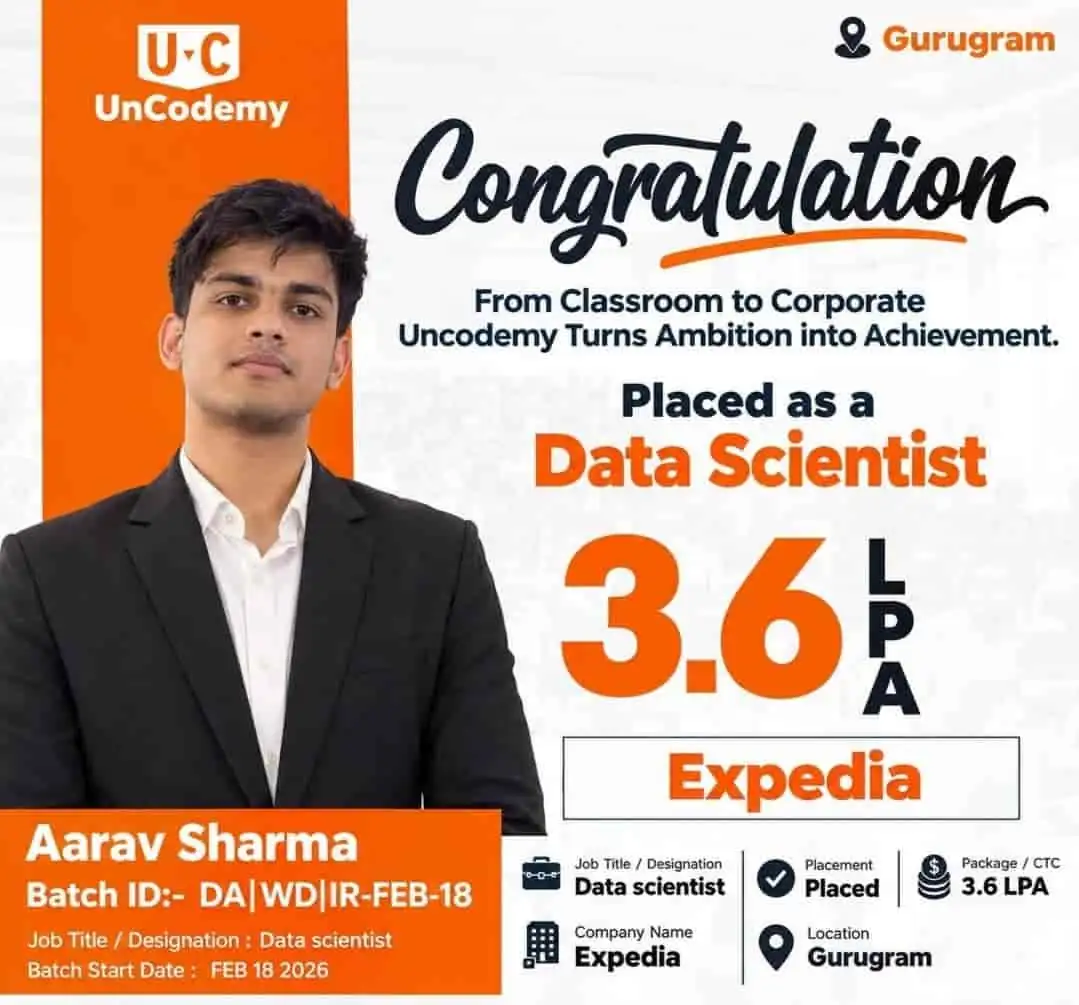
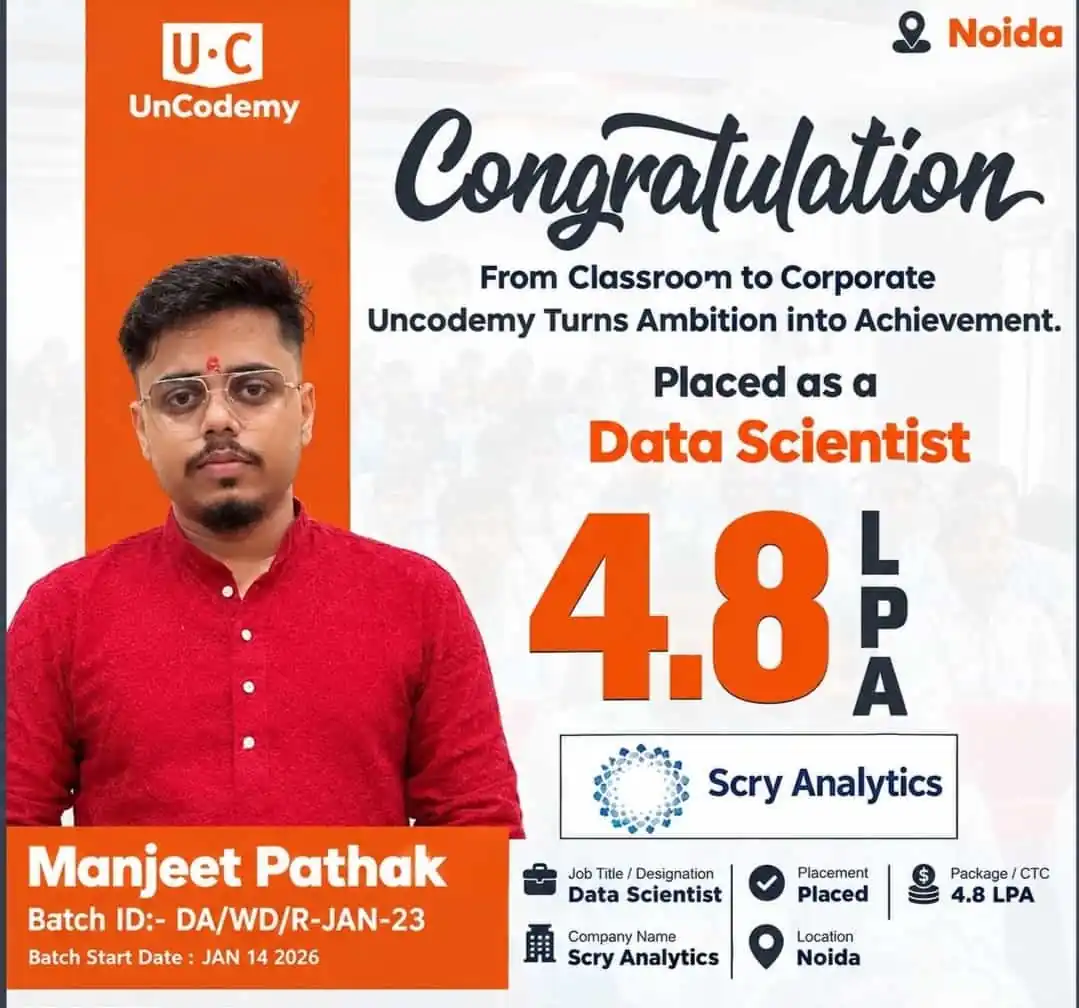
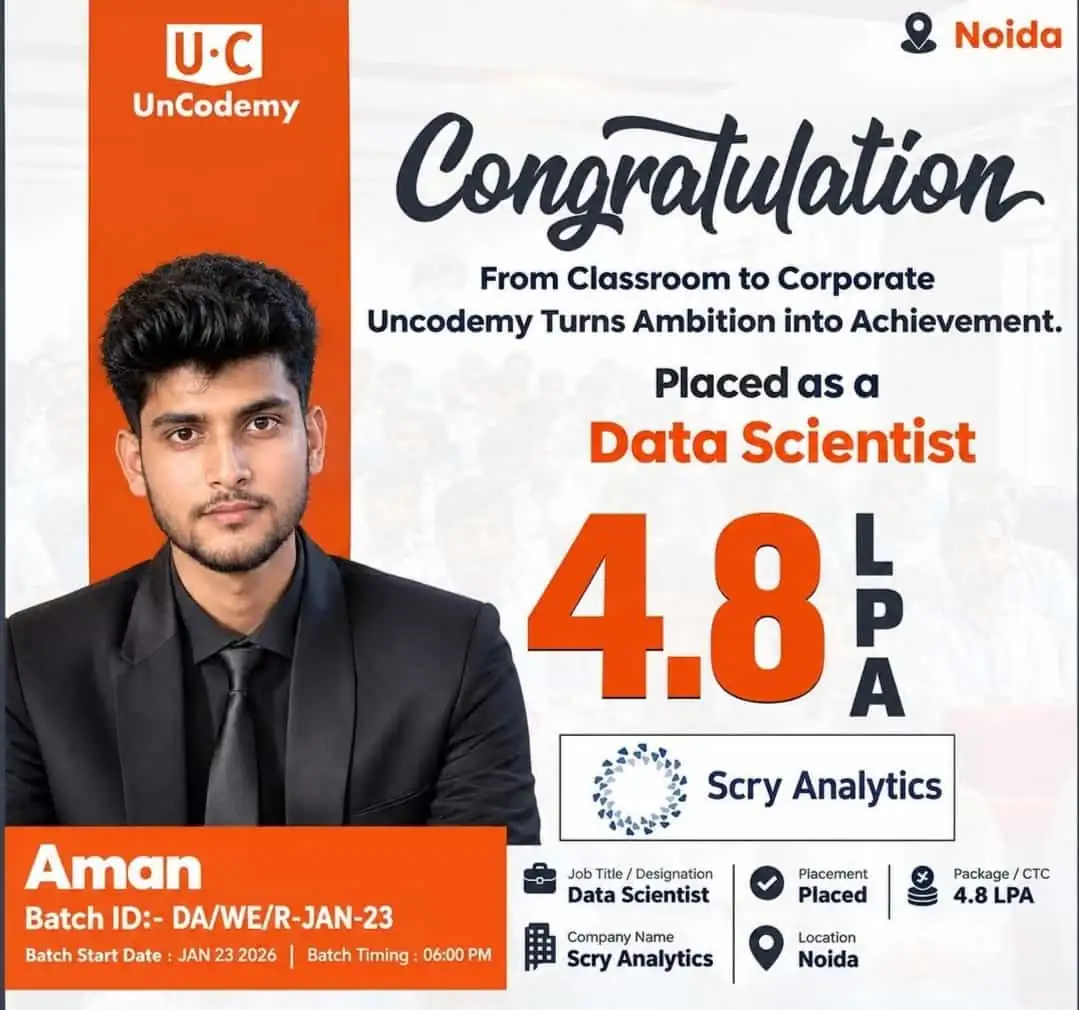
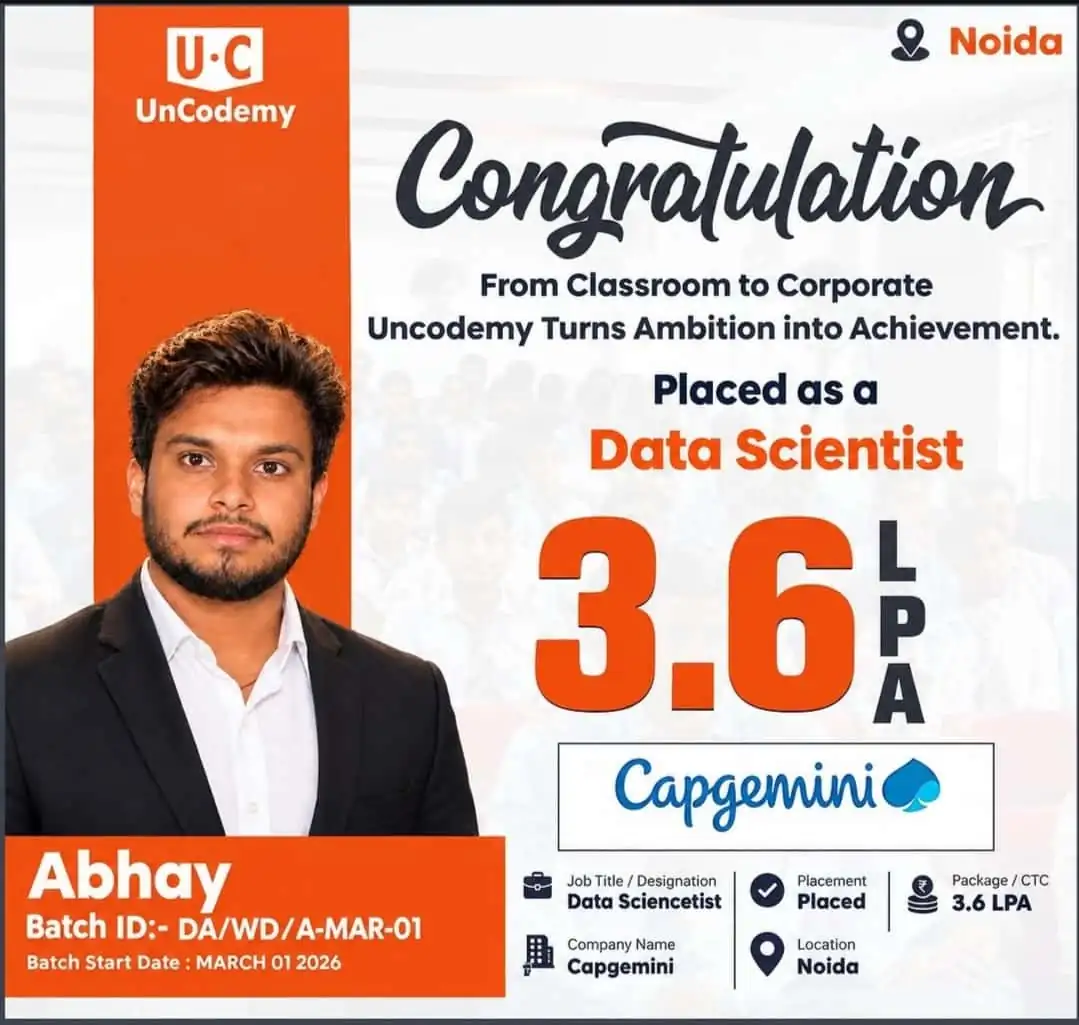
List of Placed Students Trained by Uncodemy

Individuals who finish the Uncodemy Data Science course develop practical proficiency in Python, SQL, Machine Learning, Statistics, Data Visualization (Power BI/Tableau), and Agile; after completing both the training and career-preparation modules, qualified candidates can pursue positions such as Data Analyst, Data Scientist, and Business Intelligence Analyst.

Rahul Gupta
4.5 LPA
India

Rahul Gupta

Data Scientist

Placed at:Makeo

Data Science Batch
Batch: DS/DA Weekend July Batch 10 AM
Read placement record
Aarav
5.5 LPA
India

Aarav

Data Scientist

Placed at:HSBC

Data Science Batch
Batch: DS/12/0823/IR WE 12 PM
Read placement record
Manjeet Pathak
6.5 LPA
India

Manjeet Pathak

Data Scientist

Placed at:Fiserv

Data Science Batch
Batch: DS/DA Weekend July Batch 10 AM
Read placement record
Aman
6.8 LPA
India

Aman

Data Scientist

Placed at:Fis

Data Science Batch
Batch: DS/WD/S 08:00 PM 08 JAN-UC
Read placement record
Shahid
4.8 LPA
India

Shahid

Data Scientist

Placed at:Access Meditech

Data Science Batch
Batch: DS/DA Weekend July Batch 10 AM
Read placement record
Sagar Thakur
6.0 LPA
Noida

Sagar Thakur

Data Scientist

Placed at:Genpact

Data Science Batch
Batch: DS/09/UP WD 12:30 PM
Read placement record
Abhay
5.5 LPA
Pune

Abhay

Data Scientist

Placed at:Capgemini

Data Science Batch
Batch: DS/09/0823/S WD 7PM
Read placement record
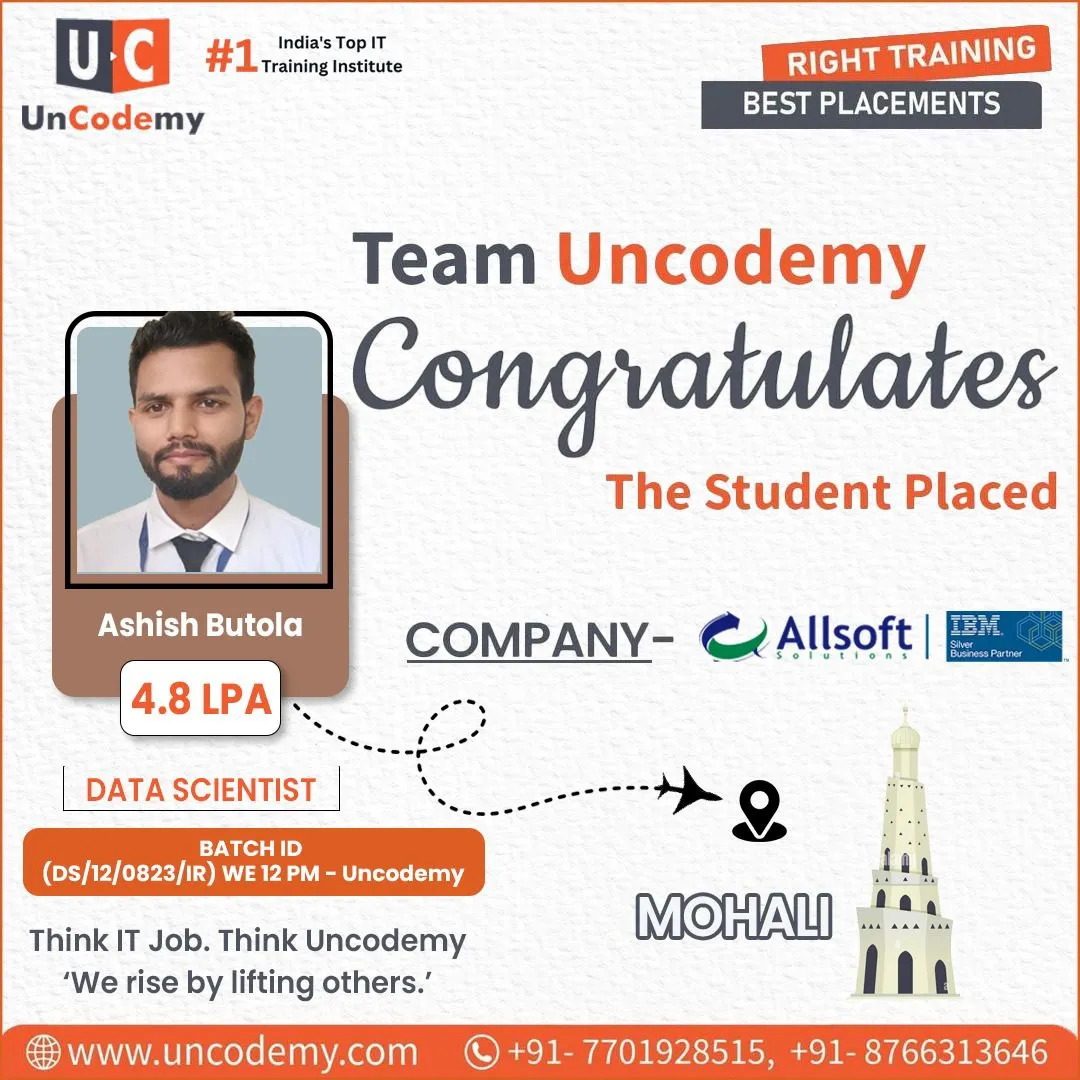
Abhay
4.8 LPA
India

Ashish Butola

Data Scientist

Placed at:Allsoft Solutions

Data Science Batch
Batch: (DS/12/0823/IR) WE 12 PM
Read placement record
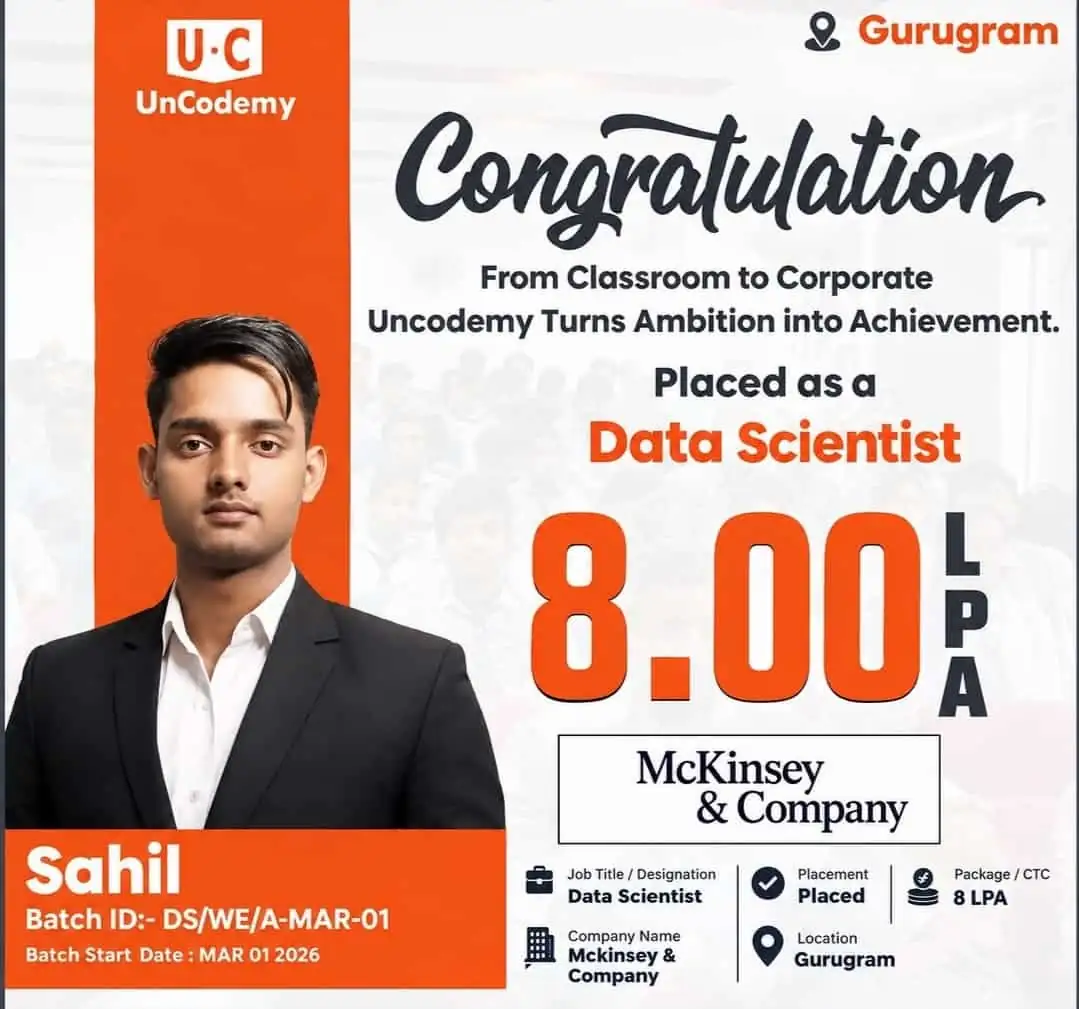
Sahil
3.8 LPA
Mohali

Sahil

Data Scientist

Placed at:Vitraya Technologies

Data Science Batch
Batch: DS/12/0823/IR WE 12 PM
Read placement record
Amit Gupta
4.0 LPA
Bangalore

Amit Gupta

LLM Engineering

Placed at:PwC

Artificial Intelligence Batch
Batch: DA|WD|R-MAR-08
Read placement record
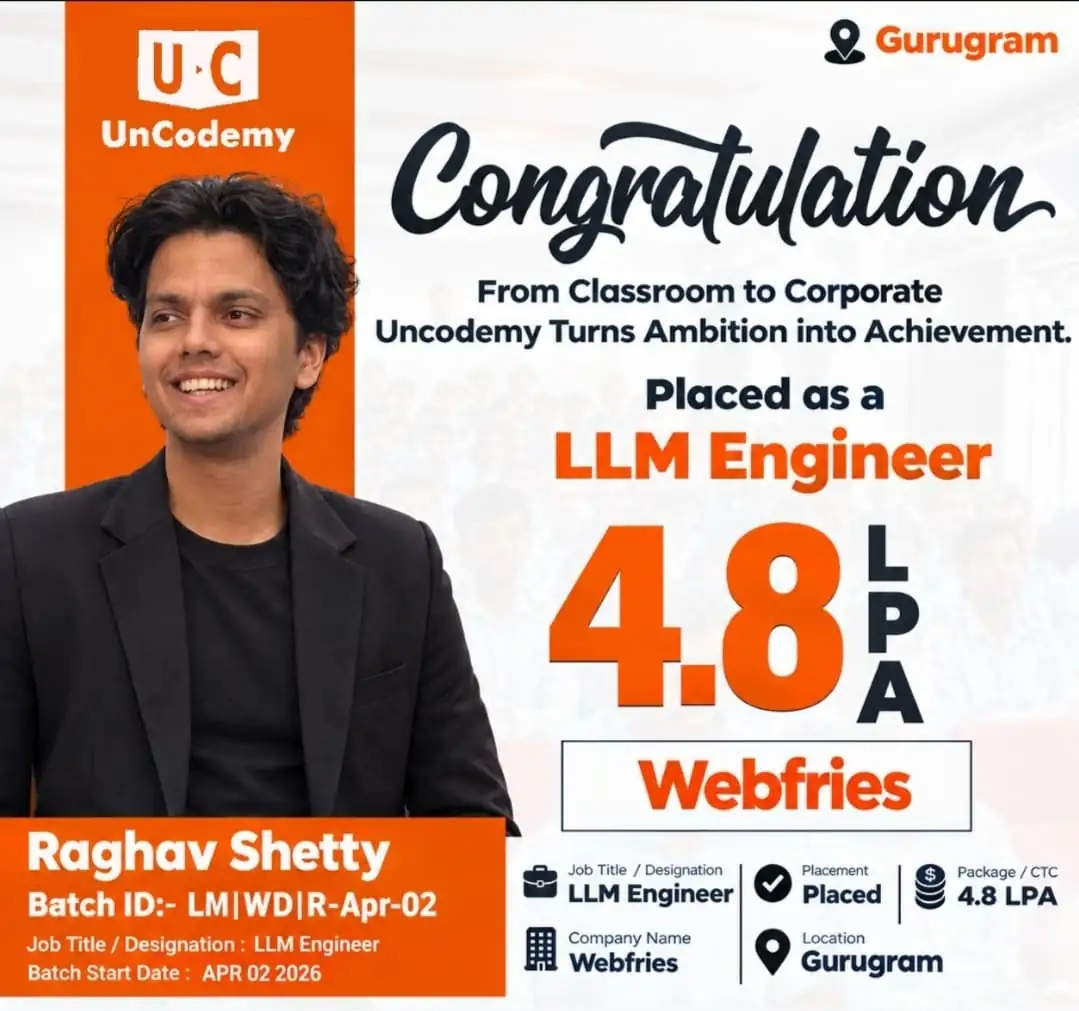
Raghav Shetty
4.8 LPA
Gurugram

Raghav Shetty

LLM Engineer

Placed at:Webfries

Artificial Intelligence Batch
Batch: LM|WD|R-Apr-02
Read placement record
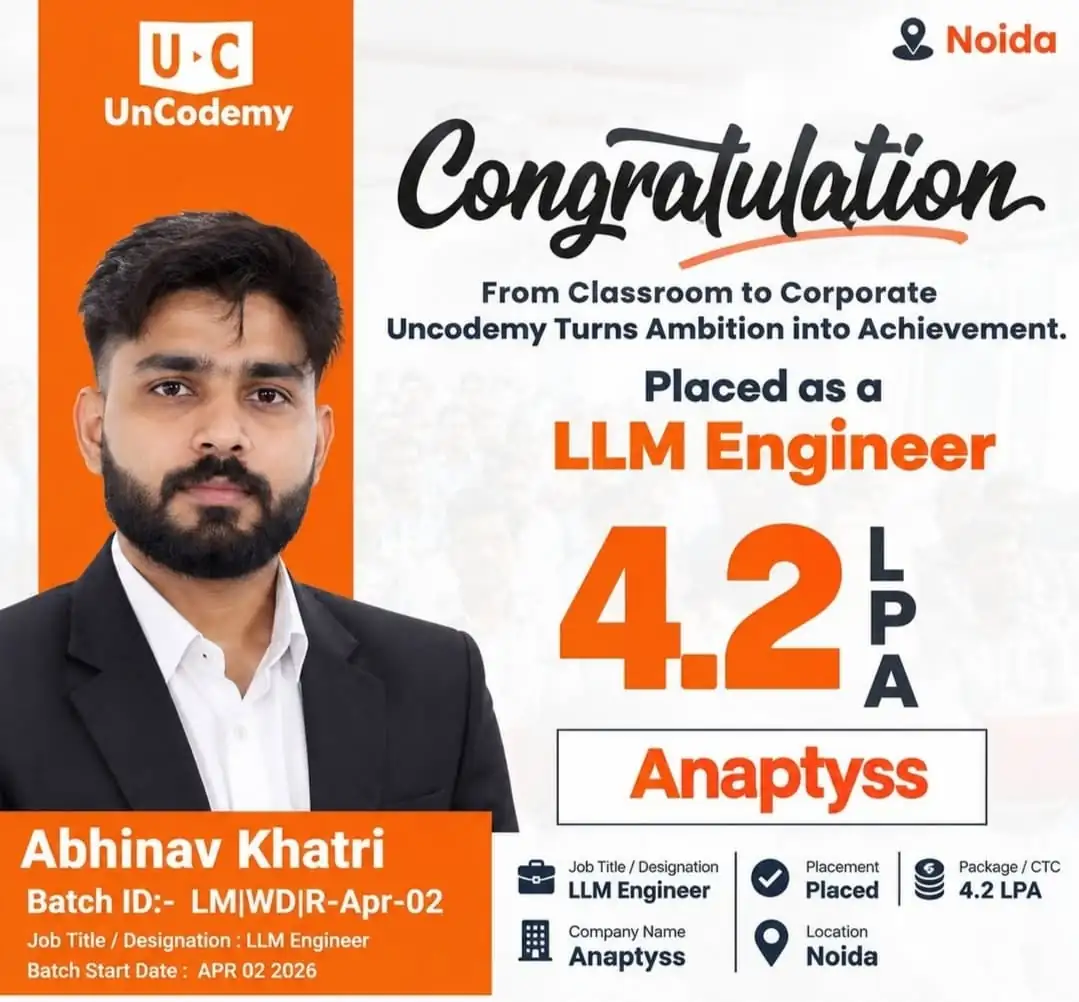
Abhinav Khatri
4.2 LPA
Noida

Abhinav Khatri

LLM Engineer

Placed at:Anaptyss

Artificial Intelligence Batch
Batch: LM|WD|R-Apr-02
Read placement record
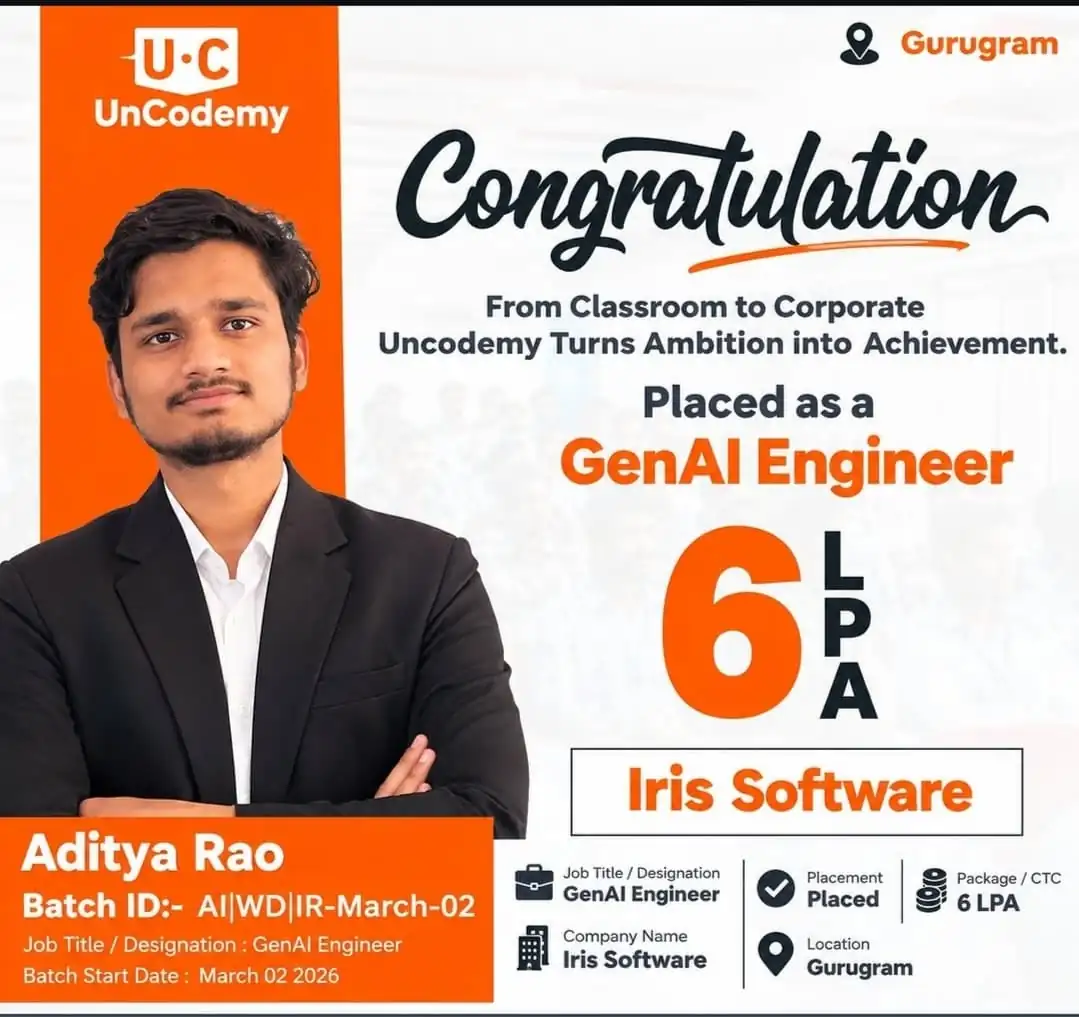
Aditya Rao
6 LPA
Gurugram

Aditya Rao

GenAI Engineer

Placed at:Iris Software

Artificial Intelligence Batch
Batch: AI|WD|R-March-02
Read placement record
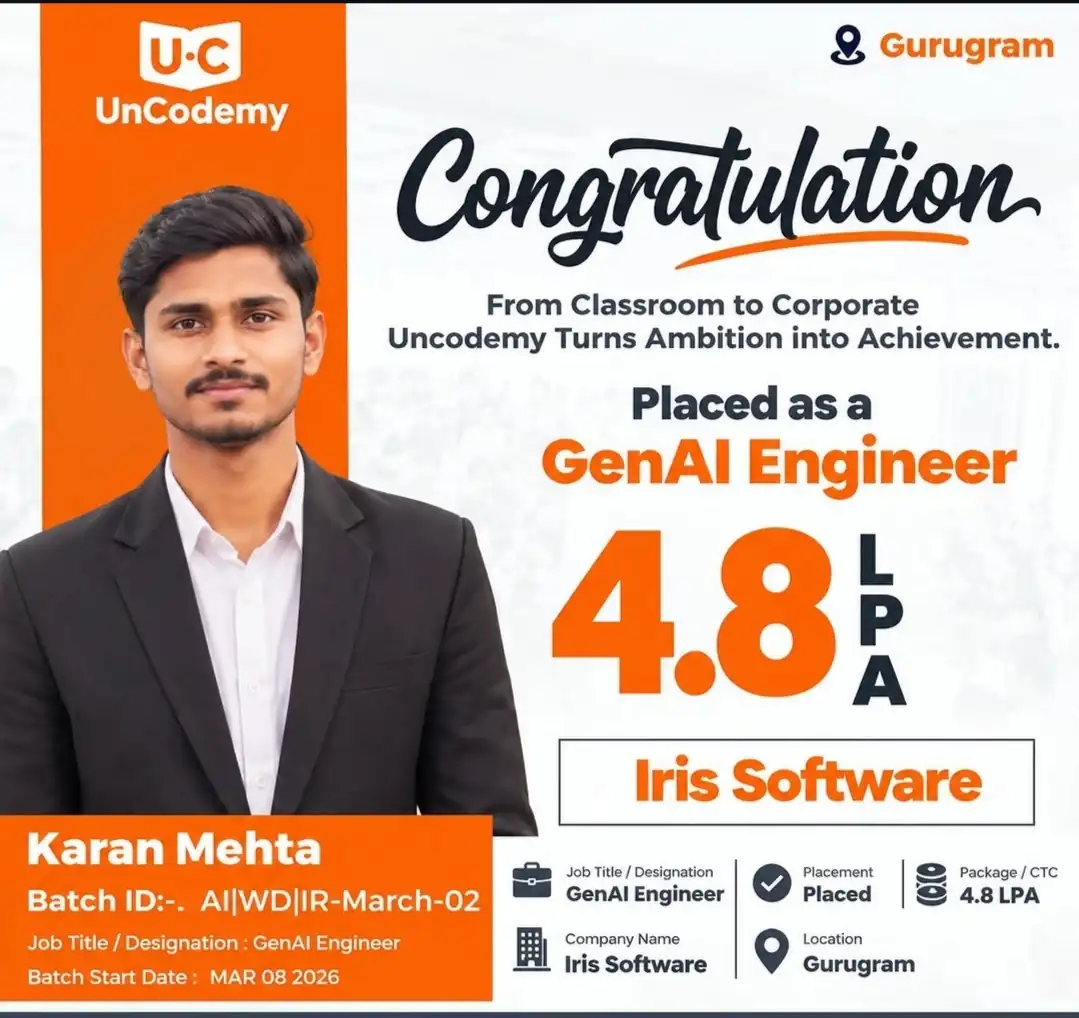
Karan Mehta
4.8 LPA
Gurugram

Karan Mehta

GenAI Engineer

Placed at:Iris Software

Artificial Intelligence Batch
Batch: AI|WD|R-March-02
Read placement record

What is Artificial Intelligence?

Bengaluru, widely regarded as India's Silicon Valley, is at the epicenter of the country's AI revolution. Here, Artificial Intelligence is not just a buzzword but a core driver of innovation across its massive tech ecosystem, from global capability centers and unicorn startups to established IT giants. The city's deep talent pool and venture capital network foster AI applications ranging from advanced fintech solutions and personalized e-commerce experiences to cutting-edge healthcare diagnostics and autonomous systems research.

What does an AI engineer do? An AI engineer in Bengaluru is likely to work on high-scale, data-intensive problems. Their work involves designing and implementing machine learning models for personalization or fraud detection, building robust MLOps pipelines, or developing conversational AI interfaces. The role is highly collaborative, requiring close work with product managers, data engineers, and software developers to integrate AI capabilities into consumer-facing and enterprise-grade products, with a strong emphasis on performance, scalability, and code quality.

Artificial Intelligence vs LLM Engineering vs RAG Engineering

While these three Uncodemy programs share some foundational elements, their specific focus and depth differ significantly. This comparison is designed for learners in Bengaluru, helping them choose a path that aligns with careers in the city's fast-paced product, startup, and enterprise tech environments.

Aspect Artificial Intelligence LLM Engineering RAG Engineering
Core focus A broad foundation covering ML, DL, NLP, CV, and GenAI Building, fine-tuning & deploying LLM-powered applications Building retrieval-grounded AI systems on enterprise knowledge
Coding depth High High High
Typical entry salary ₹4–8 LPA (Entry-Level AI Engineer, per this sheet) ₹6–10 LPA (per LLM Engineering course sheet) ₹5–9 LPA (per RAG Engineering course sheet)
Uncodemy program duration 5–6 months 5–6 months 5–6 months

Salary ranges are indicative and vary by role, skills, experience, location and employer.

Course Overview

This Artificial Intelligence course is a comprehensive 5–6 month live online learning experience, comprising over 110 live sessions and more than 183 hours of instruction. The curriculum is divided into 13 modules that progressively build your AI skills, starting with AI fundamentals, moving through Python, mathematics and statistics, data preprocessing, machine learning fundamentals, supervised and unsupervised learning, model evaluation, deep learning and neural networks, NLP, computer vision, generative AI and LLM fundamentals, AI applications and deployment, and culminating in a 25-hour industry capstone. Every module is rich with practical exercises using real-world tools. Learners in Bengaluru attend the course entirely live online, while classroom training is available at Uncodemy's Delhi and Noida centres for those who can travel.

Who should join this course:

  • Bengaluru-based developers and graduates seeking a comprehensive, structured AI foundation rather than a narrow specialization.
  • Working professionals in IT, data, or product roles looking to transition into AI/ML engineering positions.
  • Data professionals aiming to upskill from analytics or BI into full-stack AI and model deployment work.
  • Aspiring AI engineers with no prior machine learning background but a strong willingness to learn Python from the ground up.
  • Career changers moving into artificial intelligence roles.

Eligibility: Any graduate from a technical or non-technical background can enroll. Programming knowledge is helpful but not required — Python training begins in Module 2. Basic mathematics and statistics comfort is beneficial and will be developed in Module 3. A laptop and stable internet connection are necessary for the practical components.

Upcoming Artificial Intelligence Course Batches for Bengaluru Learners

Choose a batch time that fits your schedule. Our live online batches operate on IST timings. Reserve a free demo class to experience the teaching firsthand, or sign up for our upcoming weekend and weekday live batches — designed for both working professionals and students, offering flexible schedules and practical training.

Weekdays

Date Time Trainer Seats Left
07:30 PM – 08:30 PMMr. Irshad01Seat
02:00 PM – 03:00 PMMr. Upendra Kumar Tiwari02Seats
10:30 AM – 11:30 AMMr. Irshad01Seat
12:00 PM – 01:00 PMMr. Upendra Kumar Tiwari02Seats

Weekends

Date Time Trainer Seats Left
03:00 PM – 05:00 PMMr. Irshad02Seats

8+ new batches start every month. Live online batches, IST timings. Seats are limited and updated daily.

Curriculum for Artificial Intelligence Training Course in Bengaluru

Artificial Intelligence Course Syllabus in Bengaluru

The syllabus is organised into 13 modules covering 183+ hours. The order follows how AI skills build: foundations → Python → math/stats → data preprocessing → ML fundamentals → supervised/unsupervised learning → model evaluation → deep learning → NLP → computer vision → GenAI/LLM fundamentals → deployment → industry capstone. Each module includes practical exercises with real tools, and the program closes with hands-on AI projects and an industry capstone.

Module 1: Artificial Intelligence Fundamentals — 10 Hours

  • Introduction to Artificial Intelligence and its scope
  • AI vs ML vs DL vs Data Science — how they relate
  • Real-world AI applications and industry use cases
  • AI ethics, bias and responsible AI overview
  • Overview of AI development lifecycle
  • Hands-on: setting up a Python AI development environment

Module 2: Python for Artificial Intelligence — 15 Hours

  • Python basics: variables, data types, operators, control flow
  • Functions, modules and packages
  • Data structures: lists, tuples, dictionaries, sets
  • File handling and exception handling
  • Object-oriented programming fundamentals
  • Hands-on: building Python scripts for data manipulation

Module 3: Mathematics & Statistics for AI — 12 Hours

  • Linear algebra: vectors, matrices, matrix operations
  • Calculus: derivatives, gradients, chain rule
  • Probability: distributions, Bayes theorem
  • Descriptive statistics: mean, median, variance, standard deviation
  • Inferential statistics and hypothesis testing
  • Hands-on: implementing statistical calculations in Python

Module 4: Data Preprocessing & Feature Engineering — 12 Hours

  • Data cleaning: handling missing values, outliers, duplicates
  • Data transformation: scaling, normalization, encoding
  • Feature selection and feature extraction techniques
  • Handling imbalanced datasets
  • Exploratory Data Analysis (EDA) with Pandas and Matplotlib
  • Hands-on: preprocessing a real dataset for ML

Module 5: Machine Learning Fundamentals — 15 Hours

  • What is machine learning: supervised, unsupervised, reinforcement
  • Bias-variance tradeoff and overfitting/underfitting
  • Train-test split, cross-validation
  • Linear regression and logistic regression
  • Decision trees and random forests
  • Hands-on: building your first ML model with Scikit-learn

Module 6: Supervised & Unsupervised Learning — 15 Hours

  • Classification algorithms: SVM, KNN, Naive Bayes
  • Ensemble methods: bagging, boosting, gradient boosting
  • Clustering: K-means, hierarchical clustering, DBSCAN
  • Dimensionality reduction: PCA, t-SNE
  • Association rules and anomaly detection
  • Hands-on: end-to-end classification and clustering projects

Module 7: Model Evaluation & Optimization — 10 Hours

  • Evaluation metrics: accuracy, precision, recall, F1, ROC-AUC
  • Confusion matrix and classification reports
  • Hyperparameter tuning: grid search, random search
  • Regularization: L1, L2, dropout
  • Model selection and comparison
  • Hands-on: optimizing a model for a real dataset

Module 8: Deep Learning & Neural Networks — 15 Hours

  • Perceptrons and multi-layer neural networks
  • Activation functions: ReLU, sigmoid, tanh, softmax
  • Backpropagation and gradient descent
  • CNNs for image data, RNNs and LSTMs for sequences
  • Regularization techniques for deep networks
  • Hands-on: building a neural network with TensorFlow/Keras

Module 9: Natural Language Processing (NLP) — 12 Hours

  • Text preprocessing: tokenization, stemming, lemmatization
  • Bag of Words, TF-IDF, word embeddings (Word2Vec, GloVe)
  • Sentiment analysis and text classification
  • Named Entity Recognition (NER)
  • Sequence models and attention mechanisms
  • Hands-on: building an NLP pipeline with Python

Module 10: Computer Vision & Image AI — 12 Hours

  • Image fundamentals: pixels, channels, color spaces
  • Image preprocessing with OpenCV
  • Convolutional Neural Networks (CNNs) for image classification
  • Object detection: YOLO, SSD overview
  • Image segmentation and transfer learning
  • Hands-on: building an image classifier with PyTorch/OpenCV

Module 11: Generative AI & LLM Fundamentals — 15 Hours

  • Introduction to generative AI and large language models
  • Transformer architecture and attention mechanisms
  • Prompt engineering fundamentals
  • Fine-tuning vs RAG vs prompt-based approaches
  • Using OpenAI APIs and Hugging Face models
  • Hands-on: building a GenAI-powered application

Module 12: AI Applications, APIs & Deployment — 15 Hours

  • Building AI-powered web applications
  • Deploying ML models with FastAPI
  • Model serialization: pickle, joblib, ONNX
  • Containerization with Docker for AI apps
  • Cloud deployment basics for AI services
  • Hands-on: deploying an ML model as a REST API

Module 13: AI Projects & Industry Capstone — 25 Hours

  • End-to-end AI project design and problem framing
  • Data collection, cleaning, feature engineering for capstone
  • Model training, evaluation and optimization
  • Deployment and documentation of capstone project
  • Portfolio preparation and presentation
  • Interview preparation around capstone work
# Module Hours Tools
1 Artificial Intelligence Fundamentals 10 Python, Jupyter Notebook
2 Python for Artificial Intelligence 15 Python, Jupyter Notebook, Git/GitHub
3 Mathematics & Statistics for AI 12 Python, NumPy, SciPy
4 Data Preprocessing & Feature Engineering 12 Pandas, NumPy, Matplotlib, Seaborn
5 Machine Learning Fundamentals 15 Scikit-learn, Pandas
6 Supervised & Unsupervised Learning 15 Scikit-learn, Matplotlib
7 Model Evaluation & Optimization 10 Scikit-learn, Seaborn
8 Deep Learning & Neural Networks 15 TensorFlow, Keras, PyTorch
9 Natural Language Processing (NLP) 12 NLTK, spaCy, Hugging Face
10 Computer Vision & Image AI 12 OpenCV, PyTorch, TensorFlow
11 Generative AI & LLM Fundamentals 15 OpenAI APIs, Hugging Face
12 AI Applications, APIs & Deployment 15 FastAPI, Docker, Git/GitHub
13 AI Projects & Industry Capstone 25 All tools
Total 183 Hours 15+ tools

Contacted by

IR

Mr. Irshad

Curriculum & Technical Reviewer

[8+ Years Of Experience]

Specialization: Artificial Intelligence, Machine Learning, Deep Learning

Get Your Artificial Intelligence Certification In Bengaluru

What is Artificial Intelligence?

Artificial Intelligence is the discipline of creating systems that can learn patterns from data, reason over what they learn, and make predictions or decisions without being explicitly programmed for every scenario. Machine learning, deep learning, natural language processing, and computer vision constitute its core subfields. AI systems power recommendation engines, voice assistants, fraud detection, medical imaging analysis, and the generative AI tools now embedded in everyday software.

What does an AI engineer do? On a typical day, an AI engineer prepares and engineers data features, trains and evaluates ML/DL models, builds NLP or computer vision pipelines, integrates generative AI/LLM capabilities into applications, and deploys models via APIs. The role sits at the intersection of software engineering, statistics, and domain knowledge — which is why employers weight both coding ability and conceptual understanding during interviews.

Key Benefits of Our Artificial Intelligence Certification:

  • Program Completion :Provides a record of successful completion of the Artificial Intelligence program.
  • Online Verification :Certificate is verifiable online at certificate.uncodemy.com.
  • Practical Learning :Training includes hands-on ML/DL/NLP/CV projects and an industry capstone.

This is an independent Uncodemy certificate. It is not affiliated with, endorsed by, or a credential of OpenAI, Google, Meta, or any other AI vendor whose frameworks and tools are studied in this course.

Uncodemy Certificate Verification Online Certificate Verification & Download certificate.uncodemy.com
Uncodemy MSME registration certificate

Tools and Technologies Covered

Apply Now

Introducing Uncodemy


Portfolio/capstone project review:Your hands-on ML/DL/NLP/CV work and industry capstone are reviewed and refined into a portfolio an interview will find credible.

Resume & LinkedIn:We build your resume around AI/ML keywords and measurable outcomes, and align your LinkedIn profile to match.

Interview preparation:ML/DL concept questions, coding rounds, case-study discussions and AI-specific interview scenarios.

Mock interviews:Sessions with industry trainers, followed by written feedback on what to fix.

Opportunity sharing:Relevant openings are shared with you, with support through the application and interview process.

Continued support:This is active assistance, not a guarantee of employment — no training institute can honestly promise a job. Support continues after your program ends for learners who stay engaged with the process.

Instructors

The people who actually teach this course

Uncodemy ensures teaching and independent academic review stay separate. Trainers conduct the live classes, while domain reviewers make sure the syllabus remains accurate and relevant without teaching the batch. Mr. Upendra Kumar Tiwari assesses the technical content for this Data Science program, contributing a distinct quality check alongside classroom delivery.

The Delhi classroom batches are taught by the same faculty who support the Noida and online formats. Prospective learners may request to observe part of a live session before making a decision.

Trainer and reviewer names, areas of expertise and professional backgrounds are shared openly by Uncodemy, so learners can review the people connected with the course before enrolling.

Bengaluru AI guide

Breaking into AI in Bengaluru when everyone else is trying too

Bengaluru has more machine learning teams than any other Indian city, which is good news and bad news for a beginner. The openings exist, but so do thousands of other applicants with similar certificates. This guide is about how a student or early-career professional here can use a broad AI course to stand out: which kinds of teams actually use ML, what a believable first role looks like, which project ideas suit this city, and how the live online classes fit around Bengaluru's commutes.

The competition

Why a certificate alone rarely works in Bengaluru

Recruiters in the city see a large volume of resumes that list the same stack: Python, Pandas, Scikit-learn, a Titanic notebook and a sentiment classifier. When everybody claims those skills, the shortlist goes to people who can show judgment — why they chose a metric, what went wrong in their data, how they would know the model has drifted.

Read moreRead less

So treat this course as raw material, not the finish line. The modules give you the vocabulary and the practice; the difference in Bengaluru comes from one or two projects you can defend in depth, a GitHub history that shows steady work over months, and the ability to explain a model to someone who is not a data scientist. Hiring managers here often care more about that explanation than about which framework you used.

Who uses ML

The kinds of Bengaluru teams that put models into production

Consumer internet and fintech

Recommendation, search ranking, delivery-time prediction, credit and fraud scoring. These teams want strong fundamentals and usually hire freshers only through internships or very selective drives.

Global capability centres

Retail, banking, insurance and healthcare multinationals run analytics and ML teams in Whitefield, the Outer Ring Road and Manyata. Work is often forecasting, churn, pricing and document processing for the parent company.

IT services AI practices

Infosys and Wipro are headquartered in Bengaluru, and the large services firms run AI and data practices that take in trainees in batches. This is the most common door for freshers.

Read moreRead less

There is also a long tail of deep-tech, health-tech and agri-tech startups that use computer vision on scans, satellite images or crop photos. They hire in small numbers and usually expect a working demo. Companies are mentioned only to describe the market; Uncodemy has no hiring tie-up with any of them.

Course in months

What the course covers, month by month, for a Bengaluru learner

All classes for Bengaluru are live online. Uncodemy's physical classrooms are only in Noida (Sector 1) and Delhi (Shakarpur Extension, Laxmi Nagar), so you learn with the same trainers from home, a PG room or a co-working desk.

  • Duration5–6 months
  • Content183+ hours
  • Live classes110+ live sessions
  • Fee₹24,500 + GST
  • EMI₹4,818 a month for 6 months
  1. First stretch: AI fundamentals, Python, and the linear algebra, probability and statistics that later modules lean on.
  2. Second stretch: data preprocessing, feature engineering, supervised and unsupervised learning, and how to evaluate and tune models honestly.
  3. Third stretch: neural networks and deep learning, then NLP and computer vision with real libraries.
  4. Final stretch: generative AI and LLM basics, serving models through APIs, and a 25-hour industry capstone project.
Read moreRead less

The 13 modules use Python, NumPy, Pandas, Scikit-learn, Matplotlib, Seaborn, TensorFlow, Keras, PyTorch, OpenCV, Hugging Face, OpenAI APIs, Jupyter Notebook, Git/GitHub and FastAPI. If a Thursday sprint or a long Silk Board crawl makes you miss a live class, the recording is there for catch-up, but the trainers' doubt sessions are where most of the learning happens, so attend live when you can.

Entry roles

First AI and ML job titles that are realistic here

  • Data or ML analyst in a capability centre or analytics firm — SQL, Python, baseline models and dashboards that explain them.
  • AI/ML engineer trainee in a services company — model training scripts, data pipelines and API wrappers for client projects.
  • Junior computer vision or NLP engineer at a startup — narrower work, but you touch the whole pipeline.
  • Junior GenAI application developer — small tools that call a hosted model; useful, but do not make it your only skill.
Read moreRead less
Career stageWhere it usually happensIndicative Bengaluru range
FresherServices trainee, analyst, startup junior₹4–8 LPA
1–3 yearsML engineer, CV/NLP engineer₹7–15 LPA
3–6 yearsSenior ML engineer at a GCC or product firm₹15–30 LPA

These are rough, indicative bands drawn from public job listings, not a survey of our learners. Bengaluru has the widest spread in the country: the same title can differ by several lakh between a services project and a product team. Uncodemy does not promise any salary.

Local projects

Project ideas built on Bengaluru problems

A project about the city you live in is easier to explain with conviction, and interviewers often recognise the problem immediately. Use only public data so the code can live openly on GitHub.

  • Air quality forecasting using readings from public pollution-monitoring stations in the city, with a clear baseline and an honest error analysis.
  • Kannada text classification — sorting news headlines or customer messages by topic using public Indian-language corpora, which shows you understand NLP beyond English.
Read moreRead less
  • Lake and land-use change detection from free satellite imagery, a computer vision exercise that suits deep-tech and climate startups.
  • Traffic and travel-time modelling from open mobility or public transport datasets where they are available, a regression and time-series problem every Bengaluru interviewer understands.

Pick one as your capstone and go deep: clean data, a simple baseline, a better model, a FastAPI endpoint and a short README on what you would improve.

Interview rounds

How entry-level ML interviews tend to run in Bengaluru

Product companies and capability centres often start with an online coding test (Python, sometimes basic data structures), followed by an ML fundamentals round and a project deep-dive. Services firms lean more on aptitude, Python and a conversation about your capstone.

Read moreRead less
  • Expect to derive or at least explain gradient descent, regularisation and the bias–variance trade-off without slides.
  • Be ready to say how you would handle a 1% positive class, and why accuracy is the wrong metric there.
  • For CV or NLP roles, explain transfer learning and what you froze or fine-tuned in your own project.

Work through the Bangalore machine learning interview questions and the Bangalore data science set. Both are practice questions, not a record of what any specific company asked.

Explore

More for Bengaluru learners

Frequently Asked Questions

1. Is there an Uncodemy AI classroom in Bengaluru?▼

No. Bengaluru learners attend live online batches; Uncodemy's only physical classrooms are in Noida (Sector 1) and Delhi (Shakarpur Extension, Laxmi Nagar). The trainers, syllabus and capstone are the same as in the classroom batches.

2. What will the AI course cost me in Bengaluru?▼

There is no separate Bengaluru price. You pay ₹24,500 + GST, or ₹28,910 once GST is added, and you can split it into EMI of ₹4,818 a month for 6 months.

3. How many months does it take, and what is inside?▼

Plan for 5–6 months. The course has 183+ hours of content, 110+ live sessions and 13 modules, moving from Python and maths through machine learning, deep learning, NLP, computer vision and generative AI to deployment and a 25-hour industry capstone project.

4. Bengaluru has so many AI applicants. Is it still worth starting from zero?▼

Yes, if you are willing to build depth. Entry-level competition here is heavy, so plan on a strong capstone, a regular GitHub record and solid fundamentals rather than relying on the certificate alone.

5. Should I target a GCC, a startup or a services company first?▼

For most freshers the services firms and analytics companies are the realistic first door because they hire in batches. Capability centres and startups become easier after a year or two of hands-on ML work. Uncodemy has no hiring tie-up with any of them.

6. I already work in an IT support or testing role in Electronic City. Can I move into ML internally?▼

Often that is the quickest path. Learn the basics through the course, then ask your company's data or AI practice about internal openings and show them your project.

7. Do I need a coding background before I join?▼

No prior Python or ML experience is needed: Python is taught from Module 2 and the maths and statistics you need are built up in Module 3. A graduate degree in any field is enough.

8. Does the course guarantee an AI job in Bengaluru?▼

No. Uncodemy offers resume reviews, mock interviews and job-application support (placement assistance, not a job guarantee). The offer itself depends on your projects, preparation and interview performance.

Why Trust This Page? Discover Why Students Choose Uncodemy

How we maintain this page

  • Content written by:Mr. Rahul
  • Content rechecked and verified by: Mr. Irshad
  • Course curriculum verified by:Mr. Irshad
  • Technical content verified by: Mr. Irshad
  • Fee verified by: Admin Department
  • Placement figures sourced from internal placement records
  • Review counts verified against respective third-party platforms
  • Last reviewed:
Application Form