



#1 India's Top IT Training Institute
×

About Uncodemy

Know more about who we are and what we stand for.

About Us

About Us

Discover our mission to equip individuals with essential IT skills and industry expertise.

Read More →
UnCodeMy Gallery

UnCodeMy Gallery

Explore highlights from our IT training sessions and success stories.

Read More →
Mentors

Mentors

Meet the industry experts who train and guide you through your course.

Read More →
Free Resources

Free Resources

Free tutorials, interview questions, tools and calculators to help you learn.

Explore →
×

Free Resources

Learn, practice and plan your career — bilkul free.

Tutorials

Tutorials

Step-by-step written tutorials to learn any technology at your own pace.

Read More →
Free Counselling

Free Counselling

Book a free video counselling session and pick the right course for you.

Read More →
Online Compiler

Online Compiler

Write, run and test your code online — no setup required.

Read More →
Speciality
Prof_Trained

15000+Professionals Trained

Batch-every

3+Batches every month

Prof_Trained

50+Industry expert trainers

Corporate

2500+Corporate Served

What is DevOps? Why should you Join Uncodemy to Pursue it?

DevOps is a culture that allows the development and the operations team to work together. This results in continuous development, testing, integration, deployment, and monitoring of the software throughout the lifecycle.

Curriculums for DevOps Training Course in Ghaziabad

DevOps Curriculum

The curriculum has been designed by faculty from IITs, and Expert Industry Professionals.

time
100+

Hours of Content

live1-removebg-preview
55+

Live Sessions

tools
10+

Tools and Software

Set the Basics Right

This training program starts from very basic level and gradually goes to advance level so that even a fresher can understand. During the entire training program, trainer shares lot of practical examples and real business scenarios so that students can understand the concept properly. We focus a lot on practical and hence assignments are given to students.

After successful completion of this course, students can work as DevOps solution architect in any MNC.

DevOps Introduction
  • What is DevOps?
  • DevOps Roles
  • DevOps Need
  • DevOps Problems & Solution
  • Making a DevOps Transition
  • DevOps: Continuous Delivery and Benefits
  • DevOps: Lean thinking, a change of culture
  • Basic Linux and Networking Concepts
  • Architecture and Filesystem of Linux
  • Linux Commands
  • Services in Linux
  • Exposure to SED, AWK, CUT, TR, FIND, ECHO etc.
  • Shell scripting
  • Package Management using YUM, APT
  • Exposure to MONILITHIC & MICROSERVICES architecture
  • While loop For-loop and other Adhoc Real time experience
  • Cloud Computing
  • Introduction to Cloud Computing
  • Introduction to Public Private Hybrid Cloud
  • Exposure to IAAS SAAS PASS
  • AWS Cloud including services like EC2, SG, AMI, KMS, VPC, S3, Roles, Policies
  • Segregation in Networking using VPC
  • Introduction to ELB, CDN, Auto Scaling
  • Real time industry-based scenarios on AWS and private cloud Openstack
  • Source Code Management and Version Control
  • Source Code Management using GitHub
  • History of version control systems & differences between CVS, SVN, GIT
  • Centralized vs Distributed version control system
  • GitHub GUI and GIT commands
  • Cloning check in Forking ,Merging, Branching etc
  • Repository creation using API
  • Continuous Integration with Jenkins
  • Jenkins – Installation Configuration and Management
  • Setup Build Jobs using Freestyle and Declarative Pipeline
  • Integration of JENKINS with GIT
  • Integration of Maven with Jenkins
  • Jenkins Dashboard
  • Remote Builds and user management in Jenkins
  • Understating Plugins and dependency installation
  • Pipeline Creation using Jenkins for CI
  • Jenkins – Testing
  • Configuration Management using ANSIBLE
  • Understanding Configuration Management
  • Understanding Configuration Automation
  • Understanding Desired State Configuration Management
  • Understanding Continuous Configuration Automation
  • Understanding Remote Configuration Automation
  • Introduction and Overview of CHEF-PUPPET
  • Introduction of Ansible tool
  • Introduction to YAML Syntax
  • Ansible Installation and configuration
  • Ansible: Playbooks and Modules live examples on several industry scenarios
  • Basic: Running Ansible Adhoc Commands
  • Understanding Server Client based Configuration Automation
  • Ansible: Roles, Files, Templates, Handlers
  • Monitoring using Nagios,Thruk
  • Instance monitoring using Nagios
  • Installation and configuration of Nagios
  • Port ,Service monitoring
  • Windows server monitoring
  • Docker-Containers
  • Introduction to micro services
  • Introduction to Docker
  • Introduction to Docker commands practical
  • Working with containers
  • Introduction to docker HUB
  • Docker Demo
  • Docker Compose
  • Port forwarding,Yaml, Docker file
  • Kubernetes
  • What is Kubernetes
  • Technical Overview of POD,NODE,Containers
  • Kubernetes Cluster with multimode architecture
  • SCALE IN/SCALE OUT of containers
  • Services,deployments architecture
  • HELM architecture overview
  • Terraform
  • What is Terraform. Difference between Terraform and Cloud Formation
  • Build infrastructure using Terraform code
  • Change,destroy,manage infrastructure
  • Integrating Terraform on AWS
  • Updates to existing setup using Terraform
  • Terraform real time industry based examples and projects
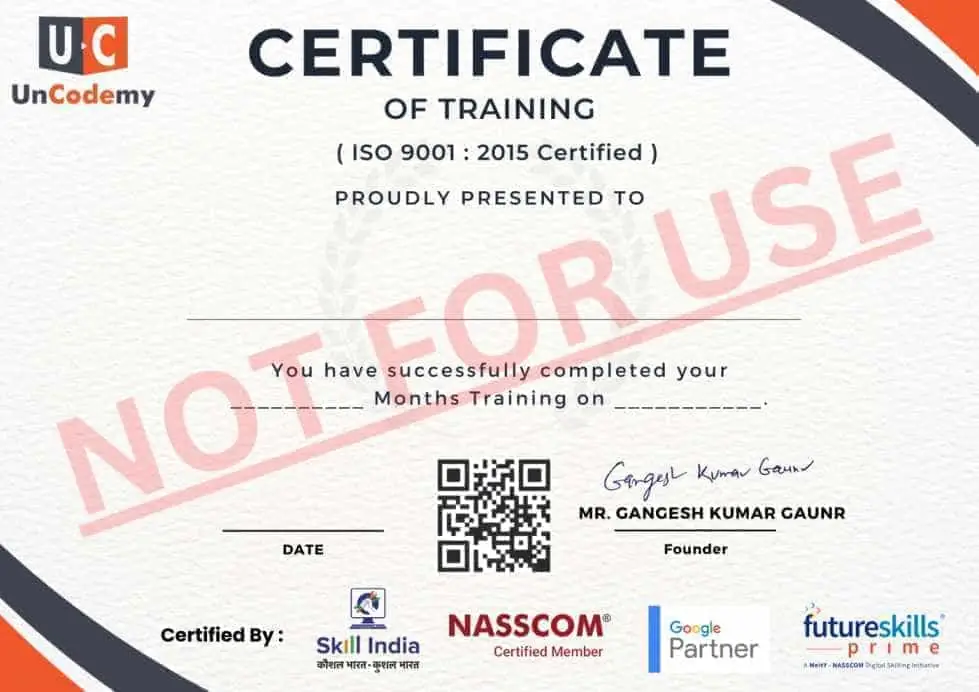
  • Get Recognised International Certifications instantly.

    The students who want to kickstart their journey should definitely go for DevOps certification course in Ghaziabad, as to be a certified professional it is required to get training from certified tutors under a certified program provided by none other than Uncodemy, which is one of the best DevOps training institutes in India, primarily located in Noida, as we bring such tutors who has deep knowledge of the most in-vogue skills required to become a successful Java developer in this fast paced changing world. DevOps course in Ghaziabad provided by Uncodemy the best Java training institute, provides the certified DevOps course with the following certificates:

    • Uncodemy Certificate
    • Uncodemy Agile Certificate
    • Module Completion Certificate
    Tools andTechnologies covered
    • tools-imgJenkins
    • tools-imgDocker
    • tools-imgAnsible
    • tools-imgKubernetes
    • tools-imgChef
    • tools-imgGit
    • tools-imgPrometheus
    • tools-imgPuppet
    • tools-imgSplunk
    Ace Every Interview with Uncodemy-

    Uncodemy, the known DevOps training institute in Ghaziabad also serves students by preparing them with the latest tips and tricks to ace interviews of absolutely any level by providing them below mentioned provisions-

    animate
    Uncodemy

    Access unparalleled learning with live sessions, recordings, assignments, and live projects led by a top-tier mentor and industry expert trainer. Elevate your skills with the best-in-class educational content.

    Young-male-holding-laptop-408w
    Get a Real World Understanding Through Industry Projects
    Uncodemy

    We Provide EMI Facility for You

    Nothing Stops you from Learning

    Young-male-holding-laptop-408w

    Become a Devops Engineer -Talk to Expert Counselor

    Awards
    c3
    c4

    Curriculum for DevOps training in Ghaziabad

    DevOps course syllabus in Ghaziabad is framed by the Industry experts of Uncodemy. This Course Content covers all the latest topics from basics to advanced level topics such as AWS Maven,...Jenkins, Docker and Ansible.

    Introduction to DevOps

    • DevOps Principles in detail
    • DevOps Engineer Skills in the market
    • Knowing DevOps Delivery Pipeline
    • Market trend of DevOps
    • DevOps Technical Challenges
    • Tools we use in DevOps
    • DevOps on Cloud

    • Essentials of Cloud computing?
    • Cloud and virtualization architecture
    • Cloud deployment architecture
    • Cloud providers – An overview
    • Why we need DevOps on Cloud?
    • Introducing to Amazon web services

    GIT – A Version controlling tool

    • Knowing about Version control
    • Git – A CLI
    • Essentials of GIT in industry
    • How to setup GIT
    • Installing Git
    • First-Time Git Setup
    • Getting a Git Repository
    • Working with various commands in GIT
    • Recording Changes to the Repository
    • How to check the Status of Your Files
    • How to track New Files
    • Staging our modified files
    • Ignoring Files from GIT
    • Viewing Your Unstaged and Staged Changes
    • How to commit Your Changes
    • Skipping the Staging Area and commit
    • Removing Files from GIT
    • Viewing the Commit History
    • Limiting Log Output
    • Using a GUI to Visualize History
    • Undoing Things
    • Changing Your Last Commit
    • Unstaging a Staged File
    • Unmodifying a Modified File
    • Working with Remotes
    • Showing Your Remotes
    • Adding Remote Repositories
    • Fetching and Pulling from Your Remotes
    • Pushing to Your Remotes
    • Inspecting a Remote
    • Removing and Renaming Remotes
    • Branching and Merging in Git
    • What a Branch Is
    • Basic in Branching and Merging
    • Branch Management in GIT
    • Branching Workflows and its usage
    • Remote Branches – create and delete
    • Rebasing
    • Git workflows
    • Git cheat sheet
    • Jenkins

    • Essentials of Continuous Integration
    • An example scenario where CI is used
    • Know about Jenkins and its architecture in detail
    • Jenkins tool Management in detail
    • Know about User management in Jenkins
    • Authentication
    • Jenkins own database user creation
    • Options to enable integration with LDAP
    • Authorization
    • Matrix based authorization
    • Project based authorization
    • Overview of Maven
    • Maven project structure
    • Maven plugins
    • Project Object Model (POM) – fundamental unit of work in Maven project
    • Maven build lifecycle
    • Adding external dependencies to maven pom.xml
    • Maven build and test project
    • Creating jobs and automatic build settings
    • What is Jenkins Pipeline?
    • Why Pipeline?
    • Integration with GIT
    • How to enable project based authorization for a job
    • Source code management while creating jobs
    • Triggering automated build
    • Maven job setup
    • Know about post build options for jobs like notifications, trigger another build, publishing reports, etc.
    • Adding a slave node to Jenkins
    • Building Delivery Pipeline
    • Notification settings in Jenkins
    • Plugin management in Jenkins
    • Docker

    • Introduction
    • Introducing Docker and its technology
    • Understanding of Docker images and containers
    • Working with container
    • How to Share and copy a container
    • Container Life Cycle
    • How to use Base Image and customize
    • Creation of Docker File
    • How to Publish Image on Docker Hub
    • Introduction to Docker Networking
    • Network Types in docker technology
    • Docker Container Networking
    • Docker Compose – An introduction
    • Docker Swarm – An introduction
    • Use Docker Compose to create php, Wordpress, mysql
    • How to Start Containers on a Cluster with Docker Swarm
    • Creating and Scaling an application in Docker swarm
    • Kubernetes

    • Introduction to Kubernetes
    • Kubernetes Cluster Architecture — An overview
    • Understanding concepts of Pods, Replica sets, deployments and namespaces
    • Understanding the concepts of services and networking
    • Persistent volumes and persistent volume claims —an overview
    • Design of Pods
    • Understanding labels, selectors, jobs, and schedulers
    • Get Placement Oriented DevOps Training from Industry Experts with our DevOps Training in Bangalore
    • Ansible

    • Introducing Ansible – A configuration management tool
    • Basics / What Will Be Installed
    • Understanding Ansible architecture
    • Control Machine Requirements
    • Managed Node Requirements
    • Inventory
    • Hosts and Groups
    • Host Variables
    • Group Variables
    • Learn various ansible Modules
    • How to use adhoc commands
    • Parallelism and Shell Commands
    • File Transfer
    • Managing Packages
    • Users and Groups
    • Deploying From Source Control
    • Managing Services
    • Introduction to YAML script
    • Playbook
    • About Playbooks
    • Playbook Language Example – YAML
    • How to Write Playbooks
    • Tasks in Playbooks
    • Understanding about various tasks in playbook
    • Introduction to Handlers and variables
    • Learn about using handlers, variables in the playbook
    • Become (Privilege Escalation)
    • Roles
    • Role Directory Structure
    • Using Roles
    • Role Duplication and Execution
    • Role Default Variables
    • Role Dependencies
    • Role Search Path
    • Ansible Galaxy
    • Including and Importing
    • Includes vs. Imports
    • Importing Playbooks
    • Including and Importing Task FilesIncluding and Importing Roles
    Read more

    DevOps Fees and course duration

    Here you will know why Uncodemy is said to be the best DevOps training institute in Ghaziabad. The DevOps boot camp in Ghaziabad we organise, is not only great in quality but they is also very...affordable. You will be surprised to know the DevOps course fees in Ghaziabad, we the Uncodemy charge! It starts from ₹50,000 and on top of that you can enjoy additional discounts if you join a right now! Also the DevOps course duration in Ghaziabad, lasts only for upto 6 months.

    But there is a special provision you will get, if you become a part of Uncodemy and decide to pursue your DevOps training in Ghaziabad with us. The working students and the students who for some reason cannot sustain standard offered DevOps course duration in Ghaziabad can go for special batches with the flexible schedules.

    On top of that you can also enjoy the additional DevOps course benefits in Ghaziabad-

    • 100% career disposed Training
    • Industry oracle Faculties
    • Demo Class Obtainable at no hidden cost.
    • Certified Experts with High Grade.
    Read more

    Get industries but trainers for DevOps training in Ghaziabad

    As you know by now, that Uncodemy which is the finest DevOps training for beginners in Ghaziabad, provides industry expert trainers to stir the core concepts of Java in students brain, in the...speed of the light. But today there are tons of sources to learn of DevOps course in Ghaziabad then why one should prefer the industry expert trainers of Uncodemy, a passionate DevOps course training provider in Ghaziabad?

    Below are the mentioned perks of joining Uncodemy to build your career-

    • Dedicated Career & Placement Assistance
    • Constant support of mentors till you get a dream job.
    • Availability of professionals even after the session through chat or call process
    • Personalised tutorials
    • Company referrals
    • Live sessions with alumni
    • Work on live projects
    • Case studies with the help of professionals together with fellow students
    • Regular tests for strong base and effective learning.
    • Option to choose from online and offline sessions
    • Mentors at Uncodemy, said to be the best DevOps training institute in Agra makes room for every
    Mentors at Uncodemy, said to be the best DevOps training institute in Ghaziabad makes room for every student to let every student feel as if they’re at home, because we strongly believe in the idea of Vasudhaiv Kutumbakam "The World Is One Family" hence, the student gets a platform where there is no discrimination based upon anything and everybody gets equal chance to learn execute and conquer.
    Read more

    Scholarship and certifications in DevOps training in Ghaziabad under Uncodemy

    Let us introduce Uncodemy, which is the best DevOps training institute in Ghaziabad based out of Delhi NCR, India.The tutors work at Uncodemy comes from big MNC’s to startups that are...rapidly earning their name in the list of successful business tycoons. Uncodemy, employees trainers, in association with fortune 500 to provide the an efficient experience to the students who are about to attain the best DevOps training in Ghaziabad exclusively by Uncodemy.

    The industry expert trainers will guide you in such a way that you won't feel unconfident and insecure while stepping into the real world of DevOps. As you know by now what kind of DevOps course benefits in Ghaziabad, you can relish. But in addition, to that you can also earn certificates along with scholarships from the reputedcertificates of Uncodemy by doing the DevOps certification course in Ghaziabad with-

    • Uncodemy Certificate
    • Uncodemy Agile Certificate
    • Module Completion Certificate
    Read more
    Ghaziabad guide

    A DevOps route for testers and developers in Ghaziabad

    Plenty of Ghaziabad residents already work in software across the river in Noida or in East Delhi — as manual or automation testers, junior developers or support engineers. Many of them sit next to the release process every day without owning it: they wait for builds, chase broken environments and test whatever lands. This page is about turning that closeness into a DevOps career. It covers what changes when a tester or developer moves into CI/CD, which teams hire for it, how to reach a classroom from Ghaziabad, the course facts and a pipeline project built around automated tests.

    Why testers

    Why testers make good DevOps engineers

    Continuous integration exists to answer one question quickly: did this change break anything? Testers spend their working lives on that question. If you have written Selenium or API test suites, you already understand test data, flaky tests, environments and the pain of a release that was 'tested on my machine'.

    Read moreRead less

    The move into DevOps adds the plumbing around testing. Instead of running a suite manually after a build, you wire it into a Jenkins pipeline so it runs on every commit, publishes a report and blocks a bad merge. Instead of asking someone for a test environment, you write it as Docker Compose files or Terraform and create it in minutes. Developers bring a different strength — they understand the build itself, dependencies and Maven or npm — but both groups end up learning the same Linux, Git, container and infrastructure skills.

    There is also a practical career reason. Manual testing roles are shrinking in many teams, and automation testers increasingly find that the people deciding how tests run are the platform or DevOps engineers. Moving into that seat keeps your quality instincts useful while giving you broader infrastructure skills. The honest catch: you will need to become comfortable on the Linux command line and with reading other people's build scripts, which takes regular practice over the length of the course rather than a weekend.

    Release work

    What release engineering looks like in practice

    In product and SaaS companies, and in IT-services firms that ship software for clients, a lot of DevOps work is release engineering: making sure code moves from a developer's branch to production safely and repeatably.

    1. Commit: a developer pushes to a feature branch in Git and opens a pull request.
    2. Build and unit test: Jenkins compiles the code, runs unit tests and builds a Docker image.
    3. Integration and UI tests: the image is deployed to a temporary environment and automated suites run against it.
    4. Approval and release: after review the same image is promoted to staging and then production, often on Kubernetes.
    5. Watch: monitoring checks error rates; if they climb, the release is rolled back.
    Read moreRead less

    A release engineer owns that path: keeps pipelines fast, fixes broken builds, manages versions and branches, and makes rollbacks boring. It is a common first DevOps role for people coming from testing, because so much of it is about quality gates.

    Employers

    Teams that hire DevOps people near Ghaziabad

    Ghaziabad itself has relatively few software product companies; the concentration of DevOps openings is in Noida, with more in Delhi and Gurugram. Many Ghaziabad residents already commute to Noida sectors along the metro lines, so these jobs are within daily reach.

    • SaaS and product companies in Noida, where a small platform team supports dozens of developers and deploys often.
    • IT-services firms delivering projects for overseas clients, with DevOps engineers attached to each project.
    Read moreRead less
    • Technology centres of larger companies that run internal platforms and need release and infrastructure automation.
    • Local businesses with web platforms — e-commerce sellers, education groups, hospitals — that sometimes need one person to own deployments and hosting.

    An internal move is often the quickest route. If your current company in Noida already has a DevOps or platform team, offer to help with pipeline maintenance for your own project's test jobs. Managers are far more willing to transfer someone who has already fixed a few Jenkins jobs than to hire an outsider.

    These are kinds of employers, not companies that recruit through Uncodemy. Uncodemy has no hiring tie-up with any Ghaziabad or Noida company.

    Getting to class

    Commuting to a classroom from Ghaziabad

    Uncodemy's classrooms are in Noida (Sector 1) and Delhi (Shakarpur Extension, Laxmi Nagar). From Vaishali, Kaushambi or Indirapuram, the Blue Line branch towards Yamuna Bank connects with the main Blue Line, from which Laxmi Nagar (for the Delhi centre) and Noida Sector 15/16 (for the Noida centre) are both reachable. From Raj Nagar Extension or areas served by the Red Line, the trip is longer and usually involves a change.

    Read moreRead less

    If you already work in Noida, an evening classroom batch near the office can be easier than going home first. Otherwise live online classes from home avoid the commute and let you use your own lab set-up. Both follow the same syllabus. Batch timings change from intake to intake, so confirm them with a counsellor before deciding.

    For lab work, a laptop with enough memory to run Docker and a small local Kubernetes cluster at the same time makes a real difference; older machines slow down badly once a few containers start. If you are buying one for the course, ask the counsellor for the current minimum specification first, and keep the laptop for practice only so that a work device's security restrictions do not block installations.

    Course facts

    Syllabus, duration and fee

    The course covers a 10-part curriculum (DevOps basics, Linux and networking, cloud, Git, Jenkins CI, Ansible, Nagios monitoring, Docker, Kubernetes, Terraform). The programme starts from a very basic level, with Linux and networking basics before the tools — useful for testers who have not administered servers before. Expect tools such as Git, Jenkins, Docker, Kubernetes, Ansible, Terraform, Chef, Puppet, Prometheus and Splunk across the modules.

    • Duration6 months
    • Content100+ hours of content
    • Live classes55+ live sessions
    • Feefrom ₹50,000
    • EMIEMI facility available (a counsellor shares the plan)
    Read moreRead less

    The fee starts from ₹50,000; the amount for your batch is the exact current fee, confirmed by a counsellor, and the same conversation covers the instalment plan. You can attend a free demo class before enrolling. For testers, the Jenkins, Docker and Kubernetes modules are where most new learning happens; the Git module will feel familiar if you already keep test code in a repository.

    The Terraform and cloud modules are newer territory for most testers. Spend extra time there, because job descriptions in NCR increasingly list infrastructure as code alongside CI/CD, and it is the part interviewers probe when they want to separate people who have only run pipelines from people who can build the environments underneath them.

    Project

    Portfolio project: a pipeline with real quality gates

    Build a pipeline that a tester would be proud of. This is a self-made practice project for your portfolio, not client work.

    1. App: take a small open-source web app or write a simple one with a REST API and a login page.
    2. Tests: add unit tests, a handful of API tests and two or three UI tests with the automation tool you already know.
    3. Pipeline: write a declarative Jenkins pipeline with separate stages — build, unit tests, Docker image, deploy to a test namespace on a local Kubernetes cluster, API and UI tests, publish reports.
    4. Gate: make the pipeline fail the build when any test fails, and show it blocking a bad change.
    5. Environments: describe the test environment with Docker Compose or Terraform so anyone can recreate it.
    Read moreRead less

    Push the Jenkinsfile, Dockerfile, Kubernetes manifests and test code to GitHub with a README that explains each stage. Add a short section on flaky tests: how you detected one, why it was flaky, and how you fixed or quarantined it. That one paragraph speaks directly to what release engineering teams struggle with daily.

    On-call

    On-call and release nights: what to expect

    DevOps work is not always a nine-to-six job. Teams that deploy to production often keep an on-call rota, and some services companies still run release windows late at night so that clients' users are not disturbed.

    Typical on-call week

    You are the first person paged when an alert fires — a failed deployment, a pod stuck in a crash loop, a full disk. Most nights are quiet; some are not.

    What good teams provide

    Runbooks, sensible alerts, a backup person, a clear escalation path and either pay or time off in lieu for on-call duty.

    Read moreRead less

    When interviewing, ask how often the rota repeats, how many pages a typical week has, and what happened after the last major incident. A team that writes blameless incident notes and fixes the cause is a team where you will learn quickly. For someone commuting from Ghaziabad, it is also fair to ask whether late release nights are done from home.

    Pay

    Indicative pay when moving from testing or development

    People moving across from testing or development usually keep some credit for their experience, but the first DevOps role may pay about the same as their current one until they show pipeline and container work in production.

    RoleCommon backgroundIndicative yearly pay
    Build and release engineerTesters, support engineers₹4–7 LPA
    DevOps engineer (1–3 years in role)Developers, automation testers₹6–12 LPA
    Senior DevOps / platform engineerSeveral years with Kubernetes and IaC₹14–24 LPA
    Read moreRead less

    Indicative only, from typical NCR job postings. Actual offers vary with the employer, your total experience, on-call allowances and interview performance. No course guarantees pay or a job.

    Interview prep

    Questions to rehearse before applying

    DevOps interviews in Noida and Delhi tend to mix fundamentals with hands-on questions. People coming from testing are often asked to connect what they know to the new role.

    • Walk through a CI/CD pipeline you built. Why are the stages in that order?
    • What is the difference between a Docker image and a container? How do you keep images small?
    • A Kubernetes pod keeps restarting. Which commands do you run first?
    • How would you run UI tests inside a pipeline without a real screen?
    Read moreRead less
    • What does Terraform state store, and why should it not sit on one person's laptop?
    • How do you handle secrets such as database passwords in Jenkins?

    Practise with the city-wise DevOps interview questions. Placement help from Uncodemy means resume reviews, mock interviews and job-application support (placement assistance, not a job guarantee).

    Explore

    More for Ghaziabad learners

    Other cloud and DevOps courses for Ghaziabad learners

    DevOps course in nearby cities

    Frequently Asked Questions

    No. Ghaziabad learners attend in Noida (Sector 1) and Delhi (Shakarpur Extension, Laxmi Nagar), or join live online classes.

    It starts from ₹50,000. What you pay is the exact current fee, confirmed by a counsellor. EMI facility available (a counsellor shares the plan).

    6 months, with 100+ hours of content and 55+ live sessions.

    No. There is no job guarantee; support covers resume reviews, mock interviews and help with applications.

    Yes, but plan extra time for Linux, shell scripting and Git. The course starts from basics, and testing experience helps with pipeline quality gates.

    Both are reachable on the Blue Line branch from Vaishali. Many people choose based on where they work: Laxmi Nagar for Delhi, Sector 15/16 for Noida.

    Some teams have on-call rotas or late release windows. Ask each employer how often and whether it is paid or compensated.

    Not necessarily. The course includes a cloud computing module; if you later want deeper cloud skills, AWS is a natural next step.

    Become a Devops Engineer -Talk to Expert Counselor