#1 India's Top IT Training Institute
×

About Uncodemy

Know more about who we are and what we stand for.

About Us

About Us

Discover our mission to equip individuals with essential IT skills and industry expertise.

Read More →
UnCodeMy Gallery

UnCodeMy Gallery

Explore highlights from our IT training sessions and success stories.

Read More →
Mentors

Mentors

Meet the industry experts who train and guide you through your course.

Read More →
Free Resources

Free Resources

Free tutorials, interview questions, tools and calculators to help you learn.

Explore →
×

Free Resources

Learn, practice and plan your career — bilkul free.

Tutorials

Tutorials

Step-by-step written tutorials to learn any technology at your own pace.

Read More →
Free Counselling

Free Counselling

Book a free video counselling session and pick the right course for you.

Read More →
Online Compiler

Online Compiler

Write, run and test your code online — no setup required.

Read More →
🔥 Most Popular in Gurugram

LLM Engineering Training Course in Gurugram by Uncodemy

Gurugram learners can join Uncodemy's LLM Engineering program as a 5–6 month instructor-led live online course. The curriculum takes you through LLM APIs, embeddings & vector databases, RAG, fine-tuning, LLM agents & tool calling, and deployment — all with practical, hands-on modules. Built for developers, data scientists/ML engineers and aspiring AI engineers, the program spans 13 modules, 100+ live sessions, 160+ hours and an enterprise LLM capstone. Fee: ₹17,500 + 18% GST, total ₹20,650. EMI starts at ₹4,032/month.

⚡SPECIAL LIMITED TIME OFFER

Special Offer: LLM Engineering Program

Now Pay Only
₹17,500/-
+ 18% GST
No Hidden Charges
100% Transparent
Total ₹20,650
Incl. 18% GST
EMI AVAILABLE
Starting ₹4,032/M*
Fill Your Details
🔒 Your information is safe and secure.

Expert Trainers

Learn from 8+ years experienced professionals

Hands-on Automation Projects

Build real LLM test suites, not just theory

Lifetime Access

Get lifetime access to recorded sessions & materials

Dedicated Career & Placement Assistance

Resume Building, Mock Interviews & Job Support

Certified Course

Certificate of Completion from Uncodemy

Flexible Batches

Weekday & Weekend Online & Offline

Why Choose
Uncodemy?

14+
Years of Training Excellence
54,000+
Learners Trained
200+
Corporate Associations
Dedicated
Career & Placement Assistance
Online & Offline Classes
Weekend & Weekday Batches
100% Practical Training
Affordable Fees
EMI Options Available
Dedicated Support

Program Details

LLM Engineering Course — Live Online Program Hands-on learning that focuses on practical LLM engineering skills and interview preparation.
A comprehensive 5–6 month instructor-led live online program covering LLM APIs, embeddings & vector databases, RAG, fine-tuning, LLM agents & tool calling, and deployment along with practical projects, mentoring and career support.
📚 Learning:
160+ Hours of Learning
⏱️ Program Duration:
5–6 Months
🎓 Live Training:
100+ Live Sessions
🛠️ Technology Coverage:
15+ Tools & Technologies
💼 Practical Learning:
Hands-on Projects, RAG Applications & AI Case Studies
💰 Program Fee:
₹17,500 + 18% GST
💰 Total Fee:
₹20,650
💳 EMI:
Starting From ₹4,032/Month*
🚀 Career Support:
Dedicated Career & Placement Assistance
🎯 Career Support Includes:
Resume Building & LinkedIn Optimization, Mock Interviews & Interview Preparation, Career Guidance & Job Opportunity Assistance

LLM Engineering Course in Gurugram — Quick Facts

🎓 Course:
LLM Engineering
🏢 Provider:
Uncodemy Edutech Pvt. Ltd.
📚 Total Learning:
160+ Hours of Learning
📖 Curriculum:
13 Modules
💼 Projects:
Hands-on Projects + Enterprise LLM Capstone
🛠️ Tools:
LLM APIs/SDKs, LangChain, Vector DBs, Python, Hugging Face, Prompt Engineering, Fine-Tuning, Evaluation, Git
🌐 Modes:
Live Online (offline only at Delhi & Noida centres; Gurugram learners join live online)
✅ Prior Coding:
Programming fundamentals helpful; Python taught from Module 2 onward. Basic ML/NLP built up in Module 3.
📜 Certificate:
Uncodemy LLM Engineering Program Certificate (verifiable online)
🗓️ Last Reviewed:
11 November 2026

List of Placed Students Trained by Uncodemy

Those who complete Uncodemy's LLM Engineering program come away with practical, job-ready expertise in LLM APIs, RAG pipelines, fine-tuning, vector databases and LLM agents. Once training and career preparation are complete, eligible learners can apply for roles such as LLM Engineer, AI Engineer and RAG/AI Application Engineer. Placement records for Gurugram learners are updated periodically — see verified outcomes at uncodemy.com/placement.

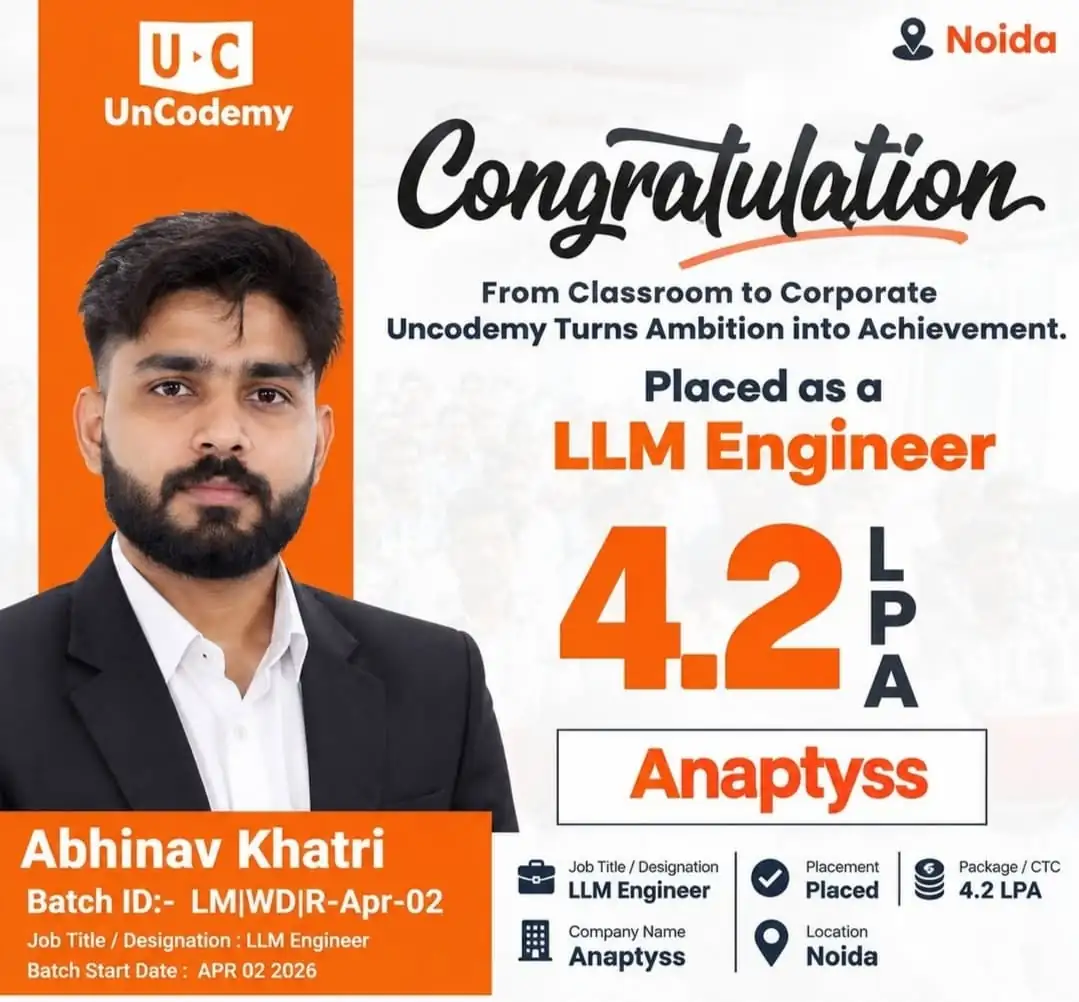
Abhinav Khatri
4.2 LPA
Noida

Abhinav Khatri

LLM Engineer

Placed at:Anaptyss

Batch: (LM|WD|IR-Apr-02)
Read placement record
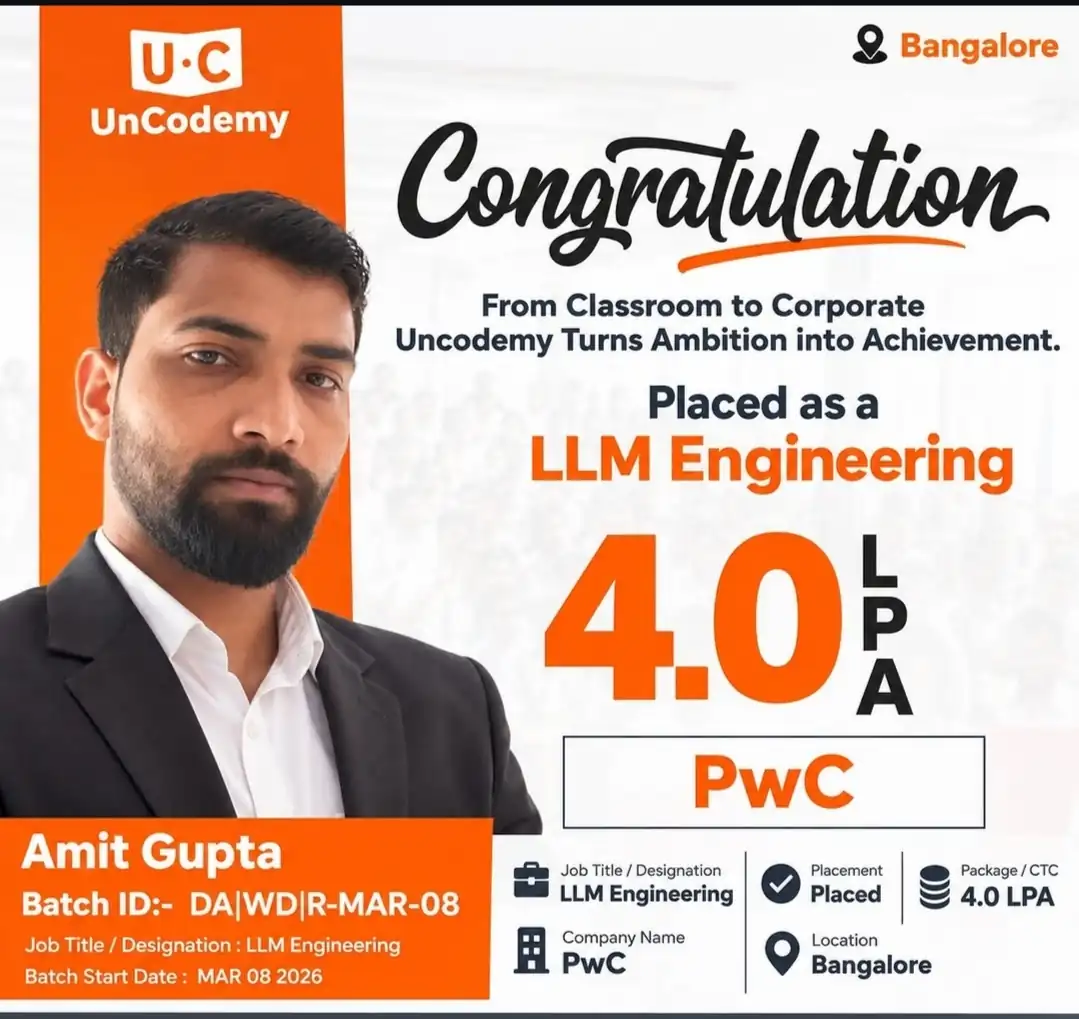
Amit Gupta
4.0 LPA
Bangalore

Amit Gupta

LLM Engineer

Placed at: PwC

(DA|WD|R-MAR-08)
Read placement record
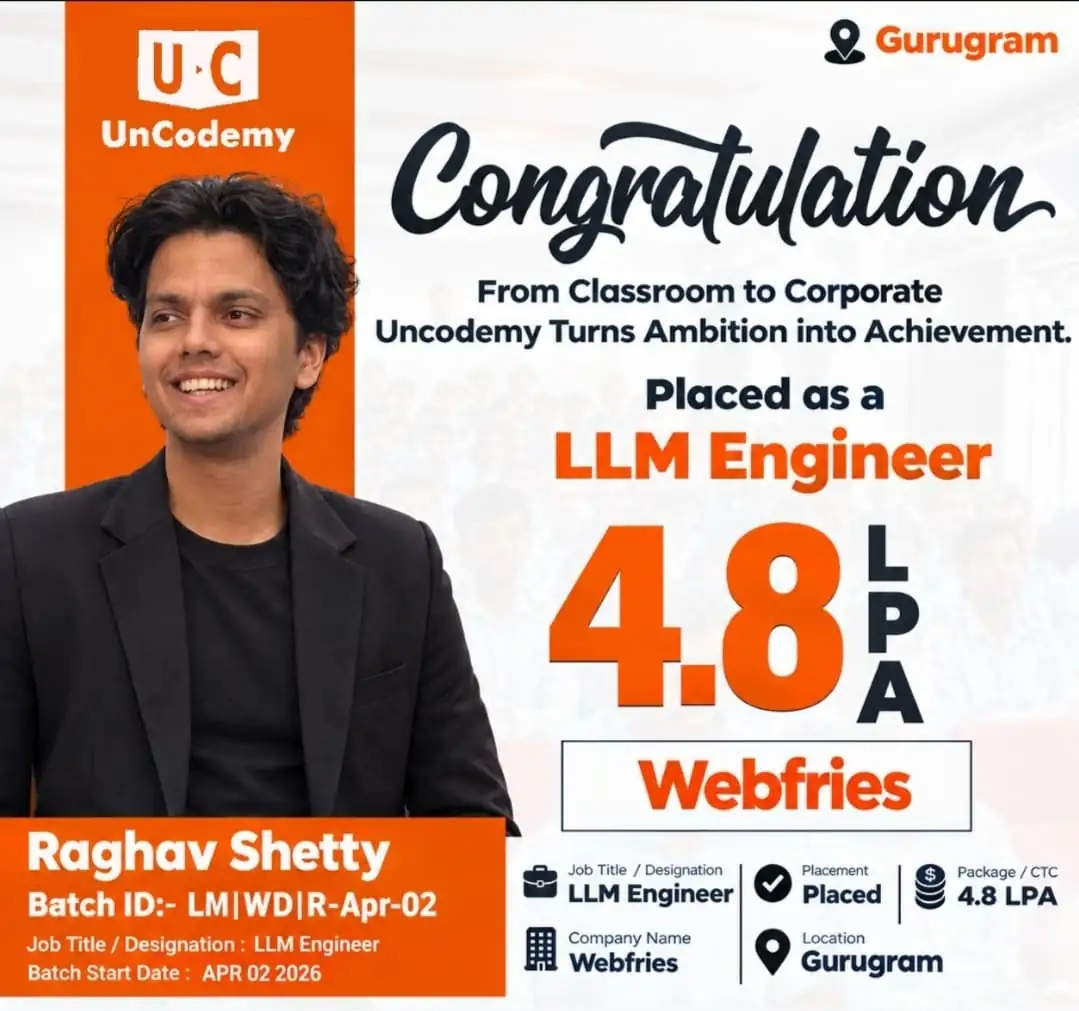
Raghav Shetty
4.8 LPA
Gurugram

Raghav Shetty

LLM Engineer

Placed at: Webfries

(LM|WD|R-Apr-02)
Read placement record
Ayush Asthana
9 LPA
India

Ayush Asthana

Senior Test Specialist

Placed at:Cognizant

APIAT/P/WD/R 08:00 AM 12J+10JL - UC
Read placement record
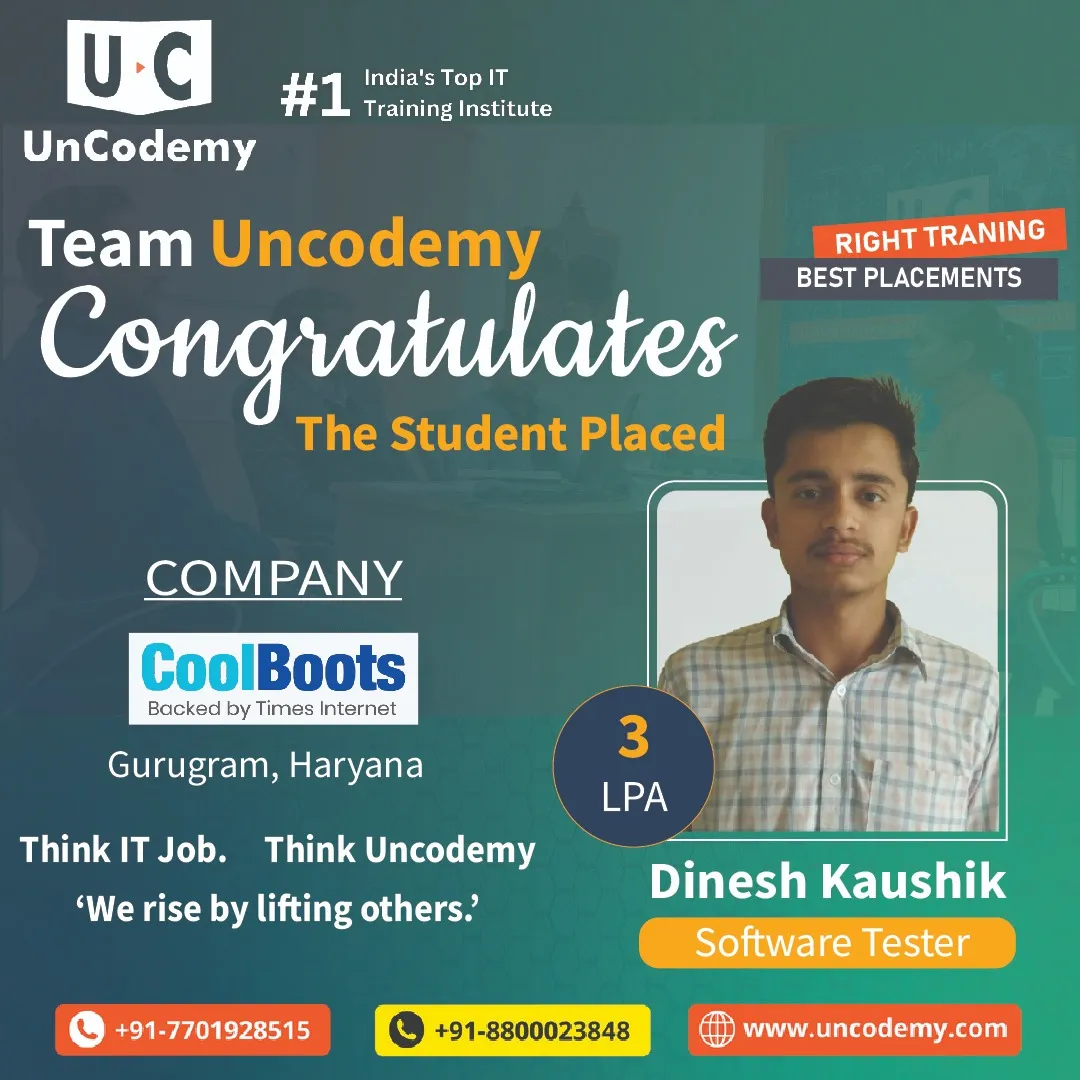
Dinesh Kaushik
3 LPA
Gurugram, Haryana

Dinesh Kaushik

Software Tester

Placed at:CoolBoots

ST/09/0823/S WD 7PM
Read placement record

What is LLM Engineering?

LLM engineering is the discipline of designing, building, fine-tuning and deploying applications powered by large language models. Traditional software engineering depends on deterministic logic; data science centres on predictive modelling from data. LLM engineering instead works with probabilistic models, prompt design, retrieval pipelines and model adaptation. It merges software engineering, machine learning and product development into one practice, converting raw LLM capabilities into dependable, production-ready features.

What does an LLM engineer do? An LLM engineer works with LLM APIs and SDKs, builds RAG pipelines using embeddings and vector databases, fine-tunes models for domain-specific tasks, designs LLM agents with tool calling, evaluates model outputs, and deploys LLM-powered applications. Daily work spans Python scripting, prompt engineering, retrieval evaluation, API integration, and using frameworks like LangChain to bring models, data and tools into a single working application.

LLM Engineering vs Generative AI vs Data Science

LLM Engineering focuses on building, fine-tuning and deploying LLM-powered applications, while Generative AI & Agentic AI emphasises autonomous agents and Data Science focuses on predictive modelling.

Aspect LLM Engineering Generative AI Data Science
Core focus Building, fine-tuning & deploying LLM-powered applications Building GenAI apps + autonomous AI agents/multi-agent systems Predictive modelling from data
Coding depth High Moderate to High High
Typical entry salary ₹6–10 LPA (Entry-Level LLM Engineer) [CONFIRM per GenAI course sheet] ₹4–8 LPA (per Data Science course sheet)
Uncodemy program duration 5–6 months ~3–4 months (indicative) 8–9 months

Salary ranges are indicative and vary by role, skills, experience, location and employer.

Course Overview

Gurugram learners can join this LLM Engineering course as a fully live online program running 5–6 months, with 100+ live sessions and 160+ hours of instruction. The 13 modules progress in a structured order — Generative AI foundations, Python for LLM engineering, ML & NLP fundamentals, transformer architecture, prompt engineering, LLM APIs & SDKs, embeddings & vector databases, RAG, LLM application development, fine-tuning, LLM agents & tool calling, evaluation & deployment, and a 20-hour Enterprise LLM capstone. Each module combines conceptual learning with practical, tool-based exercises, and the program ends with hands-on projects, RAG applications and an enterprise-grade capstone. Delivery is entirely online — convenient for Gurugram and pan-India learners.

Who should join this course:

  • Developers who want to specialise in LLM-powered applications and generative AI.
  • Data scientists and ML engineers ready to upskill into LLM engineering and RAG pipelines.
  • Aspiring AI engineers looking to build production-ready LLM applications.
  • Working professionals shifting into GenAI/LLM roles from software or analytics backgrounds.
  • Gurugram-based learners who want instructor-led live online training with real hands-on projects.

Eligibility: Knowing programming fundamentals helps, though it isn't compulsory — Python is introduced starting Module 2. Ease with fundamental ML/NLP ideas is an advantage but strengthened in Module 3. A laptop with steady internet is necessary for practical sessions.

Upcoming LLM Engineering Course Batches for Gurugram Learners

Pick a live online batch timing that fits your schedule — every batch runs on IST. A free demo class is a great first step to see how sessions are taught before you commit. After that, choose from upcoming weekday or weekend batches, designed for working professionals and students, with flexible timings and a strong hands-on focus.

Weekdays

Date Time Trainer Seats Left
16oct 07:30 PM – 08:30 PM Mr. Irshad Khan 01Seat
22oct 02:00 PM – 03:00 PM Mr. Upendra Kumar Tiwari 02Seats
26oct 10:30 AM – 11:30 AM Mr. Irshad Khan 01Seat
30oct 12:00 PM – 01:00 PM Mr. Upendra Kumar Tiwari 02Seats

Weekends

Date Time Trainer Seats Left
27oct 03:00 PM – 05:00 PM Mr. Irshad Khan 02Seats

8+ new batches start every month. All timings are in IST. Seats are limited and updated daily.

Curriculum for LLM Engineering Training Course in Gurugram

LLM Engineering Course Syllabus in Gurugram

The syllabus is organised into 13 modules covering 160 hours. The order follows how LLM engineering actually works: foundations → Python → ML/NLP basics → transformer architecture → prompt engineering → LLM APIs → embeddings/vector DBs → RAG → application development → fine-tuning → agents & tool calling → evaluation/deployment → capstone. Each module includes practical exercises with real tools, and the program closes with hands-on projects, RAG applications and an enterprise LLM capstone.

Module 1: LLM & Generative AI Foundations — 8 Hours

  • Introduction to large language models and generative AI
  • LLM architecture basics: parameters, context windows
  • Tokenization, embeddings and model behaviour
  • GenAI landscape: major model providers and use cases
  • How LLMs differ from traditional software systems
  • Probabilistic outputs and non-determinism in LLMs

Module 2: Python for LLM Engineering — 10 Hours

  • Python syntax, data structures and control flow
  • Functions, modules and packages
  • Working with APIs, JSON and environment variables
  • Virtual environments and dependency management
  • Error handling and debugging for LLM applications
  • Async programming basics for API calls

Module 3: Machine Learning & NLP Fundamentals — 10 Hours

  • Supervised vs unsupervised learning basics
  • Training, validation and test splits
  • Text preprocessing and tokenization for NLP
  • Word embeddings and vector representations
  • Attention mechanisms and sequence modelling
  • Evaluation metrics for NLP tasks

Module 4: Transformers & LLM Architecture — 12 Hours

  • Transformer architecture: encoder, decoder, attention
  • Self-attention and multi-head attention
  • Positional encoding and context length
  • Pre-training vs fine-tuning paradigms
  • Model sizes, distillation and quantization
  • Hands-on: loading and inspecting transformer models

Module 5: Prompt Engineering & Structured Outputs — 8 Hours

  • Prompt design patterns and best practices
  • Zero-shot, few-shot and chain-of-thought prompting
  • Structured outputs: JSON, XML, function schemas
  • Prompt versioning and regression testing
  • Handling ambiguity and edge cases
  • Evaluating prompt reliability

Module 6: Working with LLM APIs & SDKs — 10 Hours

  • Overview of LLM APIs (OpenAI/Gemini/Claude-style)
  • Authentication, rate limits and error handling
  • Streaming responses and async calls
  • Function calling and structured output APIs
  • Cost management and token optimization
  • Building reusable API wrappers in Python

Module 7: Embeddings & Vector Databases — 10 Hours

  • Text embeddings and semantic similarity
  • Vector databases: FAISS, Chroma, Pinecone
  • Indexing strategies and performance trade-offs
  • Chunking strategies for documents
  • Metadata filtering and hybrid search
  • Hands-on: building a vector search pipeline

Module 8: Retrieval-Augmented Generation (RAG) — 15 Hours

  • RAG architecture: retriever, generator, context
  • Building end-to-end RAG pipelines with LangChain
  • Retrieval accuracy and relevance evaluation
  • Reranking and context compression
  • Handling multi-document and multi-hop queries
  • Hands-on: building a production-style RAG application

Module 9: LLM Application Development — 12 Hours

  • Designing LLM-powered applications
  • Chains, memory and context management
  • Integrating LLMs with external data sources
  • Building chat interfaces and APIs
  • Error handling and fallback strategies
  • Hands-on: building an LLM app with LangChain

Module 10: Fine-Tuning & Model Adaptation — 15 Hours

  • When to fine-tune vs prompt engineering vs RAG
  • Dataset preparation and formatting for fine-tuning
  • Parameter-efficient fine-tuning (LoRA, adapters)
  • Using Hugging Face Transformers for fine-tuning
  • Evaluating fine-tuned model performance
  • Hands-on: fine-tuning a small LLM on a custom dataset

Module 11: LLM Agents & Tool Calling — 15 Hours

  • Agent architecture: planning, tool use, memory
  • Tool calling and function execution
  • Multi-step reasoning and task decomposition
  • Building agents with LangChain
  • Agent evaluation and failure mode analysis
  • Hands-on: building a tool-using LLM agent

Module 12: LLM Evaluation, Optimization & Deployment — 15 Hours

  • Evaluation metrics for LLM outputs
  • Automated evaluation with LLM-as-judge
  • Observability and tracing for LLM applications
  • Latency, cost and throughput optimization
  • Deployment patterns: APIs, containers, serverless
  • Monitoring production LLM applications

Module 13: Enterprise LLM Projects & Capstone — 20 Hours

  • End-to-end LLM application design and architecture
  • RAG + fine-tuning + agents integration project
  • Deployment and evaluation of capstone application
  • Code review and portfolio preparation
  • Presentation and documentation of capstone project
  • Interview preparation around capstone work
# Module Hours Tools
1 LLM & Generative AI Foundations 8 ChatGPT, Gemini, Claude
2 Python for LLM Engineering 10 Python, Git
3 Machine Learning & NLP Fundamentals 10 Python, scikit-learn, NLTK
4 Transformers & LLM Architecture 12 Hugging Face Transformers
5 Prompt Engineering & Structured Outputs 8 ChatGPT, Gemini, Claude
6 Working with LLM APIs & SDKs 10 OpenAI/Gemini/Claude APIs, Python
7 Embeddings & Vector Databases 10 FAISS, Chroma, Pinecone
8 Retrieval-Augmented Generation (RAG) 15 LangChain, Vector DBs
9 LLM Application Development 12 LangChain, Python
10 Fine-Tuning & Model Adaptation 15 Hugging Face, LoRA
11 LLM Agents & Tool Calling 15 LangChain, Python
12 LLM Evaluation, Optimization & Deployment 15 LangSmith, Docker, Python
13 Enterprise LLM Projects & Capstone 20 All tools
Total 160 Hours 15+ tools

Contacted by

IR

Mr. Irshad Khan

Curriculum & Technical Reviewer

[8+ Years Of Experience]

Specialization: LLM Engineering, Generative AI, RAG & Fine-Tuning

Get Your LLM Engineering Certification In Gurugram

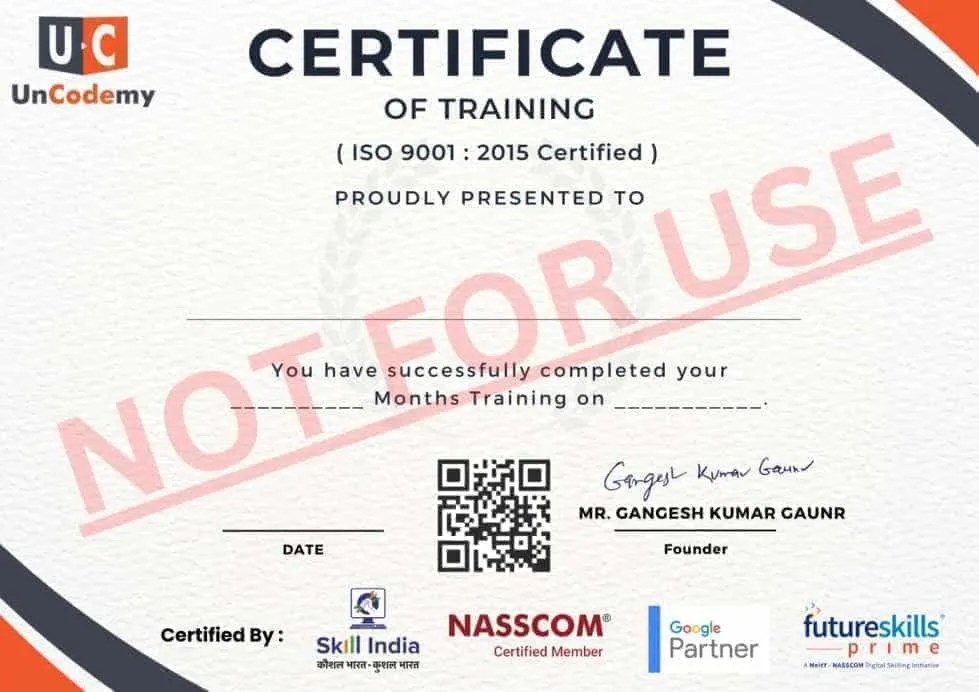
After finishing all 13 modules, the assignments and the Enterprise LLM capstone project, learners are awarded the Uncodemy LLM Engineering Program Certificate. It carries the program name, duration, tools covered and completion date. The certificate is verifiable online at certificate.uncodemy.com and provides a formal record of successful completion of the Uncodemy LLM Engineering program.

The certificate is tied to the practical work completed during the program — hands-on RAG applications, fine-tuning exercises and the 20-hour Enterprise LLM capstone project. Learners work with LLM APIs & SDKs (OpenAI/Gemini/Claude-style), LangChain, Vector Databases (FAISS/Chroma/Pinecone), Python, Hugging Face Transformers, prompt engineering tools, fine-tuning frameworks and evaluation/observability tools.

Key Benefits of Our LLM Engineering Certification:

  • Program Completion :Provides a record of successful completion of the LLM Engineering program.
  • Online Verification :Certificate is verifiable online at certificate.uncodemy.com.
  • Practical Learning :Training includes hands-on RAG applications, fine-tuning work and an enterprise capstone.

This is an independent Uncodemy certificate. It is not affiliated with, endorsed by, or a credential of OpenAI, Google, Anthropic or any other LLM/vendor provider whose APIs are taught in this course. Certificate verification process pending confirmation.

Uncodemy Certificate Verification Online Certificate Verification & Download certificate.uncodemy.com
Uncodemy MSME registration certificate

Tools and Technologies Covered

Apply Now

Introducing Uncodemy


Portfolio/capstone project review:Your hands-on RAG applications, fine-tuning work and enterprise LLM capstone are reviewed and refined into a portfolio an interviewer will find credible.

Resume & LinkedIn:We shape your resume around LLM engineering keywords and measurable outcomes, and align your LinkedIn profile to match.

Interview preparation:System design for LLM applications, RAG pipeline debugging, fine-tuning trade-off questions and LLM engineering case studies specific to AI hiring.

Mock interviews:Sessions with industry trainers, followed by written feedback on what to improve.

Opportunity sharing:Relevant openings are shared with you, with support through the application and interview process.

Continued support:This is active assistance, not a guarantee of employment — no training institute can honestly promise a job. Support continues after your program ends for learners who stay engaged with the process.

Instructors

The people who actually teach this course

Uncodemy maintains two roles apart that most institutes combine into one. Trainers provide the live sessions. Domain reviewers — independent specialists who don't teach the batch — verify the curriculum is technically accurate and current. For this program, curriculum and technical content are reviewed by Mr. Irshad Khan, with additional review by Mr. Upendra Kumar Tiwari. This means whoever teaches a course is not the only person checking whether its content is correct.

Every trainer and domain reviewer associated with Uncodemy is published by name, with their domain and background — you can look them up before you enrol rather than after.

Gurugram guide

Shipping LLM features to production from Gurugram

A lot of Gurugram's software is consumer-facing at very large scale: travel bookings, food orders, insurance quotes, card services. In teams like these an LLM feature is not a weekend demo; it has to answer in under a couple of seconds, survive traffic spikes, stay within a cost budget and be monitored like any other service. This page looks at the course from that production angle, explains how a Gurugram learner can attend, and is honest about what the course will and will not get you.

Product teams

What LLM work looks like inside Gurugram product companies

Several well-known consumer businesses are headquartered in Gurugram — Zomato, MakeMyTrip and Policybazaar among them — and large global capability centres such as American Express run technology teams here. We name them only to describe the market; Uncodemy has no hiring tie-up with any of them.

Read moreRead less

In companies of this kind, typical LLM use cases are support assistants that read order or policy history, search that understands loose queries ("cheap hill station trip in May"), summaries of long customer conversations for agents, and internal tools over policy and process documents. The engineering questions are about reliability at volume: what happens when the model provider is slow, how answers are grounded in the company's own data, how a new prompt is rolled out without breaking last week's behaviour, and who gets paged when quality drops.

Prod checklist

Five production habits Gurugram teams expect

These are the habits that separate a notebook prototype from a feature a large Gurugram product can launch. Each one maps to a part of the course.

  1. Version prompts like code — prompts live in Git, changes go through review and a regression set (prompt engineering module).
  2. Validate every structured output — parse the JSON against a schema and retry or fall back when it fails (structured outputs and API modules).
  3. Measure retrieval separately from generation — a wrong answer is often a retrieval miss, not a model problem (RAG module).
  4. Trace every request — log inputs, retrieved chunks, tokens, latency and cost so you can debug a single bad answer (evaluation and deployment module).
  5. Plan for the provider failing — timeouts, a cheaper fallback model and a polite "I can't answer that right now" path (application development module).
Read moreRead less

None of this needs a huge GPU budget. Most production LLM features in consumer apps call hosted APIs; the skill is in the plumbing, testing and monitoring around the call.

Getting to class

Online from Gurugram, or a classroom across NCR

Gurugram has no Uncodemy centre. The classrooms are in Noida (Sector 1) and Delhi (Shakarpur Extension, Laxmi Nagar), so you have two honest choices.

Live online

Same trainers, curriculum and assignments as the classroom batches, with no commute. Most people working in Cyber City, Golf Course Road or Udyog Vihar choose this, especially for weekday evening batches.

Classroom in Delhi or Noida

Possible, but plan for it: from Gurugram the Delhi centre near Laxmi Nagar and the Noida Sector 1 centre (near the Sector 15 metro station) are both on the far side of Delhi, often well over an hour each way by metro. It suits people who want face-to-face weekend sessions and do not mind the travel.

Read moreRead less

Ask the counsellor which LLM batches are currently running in a classroom before you choose, since batch formats change. You can attend a free demo class either way. The facts below are the same whichever mode you pick.

  • Duration5–6 months
  • Content160+ hours
  • Live classes100+ live sessions
  • Fee₹17,500 + GST
  • EMIfrom ₹4,032 a month (exact amount and tenure depend on the payment option)
Who it fits

Gurugram professionals who get the most out of it

  • Backend engineers (Java, Go, Node, Python) at product companies who have been asked to own an LLM feature and want the retrieval, evaluation and fine-tuning theory behind it.
  • Data scientists and analysts at GCCs and insurers who already know Python and modelling and want to move into building LLM applications rather than reporting on them.
  • Engineers in IT-services delivery teams along Sohna Road and Udyog Vihar who see GenAI projects being staffed and want to be considered for them.
Read moreRead less

It suits fewer people who only need to use ChatGPT-style tools well at work; that is a much shorter learning curve. The course covers 13 modules including Python, transformers and fine-tuning, so it is a commitment of 5–6 months. Programming fundamentals help, but Python is taught from Module 2 onwards and basic ML/NLP is built up in Module 3.

Latency and cost

The latency and cost maths a Gurugram interviewer will ask about

At consumer scale, small numbers multiply. A feature that sends 3,000 tokens per request looks cheap in testing and becomes a real line item when it runs on every order or booking. Interviewers at high-traffic companies often hand you a scenario and ask you to reduce cost or latency without losing quality.

Read moreRead less
  • Trim the context: retrieve fewer, better chunks with reranking instead of stuffing ten documents into the prompt.
  • Route by difficulty: send easy requests to a smaller, cheaper model and only escalate the hard ones.
  • Cache: identical or near-identical questions ("what is the cancellation policy?") do not need a fresh model call each time.
  • Stream: streaming the first tokens makes a slow answer feel fast in a chat interface.

Be ready to estimate cost per thousand requests on a whiteboard. Practising that arithmetic on your own projects is worth more than memorising model names.

Pay

Indicative pay for LLM-related roles in Gurugram

ProfileTypical titleIndicative range
Fresher or under 1 year, strong projectsAssociate AI / GenAI engineer₹5–9 LPA
2–4 years software or data experience + LLM workLLM engineer / AI engineer₹12–22 LPA
5+ years, owns LLM features in productionSenior AI engineer / tech lead₹25–45 LPA
Read moreRead less

Indicative only. Gurugram pay varies widely between consumer-internet firms, GCCs and services companies, and many of these roles hire laterally from people who already have software experience. Treat the bands as a rough guide and compare current listings before you negotiate.

Capstone

A capstone that looks like Gurugram production work

Build a support assistant for a made-up travel or insurance company. Put its policy documents in a vector database, add a tool that looks up a fake booking by ID, and return a structured response the frontend can render.

Read moreRead less
  • Quality: a test set of real-sounding customer questions with expected answers, run automatically on every prompt change, with an LLM-as-judge score you have spot-checked by hand.
  • Operations: traces for every request, a dashboard of latency and cost, and a fallback when the model times out.
  • Safety: refuse to reveal another customer's booking, and never let the model invent a refund amount — the amount comes from the tool, not the text.
  • Delivery: a Docker image, a short design document and a demo video in the repository.

The course's enterprise capstone gives you the time and review to build something of this size; the domain choice is yours.

Interviews

How LLM hiring loops in Gurugram tend to run

Product companies here usually keep their normal engineering loop — coding round, system design, a hiring-manager conversation — and add one LLM-specific round. That round is often a design discussion: "design a support bot for our app" or "our RAG answers got worse after a document update; how do you find out why?"

Read moreRead less

Two points to prepare for. First, you still need to pass the coding round, so do not drop data-structure practice during the course. Second, be ready to talk about failure: an evaluation that caught a regression, a prompt that leaked instructions, a cost spike you fixed. Uncodemy provides resume reviews, mock interviews and job-application support (placement assistance, not a job guarantee); the interviews themselves depend on your preparation and your projects.

Explore

More for Gurugram learners

Frequently Asked Questions

1. Is there an Uncodemy centre in Gurugram?▼

No. The classrooms are in Noida (Sector 1) and Delhi (Shakarpur Extension, Laxmi Nagar). Gurugram learners usually study live online; you can also travel to the Delhi or Noida classroom if a classroom batch is running for this course.

2. What does the LLM engineering course cost for Gurugram learners?▼

The fee is ₹17,500 + GST, or ₹20,650 including GST, and it is the same for every city and mode. EMI is available from ₹4,032 a month (exact amount and tenure depend on the payment option).

3. How long is the course and what does it include?▼

It takes 5–6 months, with 160+ hours and 100+ live sessions across 13 modules, and includes hands-on projects, RAG applications and a 20-hour enterprise LLM capstone. Tools include LLM APIs/SDKs, LangChain, vector databases (FAISS, Chroma, Pinecone), Python, Hugging Face, prompt engineering, fine-tuning (LoRA), evaluation tools and Git.

4. I work long hours in Cyber City. Can I manage this course?▼

Yes, if you protect the time. Most working learners take a live online batch at a fixed slot and set aside a few hours each weekend for assignments. Missing the Python and RAG modules makes the later ones much harder.

5. Which Gurugram companies use LLMs in their products?▼

Consumer-internet firms, insurers, travel and fintech companies and global capability centres in Gurugram are building LLM features such as support assistants and search. Uncodemy has no hiring tie-up with any specific company.

6. Will this course help me move from backend development into an AI engineer role?▼

It gives you the LLM-specific skills — APIs, retrieval, fine-tuning, evaluation and deployment — that backend engineers usually lack. Your existing engineering experience is a strong advantage; the course does not replace it.

7. Do I need prior coding experience?▼

Programming fundamentals help, but Python is taught from Module 2 onwards and basic ML/NLP is built up in Module 3.

8. Does Uncodemy guarantee a job in Gurugram after the course?▼

No. You get resume reviews, mock interviews and job-application support (placement assistance, not a job guarantee). No institute can honestly promise a job.

Why Trust This Page? Discover Why Students Choose Uncodemy

How we maintain this page

  • Content written by:Mr. Rahul
  • Content rechecked and verified by: Mr. Irshad Khan
  • Course curriculum verified by:Mr. Irshad Khan
  • Technical content verified by: Mr. Irshad Khan
  • Fee verified by: Admin Department
  • Placement figures sourced from internal placement records
  • Review counts verified against respective third-party platforms
  • Last reviewed:
Application Form
Visit Us

Nearest Classroom Training Centres

Open now
Delhi Centre
2nd & 3rd Floor, Maa Katyayni Complex, MB-1E, Madhuban Rd, next to DSEU Ambedkar College, Laxmi Nagar, Shakarpur Extension, Shakarpur, Delhi, 110092
Noida Centre
B, 14-15, Udhyog Marg, Block B, Sector 1, Noida, Uttar Pradesh 201301
Free demo classWalk-ins welcomeWheelchair accessible