#1 India's Top IT Training Institute
×

About Uncodemy

Know more about who we are and what we stand for.

About Us

About Us

Discover our mission to equip individuals with essential IT skills and industry expertise.

Read More →
UnCodeMy Gallery

UnCodeMy Gallery

Explore highlights from our IT training sessions and success stories.

Read More →
Mentors

Mentors

Meet the industry experts who train and guide you through your course.

Read More →
Free Resources

Free Resources

Free tutorials, interview questions, tools and calculators to help you learn.

Explore →
×

Free Resources

Learn, practice and plan your career — bilkul free.

Tutorials

Tutorials

Step-by-step written tutorials to learn any technology at your own pace.

Read More →
Free Counselling

Free Counselling

Book a free video counselling session and pick the right course for you.

Read More →
Online Compiler

Online Compiler

Write, run and test your code online — no setup required.

Read More →
🔥 Most Popular in Raipur

LLM Engineering Training Course in Raipur by Uncodemy

Uncodemy now brings its 5–6 month instructor-led live online LLM Engineering course to Raipur-based learners. The course curriculum navigates LLM APIs, embeddings & vector databases, RAG, fine-tuning, LLM agents & tool calling, and deployment. It serves developers, data scientists/ML engineers and aspiring AI engineers, and offers 13 modules, 100+ live sessions, 160+ hours and an enterprise LLM capstone. Fee: ₹17,500 + 18% GST, total ₹20,650. EMI starting from ₹4,032/month.

⚡SPECIAL LIMITED TIME OFFER

Special Offer: LLM Engineering Program

Now Pay Only
₹17,500/-
+ 18% GST
No Hidden Charges
100% Transparent
Total ₹20,650
Incl. 18% GST
EMI AVAILABLE
Starting ₹4,032/M*
Fill Your Details
🔒 Your information is safe and secure.

Expert Trainers

Learn from 8+ years experienced professionals

Hands-on Automation Projects

Build real llm test suites, not just theory

Lifetime Access

Get lifetime access to recorded sessions & materials

Dedicated Career & Placement Assistance

Resume Building, Mock Interviews & Job Support

Certified Course

Certificate of Completion from Uncodemy

Flexible Batches

Weekday & Weekend Online & Offline

Why Choose
Uncodemy?

14+
Years of Training Excellence
54,000+
Learners Trained
200+
Corporate Associations
Dedicated
Career & Placement Assistance
Online & Offline Classes
Weekend & Weekday Batches
100% Practical Training
Affordable Fees
EMI Options Available
Dedicated Support

Program Details

LLM Engineering Course — Live Online Program Hands-on learning focused on practical LLM engineering skills and interview preparation.
A comprehensive 5–6 month instructor-led live online program covering LLM APIs, embeddings & vector databases, RAG, fine-tuning, LLM agents & tool calling, and deployment with practical projects, mentoring and career support.
📚 Learning:
160+ Hours of Learning
⏱️ Program Duration:
5–6 Months
🎓 Live Training:
100+ Live Sessions
🛠️ Technology Coverage:
15+ Tools & Technologies
💼 Practical Learning:
Hands-on Projects, RAG Applications & AI Case Studies
💰 Program Fee:
₹17,500 + 18% GST
💰 Total Fee:
₹20,650
💳 EMI:
Starting From ₹4,032/Month*
🚀 Career Support:
Dedicated Career & Placement Assistance
🎯 Career Support Includes:
Resume Building & LinkedIn Optimization, Mock Interviews & Interview Preparation, Career Guidance & Job Opportunity Assistance

LLM Engineering Course in Raipur — Quick Facts

🎓 Course:
LLM Engineering
🏢 Provider:
Uncodemy Edutech Pvt. Ltd.
📚 Total Learning:
160+ Hours of Learning
📖 Curriculum:
13 Modules
💼 Projects:
Hands-on Projects + Enterprise LLM Capstone
🛠️ Tools:
LLM APIs/SDKs, LangChain, Vector DBs, Python, Hugging Face, Prompt Engineering, Fine-Tuning, Evaluation, Git
🌐 Modes:
Live Online (offline only at Delhi & Noida centres; Raipur learners join live online)
✅ Prior Coding:
Programming fundamentals helpful; Python taught from Module 2 onward. Basic ML/NLP built up in Module 3.
📜 Certificate:
Uncodemy LLM Engineering Program Certificate (verifiable online)
🗓️ Last Reviewed:
11 November 2026

List of Placed Students Trained by Uncodemy

Candidates hailing from Raipur who complete the Uncodemy LLM Engineering training build practical command over LLM APIs, RAG pipelines, fine-tuning, vector databases and LLM agents. Once their training and career preparation is done, eligible learners can pursue roles such as LLM Engineer, AI Engineer and RAG/AI Application Engineer. Placement data for Raipur learners is refreshed at regular intervals — see verified outcomes at uncodemy.com/placement.

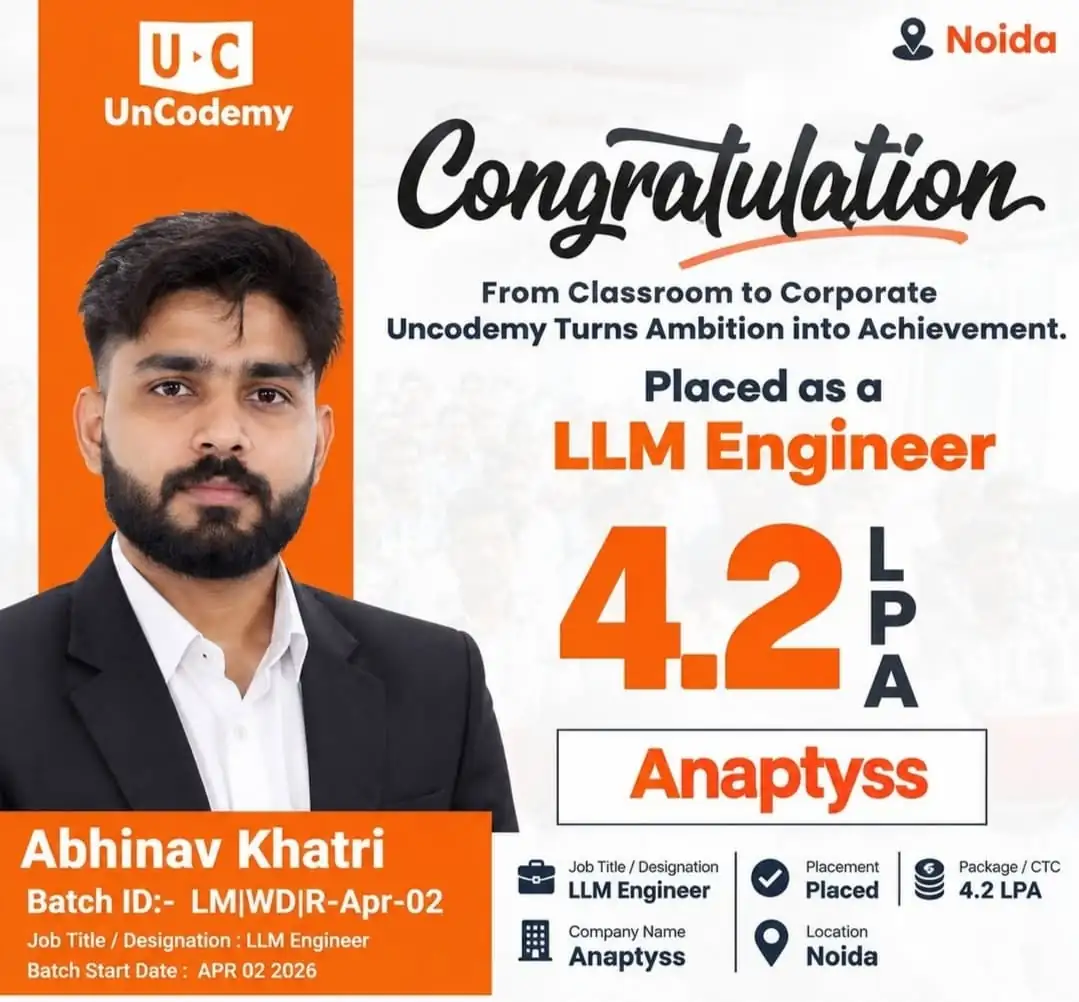
Abhinav Khatri
4.2 LPA
Noida

Abhinav Khatri

LLM Engineer

Placed at:Anaptyss

Batch: (LM|WD|IR-Apr-02)
Read placement record
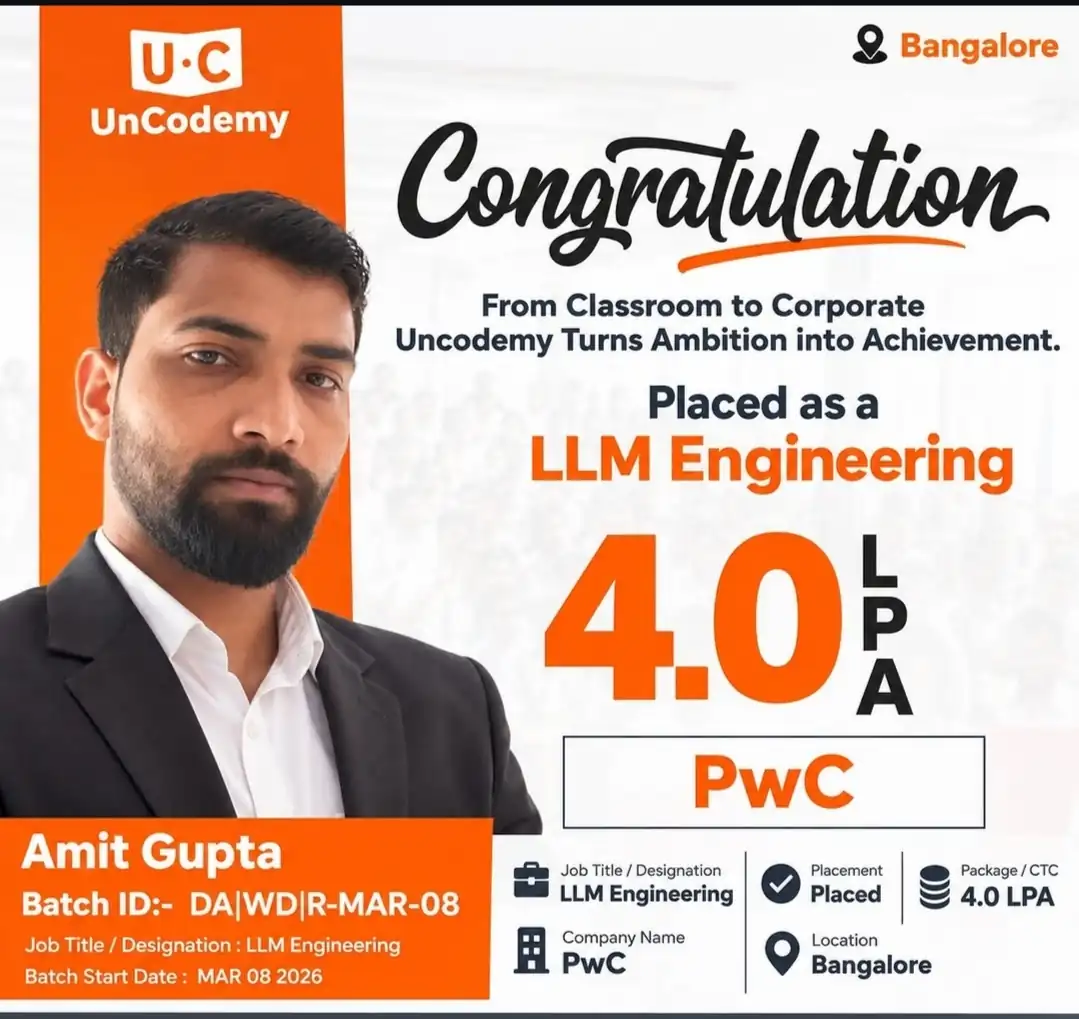
Amit Gupta
4.0 LPA
Bangalore

Amit Gupta

LLM Engineer

Placed at: PwC

(DA|WD|R-MAR-08)
Read placement record
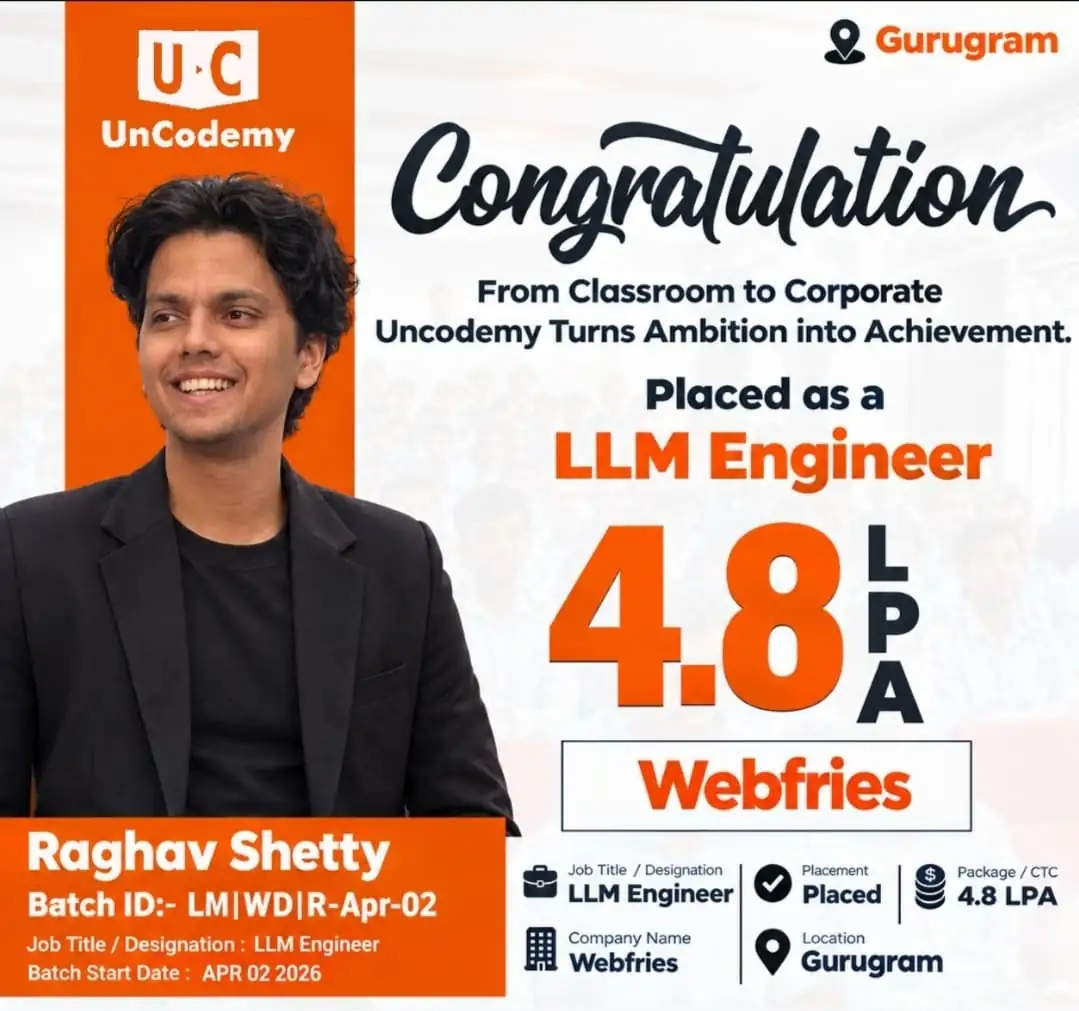
Raghav Shetty
4.8 LPA
Gurugram

Raghav Shetty

LLM Engineer

Placed at: Webfries

(LM|WD|R-Apr-02)
Read placement record
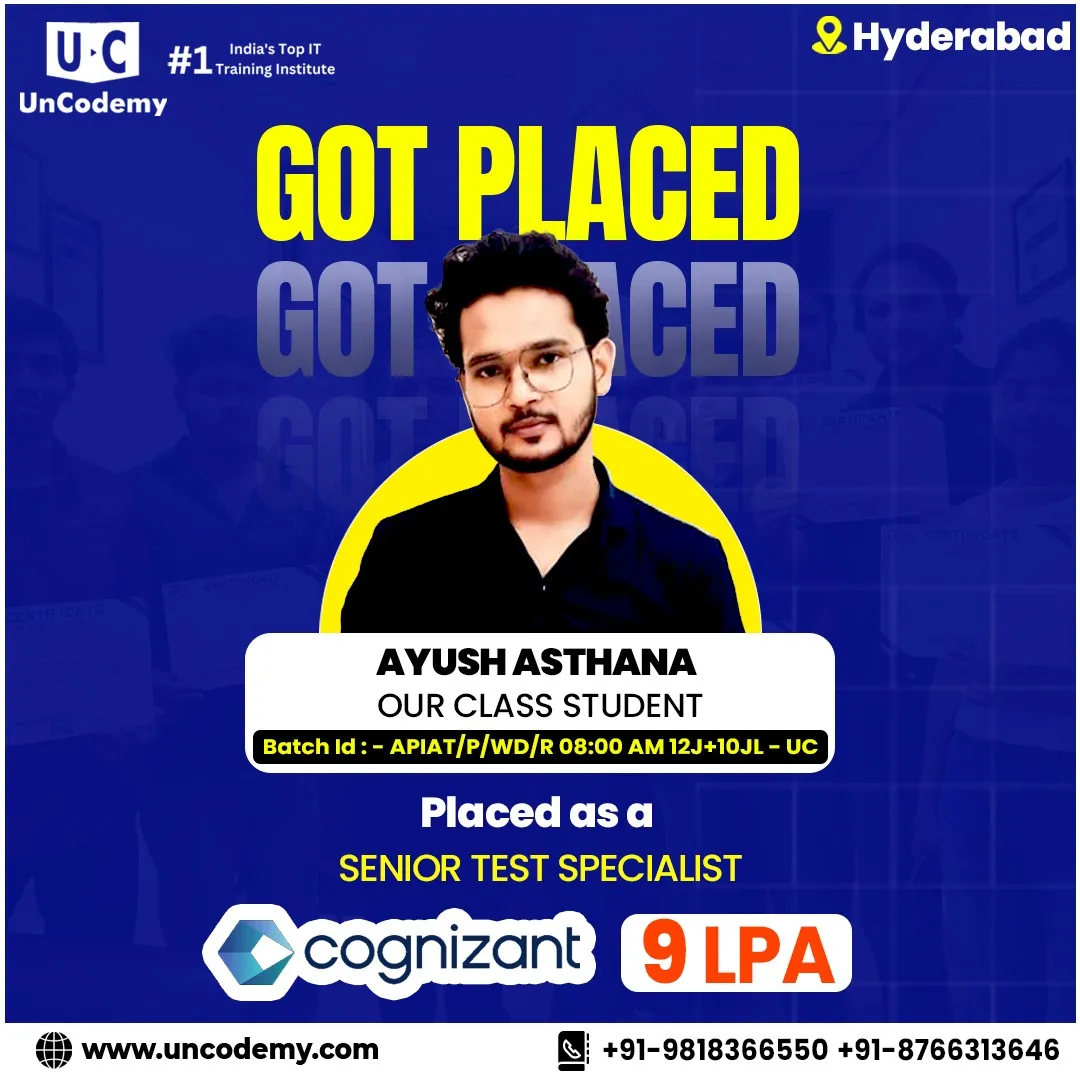
Ayush Asthana
9 LPA
India

Ayush Asthana

Senior Test Specialist

Placed at:Cognizant

APIAT/P/WD/R 08:00 AM 12J+10JL - UC
Read placement record
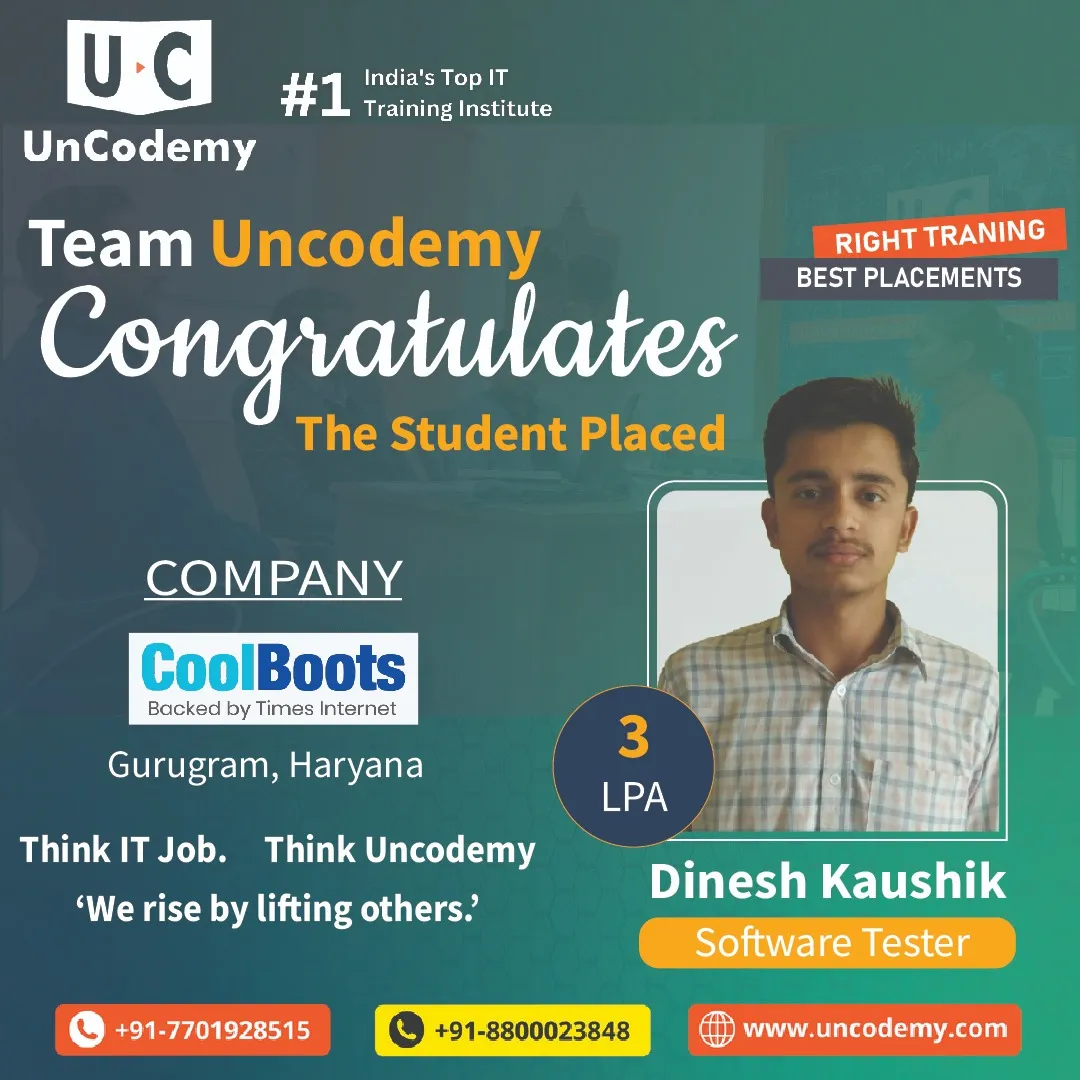
Dinesh Kaushik
3 LPA
Gurugram, Haryana

Dinesh Kaushik

Software Tester

Placed at:CoolBoots

ST/09/0823/S WD 7PM
Read placement record

What is LLM Engineering?

LLM engineering is the discipline of conceptualising, building, adapting and running applications that are fuelled by large language models. Traditional software engineering depends on deterministic rules and data science focuses on statistical predictions from data, but LLM engineering functions in a probabilistic environment of prompts, retrieval systems and model tailoring. It resides at the overlap of software engineering, machine learning and product development, transforming the underlying capabilities of LLMs into dependable, production-grade functionality.

What does an LLM engineer do? An LLM engineer works with LLM APIs and SDKs, builds RAG pipelines on embeddings and vector databases, tunes models for specific domains, crafts LLM agents that call tools, assesses model output quality, and launches LLM-powered applications. Regular duties span Python coding, prompt engineering, retrieval quality evaluation, API integration, and using frameworks such as LangChain to bind models, data and tools into unified applications.

LLM Engineering vs Generative AI vs Data Science

LLM Engineering centres on building, adapting and delivering LLM-powered applications, while Generative AI & Agentic AI emphasises autonomous agents and Data Science is anchored in predictive modelling.

Aspect LLM Engineering Generative AI Data Science
Core focus Building, fine-tuning & deploying LLM-powered applications Building GenAI apps + autonomous AI agents/multi-agent systems Predictive modelling from data
Coding depth High Moderate to High High
Typical entry salary ₹6–10 LPA (Entry-Level LLM Engineer) [CONFIRM per GenAI course sheet] ₹4–8 LPA (per Data Science course sheet)
Uncodemy program duration 5–6 months ~3–4 months (indicative) 8–9 months

Salary ranges are indicative and vary by role, skills, experience, location and employer.

Course Overview

The LLM Engineering course is a 5–6 month live online program that includes 100+ live sessions and 160+ hours of learning. It is divided into 13 modules starting with Generative AI foundations and moving through Python for LLM engineering, ML & NLP fundamentals, transformer architecture, prompt engineering, LLM APIs & SDKs, embeddings & vector databases, RAG, LLM application development, fine-tuning, LLM agents & tool calling, evaluation & deployment, and a 20-hour Enterprise LLM capstone. Every module has practical exercises built with real tools, and the program ends with hands-on projects, RAG applications and an enterprise capstone. Sessions are conducted entirely live online for Raipur and learners across the nation.

Who should join this course:

  • Developers wanting to specialise in LLM-powered applications and generative AI.
  • Data scientists and ML engineers upskilling into LLM engineering and RAG pipelines.
  • Aspiring AI engineers looking to build production-ready LLM applications.
  • Working professionals moving into GenAI/LLM roles from software or analytics backgrounds.
  • Raipur-based learners who want instructor-led live online training with hands-on projects.

Eligibility: Prior exposure to programming fundamentals is helpful but not mandatory — Python is introduced from Module 2. Some familiarity with ML/NLP concepts is useful but will be developed in Module 3. A laptop with dependable internet access is required for practical sessions.

Upcoming LLM Engineering Course Batches for Raipur Learners

Find a batch timing that fits your daily schedule. Live online batches, IST timings. Book a free demo class first-hand, or join our upcoming weekend and weekday live batches — designed for both working professionals and students, with flexible timings and hands-on training.

Weekdays

Date Time Trainer Seats Left
16oct 07:30 PM – 08:30 PM Mr. Irshad Khan 01Seat
22oct 02:00 PM – 03:00 PM Mr. Upendra Kumar Tiwari 02Seats
26oct 10:30 AM – 11:30 AM Mr. Irshad Khan 01Seat
30oct 12:00 PM – 01:00 PM Mr. Upendra Kumar Tiwari 02Seats

Weekends

Date Time Trainer Seats Left
27oct 03:00 PM – 05:00 PM Mr. Irshad Khan 02Seats

8+ new batches start every month. All timings are in IST. Seats are limited and updated daily.

Curriculum for LLM Engineering Training Course in Raipur

LLM Engineering Course Syllabus in Raipur

The syllabus is organised into 13 modules covering 160 hours. The order follows how LLM engineering actually works: foundations → Python → ML/NLP basics → transformer architecture → prompt engineering → LLM APIs → embeddings/vector DBs → RAG → application development → fine-tuning → agents & tool calling → evaluation/deployment → capstone. Each module includes practical exercises with real tools, and the program closes with hands-on projects, RAG applications and an enterprise LLM capstone.

Module 1: LLM & Generative AI Foundations — 8 Hours

  • Introduction to large language models and generative AI
  • LLM architecture basics: parameters, context windows
  • Tokenization, embeddings and model behaviour
  • GenAI landscape: major model providers and use cases
  • How LLMs differ from traditional software systems
  • Probabilistic outputs and non-determinism in LLMs

Module 2: Python for LLM Engineering — 10 Hours

  • Python syntax, data structures and control flow
  • Functions, modules and packages
  • Working with APIs, JSON and environment variables
  • Virtual environments and dependency management
  • Error handling and debugging for LLM applications
  • Async programming basics for API calls

Module 3: Machine Learning & NLP Fundamentals — 10 Hours

  • Supervised vs unsupervised learning basics
  • Training, validation and test splits
  • Text preprocessing and tokenization for NLP
  • Word embeddings and vector representations
  • Attention mechanisms and sequence modelling
  • Evaluation metrics for NLP tasks

Module 4: Transformers & LLM Architecture — 12 Hours

  • Transformer architecture: encoder, decoder, attention
  • Self-attention and multi-head attention
  • Positional encoding and context length
  • Pre-training vs fine-tuning paradigms
  • Model sizes, distillation and quantization
  • Hands-on: loading and inspecting transformer models

Module 5: Prompt Engineering & Structured Outputs — 8 Hours

  • Prompt design patterns and best practices
  • Zero-shot, few-shot and chain-of-thought prompting
  • Structured outputs: JSON, XML, function schemas
  • Prompt versioning and regression testing
  • Handling ambiguity and edge cases
  • Evaluating prompt reliability

Module 6: Working with LLM APIs & SDKs — 10 Hours

  • Overview of LLM APIs (OpenAI/Gemini/Claude-style)
  • Authentication, rate limits and error handling
  • Streaming responses and async calls
  • Function calling and structured output APIs
  • Cost management and token optimization
  • Building reusable API wrappers in Python

Module 7: Embeddings & Vector Databases — 10 Hours

  • Text embeddings and semantic similarity
  • Vector databases: FAISS, Chroma, Pinecone
  • Indexing strategies and performance trade-offs
  • Chunking strategies for documents
  • Metadata filtering and hybrid search
  • Hands-on: building a vector search pipeline

Module 8: Retrieval-Augmented Generation (RAG) — 15 Hours

  • RAG architecture: retriever, generator, context
  • Building end-to-end RAG pipelines with LangChain
  • Retrieval accuracy and relevance evaluation
  • Reranking and context compression
  • Handling multi-document and multi-hop queries
  • Hands-on: building a production-style RAG application

Module 9: LLM Application Development — 12 Hours

  • Designing LLM-powered applications
  • Chains, memory and context management
  • Integrating LLMs with external data sources
  • Building chat interfaces and APIs
  • Error handling and fallback strategies
  • Hands-on: building an LLM app with LangChain

Module 10: Fine-Tuning & Model Adaptation — 15 Hours

  • When to fine-tune vs prompt engineering vs RAG
  • Dataset preparation and formatting for fine-tuning
  • Parameter-efficient fine-tuning (LoRA, adapters)
  • Using Hugging Face Transformers for fine-tuning
  • Evaluating fine-tuned model performance
  • Hands-on: fine-tuning a small LLM on a custom dataset

Module 11: LLM Agents & Tool Calling — 15 Hours

  • Agent architecture: planning, tool use, memory
  • Tool calling and function execution
  • Multi-step reasoning and task decomposition
  • Building agents with LangChain
  • Agent evaluation and failure mode analysis
  • Hands-on: building a tool-using LLM agent

Module 12: LLM Evaluation, Optimization & Deployment — 15 Hours

  • Evaluation metrics for LLM outputs
  • Automated evaluation with LLM-as-judge
  • Observability and tracing for LLM applications
  • Latency, cost and throughput optimization
  • Deployment patterns: APIs, containers, serverless
  • Monitoring production LLM applications

Module 13: Enterprise LLM Projects & Capstone — 20 Hours

  • End-to-end LLM application design and architecture
  • RAG + fine-tuning + agents integration project
  • Deployment and evaluation of capstone application
  • Code review and portfolio preparation
  • Presentation and documentation of capstone project
  • Interview preparation around capstone work
# Module Hours Tools
1 LLM & Generative AI Foundations 8 ChatGPT, Gemini, Claude
2 Python for LLM Engineering 10 Python, Git
3 Machine Learning & NLP Fundamentals 10 Python, scikit-learn, NLTK
4 Transformers & LLM Architecture 12 Hugging Face Transformers
5 Prompt Engineering & Structured Outputs 8 ChatGPT, Gemini, Claude
6 Working with LLM APIs & SDKs 10 OpenAI/Gemini/Claude APIs, Python
7 Embeddings & Vector Databases 10 FAISS, Chroma, Pinecone
8 Retrieval-Augmented Generation (RAG) 15 LangChain, Vector DBs
9 LLM Application Development 12 LangChain, Python
10 Fine-Tuning & Model Adaptation 15 Hugging Face, LoRA
11 LLM Agents & Tool Calling 15 LangChain, Python
12 LLM Evaluation, Optimization & Deployment 15 LangSmith, Docker, Python
13 Enterprise LLM Projects & Capstone 20 All tools
Total 160 Hours 15+ tools

Contacted by

IR

Mr. Irshad Khan

Curriculum & Technical Reviewer

[8+ Years Of Experience]

Specialization: LLM Engineering, Generative AI, RAG & Fine-Tuning

Get Your LLM Engineering Certification In Raipur

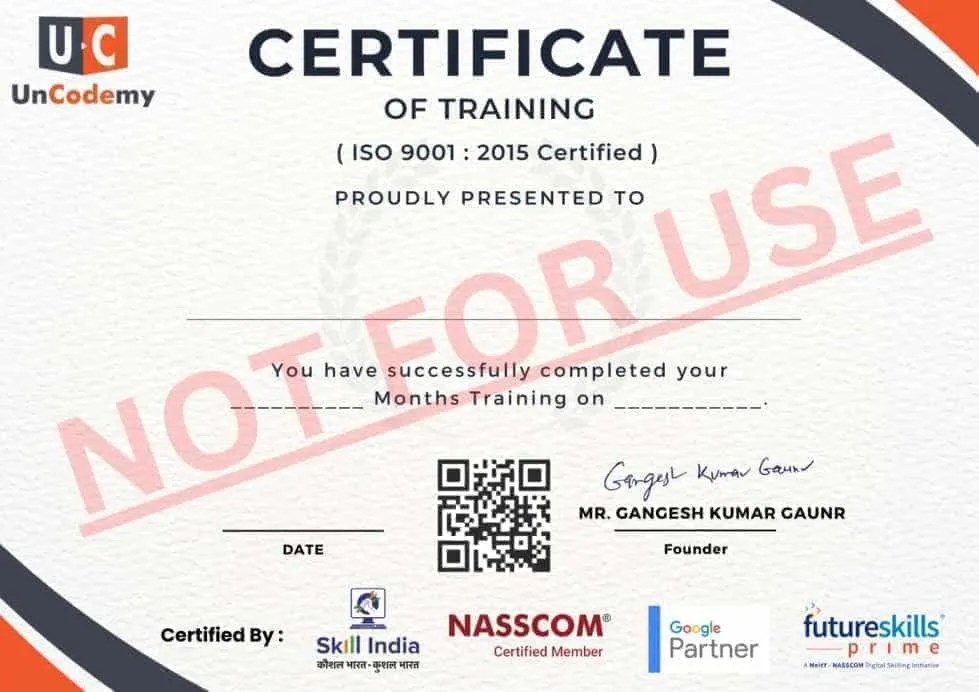
Once you complete all 13 modules, the assignments and the Enterprise LLM capstone project, you will be issued the Uncodemy LLM Engineering Program Certificate. The certificate details the program name, duration, tools covered and completion date. It can be verified online at certificate.uncodemy.com and serves as a formal record of your successful completion of the Uncodemy LLM Engineering program.

The certificate corresponds to the practical work you perform during the program — including hands-on RAG applications, fine-tuning exercises and the 20-hour Enterprise LLM capstone project. Learners get hands-on exposure to LLM APIs & SDKs (OpenAI/Gemini/Claude-style), LangChain, Vector Databases (FAISS/Chroma/Pinecone), Python, Hugging Face Transformers, prompt engineering tools, fine-tuning frameworks and evaluation/observability tools.

Key Benefits of Our LLM Engineering Certification:

  • Program Completion :Provides a record of successful completion of the LLM Engineering program.
  • Online Verification :Certificate is verifiable online at certificate.uncodemy.com.
  • Practical Learning :Training includes hands-on RAG applications, fine-tuning work and an enterprise capstone.

This is an independent Uncodemy certificate. It is not affiliated with, endorsed by, or a credential of OpenAI, Google, Anthropic or any other LLM/vendor provider whose APIs are taught in this course. Certificate verification process pending confirmation.

Uncodemy Certificate Verification Online Certificate Verification & Download certificate.uncodemy.com
Uncodemy MSME registration certificate

Tools and Technologies Covered

Apply Now

Introducing Uncodemy


Portfolio/capstone project review:Your hands-on RAG applications, fine-tuning work and enterprise LLM capstone are reviewed and refined into a portfolio an interview will find credible.

Resume & LinkedIn:We build your resume around LLM engineering keywords and measurable outcomes, and align your LinkedIn profile to match.

Interview preparation:System design for LLM applications, RAG pipeline debugging, fine-tuning trade-off questions and LLM engineering case studies specific to AI hiring.

Mock interviews:Sessions with industry trainers, followed by written feedback on what to fix.

Opportunity sharing:Relevant openings are shared with you, with support through the application and interview process.

Continued support:This is active assistance, not a guarantee of employment — no training institute can honestly promise a job. Support continues after your program ends for learners who stay engaged with the process.

Instructors

The people who actually teach this course

The course structure at Uncodemy keeps teaching and technical review as separate responsibilities. Live sessions are delivered by trainers, whereas independent domain reviewers who are not teaching the batch evaluate the curriculum for technical accuracy and up-to-date information. For this program, Mr. Irshad Khan reviews the curriculum and technical content, and Mr. Upendra Kumar Tiwari conducts an additional review. This gives learners an additional content-validation step beyond the trainer-led instruction.

Every trainer and domain reviewer associated with Uncodemy is published by name, with their domain and background — you can look them up before you enrol rather than after.

Raipur guide

Small models, big plants: LLM engineering from Raipur

Raipur and the neighbouring Bhilai–Durg belt are built on steel, power, cement and rice. Organisations in these industries have plenty of text — shift reports, quality records, purchase documents — but limited appetite for large monthly AI bills or for sending data outside. That makes one part of LLM engineering especially relevant here: choosing and adapting smaller models that run cheaply and privately, and knowing when fine-tuning helps. This page covers that angle, who joins from Raipur, and how the course is attended. Classes are live online; there is no Uncodemy centre in Chhattisgarh.

Local economy

Where language models could fit in Raipur's industries

The Bhilai Steel Plant, a ring of private steel, sponge-iron and power plants around Raipur, cement units in the region and hundreds of rice mills across Chhattisgarh form the backbone of local business. Raipur itself adds the state government in Nava Raipur, hospitals including AIIMS Raipur, and a modest software sector of ERP vendors, agencies and IT service providers. Uncodemy has no hiring tie-up with any organisation mentioned on this page.

Read moreRead less

Few of these employers advertise LLM roles. The openings are indirect: an ERP vendor asked to add a natural-language report search, a plant IT team asked whether shift logs can be summarised automatically, an agency asked for a Hindi chatbot. A developer who can answer those requests sensibly — including saying when an LLM is the wrong tool — becomes valuable quickly.

Nava Raipur's planned government district deserves a mention too. State departments run citizen-service portals and helplines that handle large volumes of Hindi and Chhattisgarhi queries, and their IT vendors are the most likely local buyers of conversational and document AI over the next few years. Such projects move slowly and come with strict data rules, so treat them as a long-term possibility rather than a quick job route.

Why small

Why smaller models matter for Raipur clients

Large frontier models through an API are the easiest place to start, but three things push Raipur organisations towards smaller models.

Cost

A plant or mill processing thousands of short records a day pays per token on an API. A small open model on one modest GPU can be cheaper at steady volume.

Privacy

Production and pricing data are sensitive. Running the model inside the organisation's network removes the question of where the data goes.

Narrow tasks

Classifying a fault note or extracting fields from a weighbridge slip does not need a model that writes poetry. A small model, possibly fine-tuned, often does it well.

Read moreRead less

The trade-off is effort: you own hosting, updates and quality checks. Knowing how to compare a small model against a large one on the same test set — and present the cost and accuracy side by side — is the skill that turns these discussions into decisions.

Fine-tuning

When fine-tuning is the right answer, and when it is not

The fine-tuning module teaches LoRA, which adapts a model by training a small set of extra weights instead of the whole network. It is cheap enough to run on a cloud notebook, which makes experimenting realistic for a Raipur learner without hardware.

Read moreRead less
  • Fine-tune for format and vocabulary: plant shorthand, mill-specific grade names, a fixed report style a small model keeps getting wrong.
  • Do not fine-tune for facts that change: prices, stock levels and procedures belong in a database or a retrieval index, where updates take minutes.
  • Start with a few hundred clean examples, hold some back for testing, and compare the tuned model with a well-prompted base model before celebrating.
  • Watch for forgetting: a model tuned hard on one task can get worse at others; test it on general questions too.

Fine-tuned models trained on company data are company data. Keep training sets and weights inside the organisation unless you have explicit permission.

How to attend

Attending the programme from Raipur

Uncodemy runs classrooms only at Noida (Sector 1) and Delhi (Shakarpur Extension, Laxmi Nagar). Learners in Raipur, Bhilai and Durg attend the same live online batches, taught by the same trainers, with recordings for revision. a free demo class lets you check the pace before enrolling.

  • Duration5–6 months
  • Content160+ hours
  • Live classes100+ live sessions
  • Fee₹17,500 + GST
  • EMIfrom ₹4,032 a month (exact amount and tenure depend on the payment option)
Read moreRead less

With GST the fee is ₹20,650. The course moves through 13 modules using LLM APIs/SDKs, LangChain, vector databases (FAISS, Chroma, Pinecone), Python, Hugging Face, prompt engineering, fine-tuning (LoRA), evaluation tools and Git. Plant employees on rotating shifts should pick a batch around their roster and use recordings for missed sessions; students should avoid starting just before university exams. A normal laptop is enough, because GPU work runs on cloud notebooks.

Who joins

Raipur learners who get the most from it

  • Students of NIT Raipur, IIIT Naya Raipur and engineering colleges affiliated to Chhattisgarh Swami Vivekanand Technical University, wanting a stronger AI portfolio for off-campus hiring.
  • Developers at Raipur ERP and software vendors whose clients — mills, plants, traders, hospitals — are starting to ask about AI features.
  • IT and automation staff in plants who already handle data from production systems and want to build tools on top of it.
Read moreRead less

Programming fundamentals help, but Python is taught from Module 2 onwards and basic ML/NLP is built up in Module 3. Staff from plant IT often know SQL and reporting tools well but have less Python; the early modules close that gap if you practise between classes. Students tend to have the opposite gap — code without context — and should choose a capstone grounded in a real industrial process.

Doctors and researchers around the city's medical institutions occasionally ask about the course for summarising literature or clinical notes. It can teach the engineering, but clinical use needs ethics approval, patient-data safeguards and medical oversight that no course provides; build only on public or synthetic text.

Capstone

A Raipur capstone: classifying and summarising plant shift notes

Write or generate around 500 synthetic shift notes for a fictional sponge-iron or rolling unit: short, messy, full of abbreviations, in English with some Hindi.

Read moreRead less
  1. Define categories (mechanical fault, electrical fault, quality issue, safety observation, routine) and label 300 notes by hand.
  2. Try a large API model with a good prompt and record accuracy and cost.
  3. Fine-tune a small open model with LoRA on 200 notes and test on the remaining 100.
  4. Add a summariser that produces an end-of-shift report for the incoming supervisor, citing which notes each line came from.
  5. Present a one-page comparison: accuracy, cost per thousand notes, latency and where each model failed.

The comparison, not the model, is the point. It shows exactly the judgement a local client or a remote interviewer wants to see.

Synthetic notes should still look realistic. Ask someone who has worked a plant shift to review twenty of them; if they laugh at the wording, rewrite before you train anything.

Rice trade

A second idea from the rice trade

Chhattisgarh's rice mills deal with procurement slips, quality certificates, transport challans and buyer emails in Hindi and English. A useful smaller project: extract lot number, variety, quantity, moisture and broken percentages, and buyer details from such documents into a spreadsheet-ready format, flagging values outside expected ranges.

Read moreRead less

This exercises structured outputs, validation and human review — and shows that you can keep arithmetic and range checks in plain code while the model handles messy text. Use made-up documents modelled on public formats; never real mill or farmer records without consent.

Pay

Indicative pay for Raipur candidates

RouteExample roleIndicative range
Local software vendor or agencyDeveloper with AI features₹2.5–5.5 LPA
Plant or large-organisation IT teamIT or automation engineer working on AI tools₹3.5–7 LPA
Remote, or Hyderabad, Pune or NCR (1–3 yrs)LLM or applied AI engineer₹6–14 LPA
Read moreRead less

Indicative ranges only; real offers depend on the employer, your experience and the interview. Public-sector pay follows fixed scales. Check current openings before making plans around a figure.

Interviews

What to expect when you interview from Raipur

Remote and metro interviewers will probe the model-choice reasoning in your capstone: why a small model, how you sized the GPU, how many training examples you used, how you avoided testing on training data, and how you would retrain when categories change. Local clients will ask simpler but sharper questions: what will it cost each month, what happens when it is wrong, who maintains it?

Read moreRead less

Practise both conversations. Uncodemy's help includes resume reviews, mock interviews and job-application support (placement assistance, not a job guarantee); you still drive your own applications and interviews.

Explore

More for Raipur learners

Frequently Asked Questions

1. Can I join a classroom batch in Raipur or Bhilai?▼

No. Uncodemy's classrooms are only in Noida (Sector 1) and Delhi (Shakarpur Extension, Laxmi Nagar). Raipur, Bhilai and Durg learners take the live online batches.

2. What is the fee?▼

₹17,500 + GST, or ₹20,650 including GST. EMI options start from ₹4,032 a month (exact amount and tenure depend on the payment option).

3. How long is the course and what does it cover?▼

5–6 months, with 160+ hours and 100+ live sessions across 13 modules: Python, NLP basics, transformers, prompting, LLM APIs, embeddings, RAG, fine-tuning with LoRA, agents, evaluation, deployment and a capstone.

4. Do I need my own GPU for fine-tuning?▼

No. The LoRA exercises run on cloud notebooks. An ordinary laptop is enough for the rest of the course.

5. I work in plant IT at a steel unit. Can I use our shift data for my project?▼

Only with written permission and inside your organisation's systems. For the course capstone, use synthetic data.

6. Will local Raipur companies hire for LLM skills?▼

A few, mostly as part of developer or IT roles. Specialist LLM roles are more common remotely and in larger cities.

7. I am at NIT Raipur. Is this useful alongside campus placements?▼

It can add a strong project to your CV, but keep preparing for coding rounds, which most companies still use first.

8. Does Uncodemy guarantee placement?▼

No. You get resume reviews, mock interviews and job-application support (placement assistance, not a job guarantee).

Why Trust This Page? Discover Why Students Choose Uncodemy

How we maintain this page

  • Content written by:Mr. Rahul
  • Content rechecked and verified by: Mr. Irshad Khan
  • Course curriculum verified by:Mr. Irshad Khan
  • Technical content verified by: Mr. Irshad Khan
  • Fee verified by: Admin Department
  • Placement figures sourced from internal placement records
  • Review counts verified against respective third-party platforms
  • Last reviewed:
Application Form
Visit Us

Nearest Classroom Training Centres

Open now
Delhi Centre
2nd & 3rd Floor, Maa Katyayni Complex, MB-1E, Madhuban Rd, next to DSEU Ambedkar College, Laxmi Nagar, Shakarpur Extension, Shakarpur, Delhi, 110092
Noida Centre
B, 14-15, Udhyog Marg, Block B, Sector 1, Noida, Uttar Pradesh 201301
Free demo classWalk-ins welcomeWheelchair accessible