GANs have enabled AI to move beyond just analyzing data to creating entirely new content, opening doors to creative, industrial, and research applications. If you are exploring a career in AI or simply want to understand how generative AI works, learning about GANs is crucial.
This article explains what GANs are, how they function, their key applications in generative AI, and why they matter in 2025.
What Are GANs?
GANs, or Generative Adversarial Networks, were introduced by Ian Goodfellow in 2014. They are a type of deep learning model that consists of two main components:
1. Generator: This neural network generates new data that resembles the real dataset. For example, it can create a realistic image of a face that doesn’t exist.
2. Discriminator: This neural network evaluates the data produced by the generator and distinguishes between real and fake data.
The generator and discriminator work in opposition, which is why it’s called “adversarial.” The generator tries to fool the discriminator, and the discriminator tries to detect fake data. Over time, this process improves the quality of generated content, making it almost indistinguishable from real data.
In simple terms, GANs act like a creative contest between two AI models, pushing each other to improve continuously.
How GANs Work
Understanding the mechanism of GANs helps explain why they are central to generative AI:
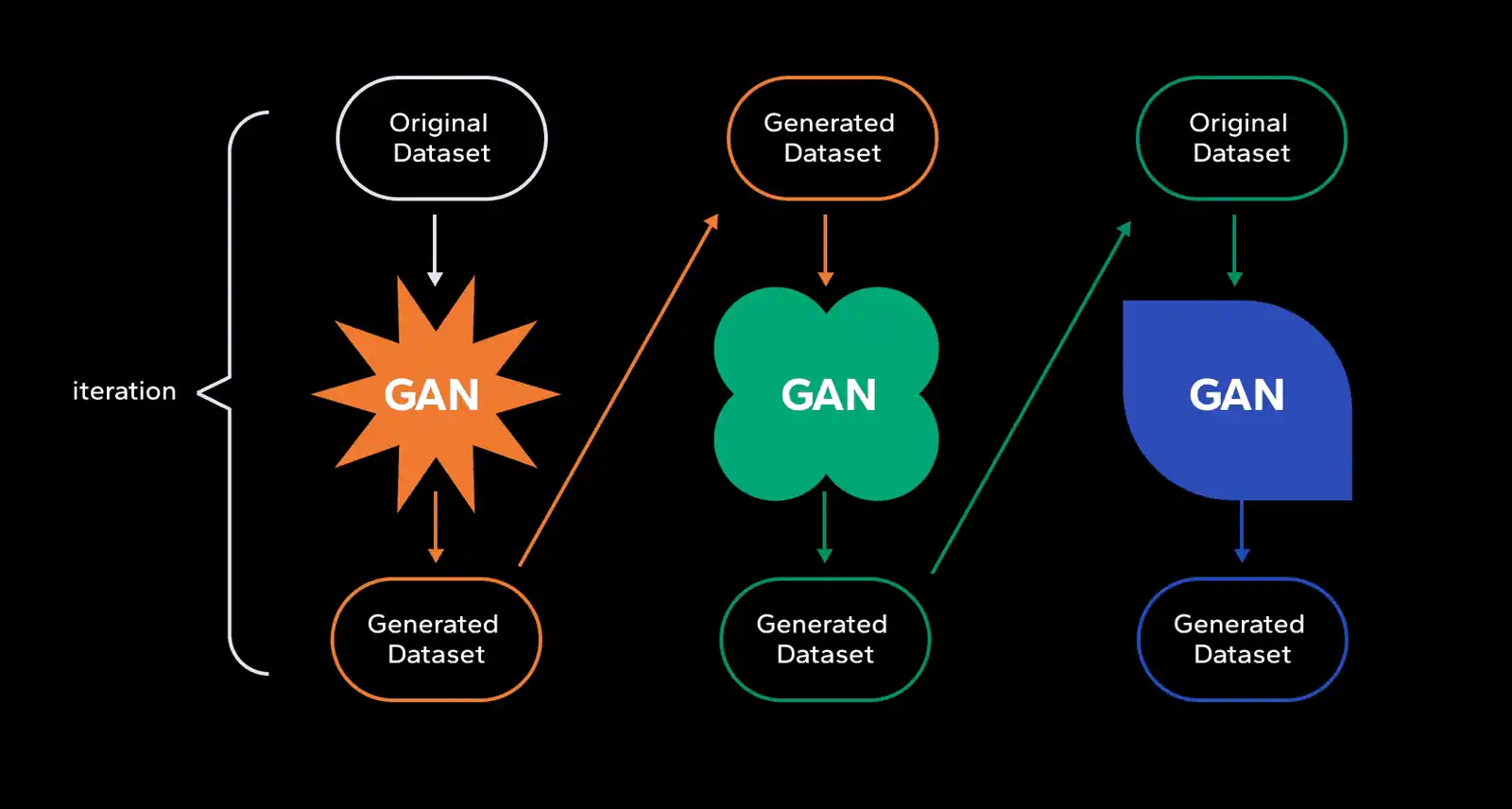
1. Training Phase: The generator starts by creating random content, and the discriminator evaluates it against real data.
2. Feedback Loop: The discriminator sends feedback to the generator, guiding it to produce more realistic outputs.
3. Iteration: Through thousands of iterations, the generator becomes better at creating data that the discriminator cannot easily distinguish from real data.
4. Output: Eventually, the GAN produces highly realistic outputs—whether images, text, or audio—that closely resemble the original dataset.
This iterative learning is what makes GANs powerful for creative AI applications, enabling machines to simulate human-like creativity.
Key Features of GANs in Generative AI
GANs offer several features that make them suitable for generative AI:
- Realism: Outputs can be photorealistic, making them suitable for industries like fashion, media, and gaming.
- Flexibility: GANs can generate multiple types of data, including images, text, audio, and videos.
- Scalability: With enough training data, GANs can produce thousands of outputs quickly.
- Continuous Learning: The adversarial nature allows the model to improve over time.
These features have made GANs a preferred choice for companies building AI-driven creative applications.
Applications of GANs in Generative AI
GANs have numerous applications across various domains. Here are the most impactful ones:
1. Image Generation
GANs are widely used to generate realistic images for creative and commercial purposes. Some common examples include:
- Art Creation: AI-generated paintings or digital art.
- Photography Enhancements: Improving resolution or adding realistic details to images.
- Fashion Design: Generating new clothing designs based on existing trends.
2. Video and Animation
GANs are capable of generating realistic videos or enhancing existing footage:
- Deepfakes: Creating realistic face swaps for movies or entertainment (used ethically in media production).
- Animation: Automating character movements and backgrounds in films or games.
3. Text and Document Generation
GANs are also used in natural language processing to generate:
- AI-Generated Stories: Crafting unique narratives for books, scripts, or games.
- Summarization: Producing summaries of large documents.
- Dialogue Systems: Generating realistic responses in chatbots or virtual assistants.
4. Music and Audio Creation
AI-powered music production has benefited from GANs:
- Music Composition: Creating new melodies based on existing music styles.
- Voice Cloning: Generating human-like voices for audiobooks, podcasts, and AI assistants.
5. Medical and Scientific Applications
GANs have critical applications in healthcare and research:
- Medical Imaging: Generating high-resolution images from low-resolution scans for diagnostics.
- Drug Discovery: Simulating molecular structures for pharmaceutical research.
- Synthetic Data Creation: Generating patient data while preserving privacy for training AI models.
6. Gaming and Virtual Reality
GANs enhance the gaming and VR industry by creating realistic:
- Characters and avatars
- Textures and backgrounds
- Interactive environments
These applications save time and cost while providing immersive experiences for users.
Advantages of Using GANs
GANs bring several benefits to generative AI projects:
- High-Quality Output: Produces realistic images, videos, and audio.
- Automation: Reduces human effort in content creation.
- Innovation: Enables new possibilities in art, design, and research.
- Data Augmentation: Generates synthetic datasets to train other AI models.
Challenges with GANs
While GANs are powerful, they come with certain challenges:
- Training Instability: GANs can be difficult to train, and the balance between generator and discriminator is critical.
- Data Dependency: Requires large datasets for better output quality.
- Ethical Concerns: GANs can be misused for creating deepfakes or misleading content.
- Computational Cost: High-performance hardware is often required for training GANs efficiently.
Addressing these challenges requires careful design, ethical guidelines, and proper resource management.
Career Opportunities Involving GANs
Professionals with expertise in GANs and generative AI are in high demand. Some key roles include:
- AI Research Scientist: Developing new GAN architectures and improving performance.
- Machine Learning Engineer: Implementing GANs for practical applications in business and healthcare.
- AI Creative Developer: Using GANs for art, music, and game design.
- Data Scientist: Applying GANs to data augmentation, simulation, and predictive modeling.
With AI-driven industries growing rapidly, mastering GANs can open doors to exciting, high-paying career paths.
How to Learn GANs Effectively
Learning GANs requires a mix of theory and practice:
1. Understand Neural Networks: Learn the basics of deep learning and convolutional networks.
2. Study GAN Architecture: Understand generator, discriminator, and adversarial training.
3. Work on Projects: Build image generators, text generators, or music creation projects.
4. Use Frameworks: Gain experience with Python, TensorFlow, and PyTorch for GAN implementation.
5. Follow Trends: Stay updated on research papers and new GAN variants like StyleGAN or CycleGAN.
For those looking for structured learning, Uncodemy’s Artificial Intelligence course and Data Science course provide hands-on exposure to GANs, generative AI tools, and real-world projects.
👉 Explore Uncodemy’s AI Course
Future of GANs in Generative AI
The future of GANs is promising. With advances in deep learning, GANs are becoming more efficient, creative, and accessible. Some upcoming trends include:
- Higher Resolution Outputs: Generating 4K+ realistic images and videos.
- Multi-Modal GANs: Creating content that combines text, audio, and visual data.
- AI Collaboration: GANs working alongside other AI models for enhanced creativity.
- Ethical and Safe AI: Developing frameworks to prevent misuse of generated content.
Professionals who understand GANs today will be at the forefront of AI innovation tomorrow.
Conclusion
Generative Adversarial Networks (GANs) have transformed the possibilities of AI by allowing machines to create, simulate, and innovate. From images and videos to music and medical applications, GANs play a vital role in generative AI.
For aspiring AI professionals, mastering GANs is not just an option—it’s a necessity to stay competitive in the evolving tech landscape. By combining hands-on projects, theoretical understanding, and exposure to industry tools, learners can leverage GANs to build cutting-edge AI applications.
If you want structured learning with real-world exposure to GANs and generative AI, Uncodemy offers comprehensive courses that guide students from fundamentals to advanced projects, making them ready for high-demand AI roles.
👉 Join Uncodemy’s AI Course Today
GANs are shaping the future of AI creativity, and learning them today can open the doors to a rewarding and future-proof career in the AI industry.