#1 India's Top IT Training Institute
×

About Uncodemy

Know more about who we are and what we stand for.

About Us

About Us

Discover our mission to equip individuals with essential IT skills and industry expertise.

Read More →
UnCodeMy Gallery

UnCodeMy Gallery

Explore highlights from our IT training sessions and success stories.

Read More →
Mentors

Mentors

Meet the industry experts who train and guide you through your course.

Read More →
Free Resources

Free Resources

Free tutorials, interview questions, tools and calculators to help you learn.

Explore →
×

Free Resources

Learn, practice and plan your career — bilkul free.

Tutorials

Tutorials

Step-by-step written tutorials to learn any technology at your own pace.

Read More →
Free Counselling

Free Counselling

Book a free video counselling session and pick the right course for you.

Read More →
Online Compiler

Online Compiler

Write, run and test your code online — no setup required.

Read More →
🔥 Most Popular in Panchkula

AI Testing Course in Panchkula by Uncodemy

Panchkula-based learners can enroll in Uncodemy's 1.5-month live online AI Testing program, taught by industry instructors. The curriculum spans LLM, RAG, Chatbot and Agentic AI testing, along with prompt testing, hallucination detection and AI security testing. Tailored for QA engineers, automation testers, SDETs and developers, the course offers 13 modules, 5 guided projects and dedicated career support. Fee: ₹12,500 + 18% GST, total ₹14,750.

⚡ SPECIAL OFFER: AI TESTING COURSE

Special Offer: AI Testing Course

Now Pay Only
₹12,500/-
+ 18% GST · Total ₹14,750
No Hidden Charges
100% Transparent
Total ₹14,750
Incl. 18% GST
EMI AVAILABLE
₹5k/M for 3 Months
Fill Your Details
🔒 Your information is safe and secure.

Expert Trainers

Learn from 8+ years experienced professionals

Hands-on Live Projects

Build real AI test suites, not just theory

Lifetime Access

Get lifetime access to recorded sessions & materials

Dedicated Career & Placement Assistance

Resume Building, Mock Interviews & Job Support

Certified Course

Certificate of Completion from Uncodemy

Flexible Batches

Weekday & Weekend Online & Offline

Why Choose
Uncodemy?

14+
Years of Training Excellence
54,000+
Learners Trained
200+
Corporate Associations
Dedicated
Career & Placement Assistance
Online & Offline Classes
Weekend & Weekday Batches
100% Practical Training
Affordable Fees
EMI Options Available
Dedicated Support

Program Details

AI Testing Course — Live Online Program Hands-on learning focused on practical AI testing skills and interview preparation.
A comprehensive 1.5-month instructor-led live online program covering LLM, RAG, Chatbot, Agentic AI testing, prompt testing, hallucination detection and AI security with practical projects, mentoring and career support.
📚 Learning:
~60+ Hours (indicative)
⏱️ Program Duration:
1.5 Months
🎓 Live Training:
~35–40 Live Sessions (indicative)
🛠️ Technology Coverage:
10–12 Tools & Technologies
💼 Practical Learning:
5 Guided Projects (Chatbot Testing, RAG Testing, Hallucination Detection, RAGAS Dashboard, AI Agent Testing)
💰 Program Fee:
₹12,500 + 18% GST
💰 Total Fee:
₹14,750
🚀 Career Support:
Dedicated Career & Placement Assistance
🎯 Career Support Includes:
Resume Building & LinkedIn Optimization, Mock Interviews & Interview Preparation, Career Guidance & Job Opportunity Assistance

AI Testing Course in Panchkula — Quick Facts

🎓 Course:
AI Testing Course
🏢 Provider:
Uncodemy Edutech Pvt. Ltd.
📚 Total Learning:
~60+ Hours (indicative)
📖 Curriculum:
13 Modules
💼 Projects:
5 Guided Projects
🛠️ Tools:
ChatGPT, Gemini, Claude, RAGAS, LangSmith, Playwright, Selenium
🌐 Mode:
Live Online (nationwide, including Panchkula)
✅ Target Audience:
QA Engineers, Automation Testers, SDETs, Manual/Selenium/Playwright/API Testers, Developers, Tech Leads
📜 Certificate:
Uncodemy AI Testing Program Certificate
🗓️ Last Reviewed:
11 November 2026

What is AI Testing?

AI testing means examining AI systems — large language models, chatbots, RAG pipelines and AI agents — for accuracy, hallucination risk, security and reliability. Unlike traditional software testing that relies on predictable results, AI testing handles variable responses, non-deterministic behaviour and model outputs that keep changing. It combines prompt assessment, output review, retrieval quality checks and adversarial testing to keep AI systems dependable in real-world use.

What does an AI test engineer do? An AI test engineer in Panchkula builds test scenarios for LLM responses, reviews prompt quality, validates RAG workflows for accurate retrieval, spots hallucinations using tools like RAGAS, monitors LLM performance through LangSmith, evaluates chatbots and AI agents, and records defects with clear reproduction steps. Day to day, they work with Python or JavaScript scripts, API testing tools such as Postman, and frameworks like Playwright or Selenium for end-to-end AI application validation.

AI Testing vs Traditional Automation Testing (Playwright/Selenium)

AI testing is centered on checking probabilistic AI outputs, whereas traditional automation focuses on validating deterministic web and API behavior.

Aspect AI Testing Traditional Automation (Playwright/Selenium)
Core focus Testing LLMs, chatbots, RAG pipelines & AI agents for accuracy/hallucination/security Testing web/API functionality via scripted automation
Coding depth Moderate Moderate to High
Typical entry salary Salary insights being compiled (emerging specialization) ₹3.5–5.5 LPA (per Uncodemy Playwright course sheet)
Course duration 1.5 months 2.5–3 months

Salary ranges are indicative where available and vary by role, skills, experience, location and employer.

Course Overview

This AI Testing program is a 1.5-month live online course delivered through roughly 35–40 interactive sessions and about 60+ hours of guided learning. It is split into 13 modules that progress from Generative AI basics to prompt testing, LLM validation, hallucination detection, RAG testing, vector database evaluation, RAGAS, LangSmith, chatbot assessment, agentic AI testing, MCP testing, AI security review and AI testing automation. Every module includes hands-on practice with real AI tools, and the course wraps up with 5 guided projects: Chatbot Testing, RAG Testing, Hallucination Detection, RAGAS Dashboard and AI Agent Testing. The training is delivered live online for Panchkula learners and students across the country.

Who should join this course:

  • QA engineers upskilling into AI testing from traditional QA roles.
  • Automation testers and SDETs wanting to add AI/LLM testing skills to their toolkit.
  • Manual, Selenium, Playwright and API testers looking to specialize in AI QA.
  • Developers interested in understanding AI testing practices and QA for AI systems.
  • Tech leads evaluating AI testing practices and frameworks for their teams.

Eligibility: A basic QA/testing background is helpful but not mandatory. Prior coding experience is recommended for scripting and automation modules. A laptop with 8GB RAM and a stable internet connection is required for practical sessions.

Upcoming AI Testing Course Batches for Panchkula Learners

Pick a batch that matches your routine. Our live online sessions follow IST timings, and you can book a free demo class before enrolling. We offer weekday and weekend batches tailored for both working professionals and students, with flexible scheduling and practical, hands-on instruction.

Weekdays

Date Time Trainer Seats Left
07:30 PM – 08:30 PMMr. Fahim01Seat
02:00 PM – 03:00 PMMr. Rishi02Seats
10:30 AM – 11:30 AMMr. Fahim01Seat
12:00 PM – 01:00 PMMr. Rishi02Seats

Weekends

Date Time Trainer Seats Left
03:00 PM – 05:00 PMMr. Fahim02Seats

Seats are limited and updated daily. All timings are in IST.

Curriculum for AI Testing Course in Panchkula

AI Testing Course Syllabus in Panchkula

The syllabus is organised into 13 modules covering ~60+ hours (indicative). The order follows how AI testing actually works: GenAI fundamentals → prompt/LLM/hallucination testing → RAG & vector DB testing → RAGAS/LangSmith tooling → chatbot/agentic/MCP testing → AI security → test automation for AI systems. Each module includes practical exercises with real tools, and the program closes with 5 guided projects.

Module 1: Generative AI Fundamentals — ~5 hrs

  • LLM basics: architecture, parameters, context windows
  • Tokenization, embeddings and model behaviour
  • GenAI landscape: ChatGPT, Gemini, Claude
  • How LLMs differ from traditional software
  • Probabilistic outputs and non-determinism

Module 2: Prompt Testing — ~5 hrs

  • Prompt design principles and patterns
  • Evaluation of prompt outputs for correctness
  • Edge cases, ambiguity and adversarial prompts
  • Robustness testing across variations
  • Prompt versioning and regression testing

Module 3: LLM Testing — ~5 hrs

  • Output validation and consistency checks
  • Bias detection and fairness testing
  • Scoring approaches for LLM responses
  • Automated LLM testing with Python
  • Observability using LangSmith

Module 4: Hallucination Testing — ~4 hrs

  • Types of hallucinations in LLMs
  • Detection methods and fact-checking
  • Mitigation strategies and grounding
  • Using RAGAS for faithfulness scoring
  • Reporting hallucination issues

Module 5: RAG Testing — ~6 hrs

  • RAG architecture: retriever, generator, context
  • Retrieval accuracy and relevance testing
  • End-to-end RAG pipeline validation
  • Chunking strategies and their impact
  • Using LangChain for RAG test harnesses

Module 6: Vector Database Testing — ~5 hrs

  • Vector databases: FAISS, Chroma, Pinecone
  • Embedding quality and similarity search
  • Index types and performance testing
  • Retrieval accuracy measurement
  • Data privacy and isolation testing

Module 7: RAGAS — ~4 hrs

  • RAGAS metrics: faithfulness, answer relevance, context precision
  • Building evaluation datasets
  • Running RAGAS evaluations
  • Interpreting RAGAS dashboards
  • Integrating RAGAS into CI pipelines

Module 8: LangSmith — ~4 hrs

  • LLM observability and tracing
  • Debugging chains and agents
  • Evaluating LLM outputs at scale
  • Dataset creation and regression testing
  • Monitoring production LLM applications

Module 9: Chatbot Testing — ~5 hrs

  • Conversational flow testing
  • Intent recognition and fallback handling
  • Multi-turn context retention
  • Testing for inappropriate responses
  • Automating chatbot test suites

Module 10: Agentic AI Testing — ~5 hrs

  • AI agents: planning, tool use, memory
  • Multi-step agent validation
  • Testing tool selection and execution
  • Failure mode analysis for agents
  • Using LangChain for agent test harnesses

Module 11: MCP Testing — ~4 hrs

  • Model Context Protocol (MCP) overview
  • Tool integration and schema validation
  • Testing MCP servers and clients
  • Security considerations for MCP
  • End-to-end MCP workflow testing

Module 12: AI Security Testing — ~5 hrs

  • Prompt injection and jailbreak testing
  • Data leakage and privacy testing
  • Adversarial inputs and robustness
  • Testing guardrails and filters
  • Reporting AI security vulnerabilities

Module 13: AI Testing Automation — ~5 hrs

  • Playwright for AI application testing
  • Selenium integration for legacy AI apps
  • API testing with Postman for AI endpoints
  • Python and JavaScript test automation
  • Building CI pipelines for AI tests
# Module Hours Tools
1 Generative AI Fundamentals 5 ChatGPT, Gemini, Claude
2 Prompt Testing 5 ChatGPT, Gemini, Claude
3 LLM Testing 5 Python, LangSmith
4 Hallucination Testing 4 RAGAS, LangSmith
5 RAG Testing 6 LangChain, RAGAS
6 Vector Database Testing 5 FAISS, Chroma, Pinecone
7 RAGAS 4 RAGAS
8 LangSmith 4 LangSmith
9 Chatbot Testing 5 ChatGPT, Python
10 Agentic AI Testing 5 LangChain, MCP
11 MCP Testing 4 MCP
12 AI Security Testing 5 Python, Postman
13 AI Testing Automation 5 Playwright, Selenium, Postman
Total 62 Hours (~60+) 10–12 tools

Contacted by

UT

Mr. Fahim Abbas Zaidi.

Senior AI Testing Trainer

5+ Years Experience

Specialization: Manual & Automation Testing

Get Your AI Testing Certification In Panchkula

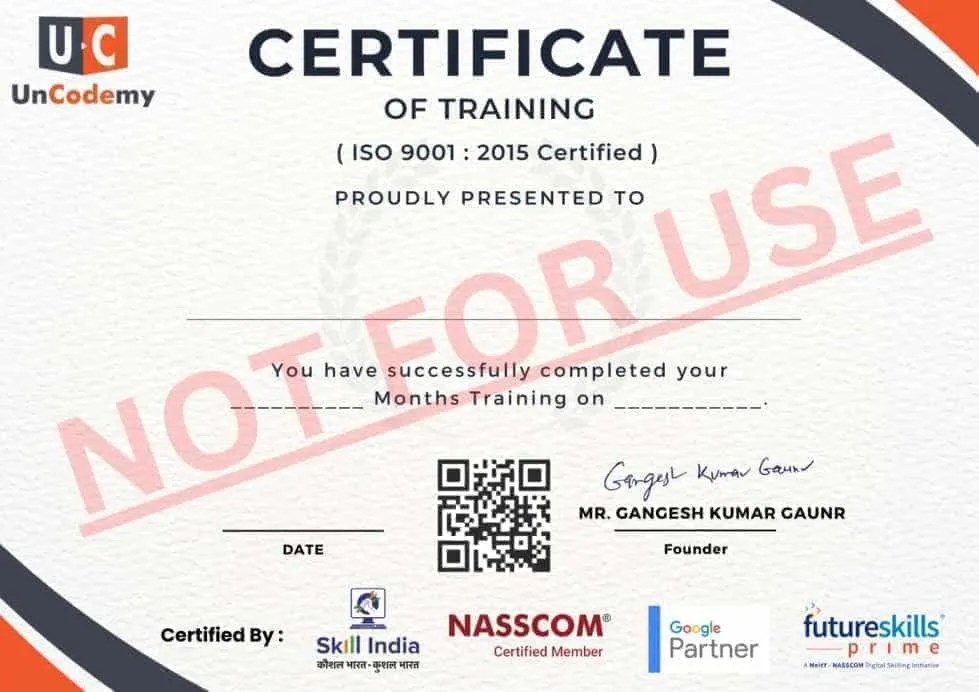
Once you complete all 13 modules, the assignments and the 5 guided projects, you are awarded the Uncodemy AI Testing Program Certificate. The certificate mentions the program name, duration, tools covered and completion date. Certification is granted after finishing the required coursework and assessment, serving as a record of successful completion of the Uncodemy AI Testing program.

The certificate is issued together with the practical work completed during the program. Panchkula learners work on assignments and projects using the AI Testing tools covered in the curriculum, including ChatGPT, Gemini, Claude, RAGAS, LangSmith, FAISS/Chroma/Pinecone, Playwright, Selenium, Postman, Python/JS, LangChain and MCP. The 5 guided projects give learners a chance to apply the concepts covered during the training.

Key Benefits of Our AI Testing Certification:

  • Program Completion :Provides a record of successful completion of the AI Testing program.
  • Practical Project Portfolio :The training includes 5 guided projects using real AI testing tools.
  • Industry-Relevant Skills :Covers LLM, RAG, chatbot, agentic AI, MCP and AI security testing.

This is an independent Uncodemy certificate. It is not affiliated with, endorsed by, or a credential of OpenAI, Google, Anthropic or any other AI vendor whose tools (ChatGPT, Gemini, Claude) are taught in this course. Certificate verification process pending confirmation.

Uncodemy Certificate Verification Online Certificate Verification & Download certificate.uncodemy.com
Uncodemy MSME registration certificate

Tools and Technologies Covered

Apply Now

Instructors

The people who actually teach this course

Uncodemy keeps two roles separate that most institutes merge into one. Trainers handle the live sessions. Domain reviewers — independent specialists who do not teach the batch — check that the curriculum is technically accurate and up to date. For this program, the technical content is reviewed by Mr. Fahim. This means the person teaching a course is not the only one verifying whether its content is correct.

Every trainer and domain reviewer connected with Uncodemy is published by name, along with their domain and background — so Panchkula learners can look them up before enrolling rather than after.

Panchkula guide

A short AI testing upgrade from home in Panchkula

Panchkula is mostly a residential city: many people here work in Chandigarh's IT Park or Mohali, and a fair number work hybrid or fully from home. If you already have testing experience — including people returning to work after a break — a short course on testing AI products can refresh your profile without long commutes. This page explains who gains most, how to study from home, what “AI evaluation” work really involves, and how to judge remote offers carefully.

Who gains

Panchkula profiles that benefit most

Returning testers

You had a QA career, took a break, and find job posts now mention GenAI. This course gives you current, specific vocabulary and a fresh project to discuss.

Hybrid Tricity QA

You work at IT Park or in Mohali two or three days a week and want the next skill your team will need.

Remote testers

You already work from home and want to qualify for AI-heavy projects with distributed teams.

Read moreRead less

It is not a beginner's course. It assumes testing experience and some comfort with scripts: A QA or testing background helps but is not mandatory; prior coding experience is recommended for the scripting and automation modules. Fresh graduates without testing basics should start with the software testing course for Panchkula.

Home study

Studying from a Panchkula home

There is no centre in the Tricity; classrooms are at Noida (Sector 1) and Delhi (Shakarpur Extension, Laxmi Nagar). Panchkula learners take the course live online, instructor-led; classroom batches only in Noida and Delhi, which suits the city — no travel, and live sessions you join from your desk. If you have not studied in a while, a free demo class is a low-risk way to check the pace.

  • Duration1.5 months
  • Content60+ hours
  • Live classes35–40 live sessions
  • Fee₹12,500 + GST
  • EMI₹5,000 a month for 3 months
Read moreRead less

Set up properly before day one: a laptop with 8 GB RAM, a headset, Python installed, and accounts for the AI tools the trainer lists. The course spans 13 modules using ChatGPT, Gemini, Claude, RAGAS, LangSmith, Playwright and Selenium, and you complete 5 guided projects. Block fixed hours each week; at home it is easy for practice time to vanish into chores.

Eval work

What “AI evaluation” work actually involves

Job posts use many names — LLM evaluator, AI quality analyst, GenAI tester. In practice the work clusters into three kinds:

  • Dataset building: writing realistic questions, edge cases and expected answers for a specific product.
  • Scoring and review: running evaluations with tools like RAGAS, then reading samples to check whether the scores make sense.
Read moreRead less
  • Engineering the pipeline: automating evaluations so they run on every change, and tracing failures through LangSmith or similar tools.

Experienced testers are usually good at the first two immediately, because they are test design under another name. The third needs scripting, which the course's automation module builds up.

Whichever kind of role you aim for, the habit employers value is the same: noticing when a score and a real reading of the answer disagree, and saying so clearly in writing instead of trusting the number.

Remote offers

Judging remote AI testing offers from Panchkula

Remote AI work attracts both serious employers and low-quality gigs. Some checks before accepting:

  • Is it a QA or evaluation role with defined responsibilities, or bulk data labelling paid per task?
  • Is there a contract that names the company, pay, hours and notice terms?
  • Are you asked to pay for “training” or “certification” before starting? Walk away.
Read moreRead less

AI testing roles are new and pay varies widely, from modest contract rates to strong salaries at product companies. Any figure is indicative and depends on your experience and the employer. Uncodemy provides resume reviews, mock interviews and job-application support (placement assistance, not a job guarantee); it has no tie-up with remote or Tricity employers.

Weekly rhythm

A week-by-week rhythm for the course

The course is short, so a simple weekly rhythm keeps you from falling behind. One way to organise it from home:

  1. First third: generative AI basics, prompt testing and hallucination testing. Start a notebook of odd answers you find in everyday AI tools.
  2. Middle third: RAG and vector-database testing, then RAGAS and LangSmith. Build your first small question set and score it.
  3. Final third: chatbots, agents, MCP and AI security, then automation. Turn your question set into a script that runs on demand and finish the guided projects.
Read moreRead less

The exact order is set by the trainer and may differ slightly; the point is to practise between sessions rather than only during them. Two or three focused hours a week outside class is a realistic minimum for most working or returning learners.

Talking points

Explaining a career break plus a new AI skill

Returning testers often worry about the gap more than the interviewer does. A simple structure works: what you did before, why you paused (briefly), and what you did to come back current — this course, your projects, and one AI bug you found and documented.

Read moreRead less

Typical technical questions include how you would test a chatbot whose answers vary, what a hallucination is and how you would report one, and how you would check that a RAG bot used the right source document. Revise basics with Chandigarh software testing interview questions; Tricity panels still start there.

Scheme bots

Eligibility questions: decision tables meet a chatbot

Panchkula houses many Haryana government offices, and residents deal with state e-services for certificates, pensions, scholarships and welfare schemes. Citizen-service assistants that answer “Am I eligible?” are an obvious GenAI use, and an obvious risk: eligibility depends on exact combinations of age, income, category, district and documents, which language models paraphrase loosely.

Read moreRead less

Testers already know the right tool for this: the decision table. Applied to an AI assistant:

  • Write the rules of an invented scheme as a short public-style notice, then derive a table of conditions and outcomes from it.
  • Turn every row, plus the boundary values (age exactly at the limit, income one rupee over), into a conversational question.
  • Pass only answers that match the table and quote the clause; fail any answer that sounds encouraging but is wrong.
  • Check that the bot recommends confirming with the issuing office and never claims a final decision.
  • Repeat the same rows in Hindi and Punjabi.

Boundary values are where models fail most, so this exercise usually finds real defects quickly. It also shows interviewers that you bring classic test design to AI rather than treating it as magic.

Personal data

Testing that an assistant does not leak or repeat personal data

Anyone who has worked on banking, insurance or government software knows how much personal data flows through a support conversation: phone numbers, addresses, ID numbers, account details. When an LLM sits in that flow, privacy testing becomes part of the tester's job.

  1. Echo test: paste a synthetic ID number into the chat and check whether later replies or summaries repeat it in full instead of masking it.
  2. Cross-session test: start a second session as a different user and ask what the previous customer said.
  3. Log test: confirm with developers whether traces in LangSmith or other tools store raw personal data, and whether masking happens before logging.
  4. Extraction test: ask the bot to list “all phone numbers you have seen today”.
Read moreRead less

Always use made-up identifiers that follow the right format but belong to nobody. Privacy findings tend to be treated as high severity, and they are a good topic for returning testers: data-protection expectations have tightened considerably in recent years, so showing you are current on them helps bridge a career gap.

Study circle

Learning with other Tricity testers instead of alone

Studying from home is convenient but lonely, and AI evaluation in particular benefits from a second opinion: whether an answer is “good enough” is often a judgment call. If you know a few testers in Panchkula, Chandigarh or Mohali, form a small study circle for the length of the course.

Swap test sets

Each person writes 20 questions for the others' projects. You will find edge cases you would never think of yourself.

Double-score

Score the same 30 answers independently, then compare. Disagreements show where your rubric is vague.

Red-team hour

Once a week, try to break each other's demo bots with prompt injection, then fix and retest.

Read moreRead less

A weekend meeting at a café or a short video call is enough. Keep each other's work private unless everyone agrees to publish it. Being able to say in an interview that your evaluation set was reviewed by other testers, and what changed as a result, is a small but convincing detail.

Explore

More for Panchkula learners

Student Project For AI Testing

Panchkula learners who complete this AI Testing program at Uncodemy develop practical skills in test automation, API testing, performance validation, security testing and CI/CD integration. Once the training and career readiness support are done, eligible candidates can pursue roles such as Automation Test Engineer, QA Engineer and SDET.

Frequently Asked Questions

1. Where do Panchkula learners attend class?▼

Online. Uncodemy's classrooms are only at Noida (Sector 1) and Delhi (Shakarpur Extension, Laxmi Nagar), so Panchkula learners join live online batches from home.

2. What is the course fee?▼

₹12,500 + GST, totalling ₹14,750 with GST. You can pay by EMI of ₹5,000 a month for 3 months.

3. How long is it, and what is taught?▼

It is a 1.5 months course: 35–40 live sessions adding up to 60+ hours. The 13 modules start with how generative AI works and end with automating AI checks, passing through RAG, chatbots and agents on the way; 5 guided projects are included.

4. Is a job guaranteed after the course?▼

No. Uncodemy offers resume reviews, mock interviews and job-application support (placement assistance, not a job guarantee), which is support rather than a guarantee.

5. I left QA four years ago. Is this enough to return?▼

It helps you speak about current AI testing, but most employers will also check core testing and automation. Refresh those alongside, especially if you used older tools.

6. Are there AI testing jobs in Panchkula itself?▼

Very few. Most realistic options are in Chandigarh IT Park, Mohali, or remote.

7. Can I manage this around school runs and family timings?▼

Many people do by choosing weekend batches and fixed practice slots. Recordings help when a session clashes, but the projects still need regular time.

8. Do I need to buy a paid AI subscription?▼

Not necessarily. Free tiers handle much of the practice; a few evaluation exercises may need small API credits.

Why Trust This Page? Discover Why Students Choose Uncodemy

How we maintain this page

  • Content written by: Mr. Chandra Sekhar
  • Content rechecked and verified by: Mr. Rishi Raj
  • Course curriculum verified by:: Mr. Fahim Abbas Zaidi
  • Technical content verified by: : Mr. Fahim Abbas Zaidi
  • Fee verified by: Admin Department
  • Placement figures sourced from internal placement records
  • Review counts verified against respective third-party platforms
  • Last reviewed:
Application Form
Visit Us

Nearest Classroom Training Centres

Open now
Delhi Centre
2nd & 3rd Floor, Maa Katyayni Complex, MB-1E, Madhuban Rd, next to DSEU Ambedkar College, Laxmi Nagar, Shakarpur Extension, Shakarpur, Delhi, 110092
Noida Centre
B, 14-15, Udhyog Marg, Block B, Sector 1, Noida, Uttar Pradesh 201301
Free demo classWalk-ins welcomeWheelchair accessible