#1 India's Top IT Training Institute
×

About Uncodemy

Know more about who we are and what we stand for.

About Us

About Us

Discover our mission to equip individuals with essential IT skills and industry expertise.

Read More →
UnCodeMy Gallery

UnCodeMy Gallery

Explore highlights from our IT training sessions and success stories.

Read More →
Mentors

Mentors

Meet the industry experts who train and guide you through your course.

Read More →
Free Resources

Free Resources

Free tutorials, interview questions, tools and calculators to help you learn.

Explore →
×

Free Resources

Learn, practice and plan your career — bilkul free.

Tutorials

Tutorials

Step-by-step written tutorials to learn any technology at your own pace.

Read More →
Free Counselling

Free Counselling

Book a free video counselling session and pick the right course for you.

Read More →
Online Compiler

Online Compiler

Write, run and test your code online — no setup required.

Read More →
🔥 Most Popular in Mumbai

RAG Engineering Training Course in Mumbai by Uncodemy

Mumbai learners can be part of Uncodemy's instructor-led live online RAG Engineering program, spread over 5–6 months. The syllabus includes document ingestion & chunking, embeddings, vector databases, retrieval pipelines, hybrid search and production RAG deployment. It is aimed at developers, data scientists/ML engineers and aspiring AI engineers, and comprises 13 modules, 90+ live sessions, 140+ hours and an enterprise RAG capstone. Fee: ₹17,500 + 18% GST, total ₹20,650. EMI starting from ₹4,032/month.

⚡SPECIAL LIMITED TIME OFFER

Special Offer: RAG Engineering Program

Now Pay Only
₹17,500/-
+ 18% GST
No Hidden Charges
100% Transparent
Total ₹20,650
Incl. 18% GST
EMI AVAILABLE
Starting ₹4,032/M*
Fill Your Details
🔒 Your information is safe and secure.

Expert Trainers

Learn from 8+ years experienced professionals

Hands-on Automation Projects

Build real Playwright test suites, not just theory

Lifetime Access

Get lifetime access to recorded sessions & materials

Dedicated Career & Placement Assistance

Resume Building, Mock Interviews & Job Support

Certified Course

Certificate of Completion from Uncodemy

Flexible Batches

Weekday & Weekend Online & Offline

Online & Offline Classes
Weekend & Weekday Batches
100% Practical Training
Affordable Fees
EMI Options Available
Dedicated Support

Program Details

RAG Engineering Course — Live Online Offering Practical, hands-on learning designed around real RAG engineering skills and interview preparation.
A complete 5–6 month instructor-led live online program exploring embeddings, vector databases, retrieval pipelines, hybrid search, and production RAG deployment, backed by practical projects, mentoring and career support.
📚 Learning:
140+ Hours of Learning
⏱️ Program Duration:
5–6 Months
🎓 Live Training:
90+ Live Sessions
🛠️ Technology Coverage:
15+ Tools & Technologies
💼 Practical Learning:
Hands-on RAG Projects & Enterprise AI Case Studies
💰 Program Fee:
₹17,500 + 18% GST
💰 Total Fee:
₹20,650
💳 EMI:
Starting From ₹4,032/Month*
🚀 Career Support:
Dedicated Career & Placement Assistance
🎯 Career Support Includes:
Resume Building & LinkedIn Optimization, Mock Interviews & Interview Preparation, Career Guidance & Job Opportunity Assistance

RAG Engineering Course in Mumbai — Quick Facts

🎓 Course:
RAG Engineering
🏢 Provider:
Uncodemy Edutech Pvt. Ltd.
📚 Total Learning:
140+ Hours of Learning
📖 Curriculum:
13 Modules
💼 Projects:
Hands-on RAG Projects + Enterprise RAG Capstone
🛠️ Tools:
Python, OpenAI APIs, LangChain, LlamaIndex, Vector Databases
🌐 Modes:
Live Online (offline only at Delhi & Noida centres; Mumbai learners join live online)
✅ Prior Coding:
Programming fundamentals helpful; Python taught from Module 2 onward. Basic LLM concepts built up in Module 3.
📜 Certificate:
Uncodemy RAG Engineering Program Certificate (verifiable online)
🗓️ Last Reviewed:
11 November 2026

What is RAG Engineering?

RAG Engineering (Retrieval-Augmented Generation) is the discipline of combining large language models with external knowledge retrieval, so that answers are grounded in real, up-to-date enterprise data instead of leaning entirely on the model's training data. It entails document ingestion, chunking, embeddings, vector databases and retrieval pipelines that deliver relevant context into an LLM at query time — cutting hallucination and allowing AI systems to respond to questions about private, domain-specific or frequently changing information.

What does a RAG engineer do? A RAG engineer manages document ingestion and chunking, constructs embeddings and oversees vector databases, designs retrieval pipelines, implements hybrid search, evaluates RAG accuracy, and deploys production RAG systems. The everyday workload includes Python scripting, working with frameworks such as LangChain and LlamaIndex, honing chunking and retrieval strategies, measuring relevance and faithfulness, and exposing RAG-powered APIs that applications can consume.

RAG Engineering vs LLM Engineering vs Generative AI

RAG Engineering zeroes in on building retrieval-grounded AI systems on enterprise knowledge, while LLM Engineering takes a broader view of LLM-powered applications and Generative AI gives priority to autonomous agents.

Aspect RAG Engineering LLM Engineering Generative AI
Core focus Building retrieval-grounded AI systems on enterprise knowledge Building, fine-tuning & deploying LLM-powered applications broadly Building GenAI apps + autonomous AI agents
Coding depth High High Moderate to High
Typical entry salary ₹5–9 LPA (Entry-Level RAG Engineer) ₹6–10 LPA (per LLM Engineering course sheet) [CONFIRM per GenAI course sheet]
Uncodemy program duration 5–6 months 5–6 months ~3–4 months (indicative)

Salary ranges are indicative and vary by role, skills, experience, location and employer.

Course Overview

The RAG Engineering course runs for 5–6 months as a live online program, offering 90+ live sessions and 140+ hours of learning. It is arranged into 13 modules that carry learners from RAG & enterprise knowledge AI foundations through Python for RAG engineering, LLM fundamentals & API integration, document processing & data ingestion, text chunking & document transformation, embeddings & semantic search, vector databases & indexing, RAG, advanced retrieval & reranking, hybrid search & knowledge retrieval, RAG evaluation & optimization, production RAG APIs & deployment, and a 20-hour enterprise RAG capstone. Each module includes practical exercises with real tools, and the program finishes with hands-on RAG projects and an enterprise capstone. It is delivered fully live online for Mumbai and nationwide learners.

Who should join this course:

  • Developers wanting to specialise in retrieval-grounded AI systems and enterprise knowledge assistants.
  • Data scientists and ML engineers upskilling into RAG engineering and vector search.
  • Aspiring AI engineers looking to build production-ready RAG applications.
  • Working professionals moving into GenAI/RAG roles from software or analytics backgrounds.
  • Mumbai-based learners who want instructor-led live online training with hands-on projects.

Eligibility: Programming fundamentals are an advantage rather than a prerequisite — Python is taught starting from Module 2. Awareness of basic LLM concepts helps, but the program builds these from Module 3 onward. A laptop with reliable internet is required for the practical sessions.

Upcoming RAG Engineering Course Batches for Mumbai Learners

Go with a batch timing that suits your schedule. Live online batches, IST timings. Book a free demo class to try it first-hand, or join our upcoming weekday and weekend live batches — designed for both working professionals and students, with flexible timings and hands-on training.

Weekdays

Date Time Trainer Seats Left
07:30 PM – 08:30 PMMr. Irshad01Seat
02:00 PM – 03:00 PMMr. Upendra Kumar Tiwari02Seats
10:30 AM – 11:30 AMMr. Irshad01Seat
12:00 PM – 01:00 PMMr. Upendra Kumar Tiwari02Seats

Weekends

Date Time Trainer Seats Left
03:00 PM – 05:00 PMMr. Irshad02Seats

8+ new batches start every month. All timings are in IST. Seats are limited and updated daily.

Curriculum for RAG Engineering Training Course in Mumbai

RAG Engineering Course Syllabus in Mumbai

The syllabus unfolds across 13 modules covering 140 hours. Its order mirrors how RAG engineering truly works: foundations → Python → LLM fundamentals & API integration → document processing & chunking → embeddings & semantic search → vector databases → RAG → advanced retrieval/reranking → hybrid search → evaluation → production deployment → capstone. Each module brings practical exercises with real tools, and the program concludes with hands-on RAG projects and an enterprise RAG capstone.

Module 1: RAG & Enterprise Knowledge AI Foundations — 8 Hours

  • Introduction to RAG and enterprise knowledge AI
  • How RAG differs from fine-tuning and prompt-only approaches
  • Enterprise knowledge sources: documents, databases, APIs
  • RAG architecture overview: ingestion, retrieval, generation
  • Use cases: knowledge assistants, enterprise search, AI copilots
  • Challenges: accuracy, freshness, privacy and scale

Module 2: Python for RAG Engineering — 10 Hours

  • Python syntax, data structures and control flow
  • Functions, modules and packages
  • Working with APIs, JSON and environment variables
  • Virtual environments and dependency management
  • File I/O and handling document formats
  • Error handling and debugging for RAG applications

Module 3: LLM Fundamentals & API Integration — 10 Hours

  • LLM basics: tokens, context windows, temperature
  • Overview of LLM APIs (OpenAI/Gemini/Claude-style)
  • Authentication, rate limits and error handling
  • Streaming responses and async calls
  • Prompt basics for RAG-grounded answers
  • Building reusable API wrappers in Python

Module 4: Document Processing & Data Ingestion — 8 Hours

  • Document formats: PDF, HTML, DOCX, Markdown, CSV
  • Text extraction and cleaning pipelines
  • Metadata extraction and enrichment
  • Handling tables, images and structured content
  • Incremental ingestion and update strategies
  • Hands-on: building a document ingestion pipeline

Module 5: Text Chunking & Document Transformation — 8 Hours

  • Chunking strategies: fixed-size, recursive, semantic
  • Overlap, chunk size and their impact on retrieval
  • Document transformation and normalization
  • Metadata tagging for filtered retrieval
  • Handling multi-document and hierarchical content
  • Hands-on: comparing chunking strategies

Module 6: Embeddings & Semantic Search — 10 Hours

  • Text embeddings and semantic similarity
  • Embedding models: OpenAI, Hugging Face, open-source
  • Similarity metrics: cosine, dot product, Euclidean
  • Building and querying a semantic search index
  • Evaluating embedding quality for retrieval
  • Hands-on: building a semantic search pipeline

Module 7: Vector Databases & Indexing — 10 Hours

  • Vector databases: FAISS, ChromaDB, Pinecone, pgvector
  • Index types: flat, IVF, HNSW and trade-offs
  • Upserting, updating and deleting vectors
  • Metadata filtering and namespaces
  • Performance, scaling and cost considerations
  • Hands-on: building a vector search index

Module 8: Retrieval-Augmented Generation (RAG) — 12 Hours

  • RAG architecture: retriever, context builder, generator
  • Building end-to-end RAG pipelines with LangChain
  • Building RAG pipelines with LlamaIndex
  • Prompt design for grounded answers
  • Handling citations and source attribution
  • Hands-on: building a production-style RAG application

Module 9: Advanced Retrieval & Reranking — 10 Hours

  • Multi-query and query rewriting strategies
  • Reranking with cross-encoders and LLMs
  • Context compression and window expansion
  • Handling multi-hop and comparative queries
  • Retrieval fallback and error handling
  • Hands-on: adding reranking to a RAG pipeline

Module 10: Hybrid Search & Knowledge Retrieval — 10 Hours

  • Combining keyword (BM25) and vector search
  • Reciprocal rank fusion and score normalization
  • Elasticsearch/OpenSearch for hybrid retrieval
  • Metadata filters and structured queries
  • Knowledge graph integration basics
  • Hands-on: building a hybrid search system

Module 11: RAG Evaluation, Accuracy & Optimization — 12 Hours

  • Retrieval metrics: recall, precision, MRR, nDCG
  • Generation metrics: faithfulness, answer relevance
  • Building evaluation datasets for RAG
  • Automated evaluation with LLM-as-judge
  • Diagnosing and fixing retrieval failures
  • Hands-on: evaluating a RAG pipeline end-to-end

Module 12: Production RAG, APIs & Deployment — 12 Hours

  • Exposing RAG pipelines as APIs with FastAPI
  • Latency, caching and throughput optimization
  • Cost management for embeddings and LLM calls
  • Containerization and deployment with Docker
  • Monitoring, logging and observability for RAG
  • Hands-on: deploying a RAG API to the cloud

Module 13: Enterprise RAG Projects & Capstone — 20 Hours

  • End-to-end RAG application design and architecture
  • Ingestion + embeddings + vector DB + retrieval integration
  • Evaluation and optimization of the capstone application
  • Code review and portfolio preparation
  • Presentation and documentation of capstone project
  • Interview preparation around capstone work
# Module Hours Tools
1 RAG & Enterprise Knowledge AI Foundations 8 Python, LLM APIs
2 Python for RAG Engineering 10 Python, Git
3 LLM Fundamentals & API Integration 10 OpenAI APIs, Hugging Face
4 Document Processing & Data Ingestion 8 Python, LlamaIndex
5 Text Chunking & Document Transformation 8 LangChain, LlamaIndex
6 Embeddings & Semantic Search 10 Hugging Face, OpenAI Embeddings
7 Vector Databases & Indexing 10 FAISS, ChromaDB, Pinecone, pgvector
8 Retrieval-Augmented Generation (RAG) 12 LangChain, LlamaIndex, Vector DBs
9 Advanced Retrieval & Reranking 10 LangChain, Cross-Encoders
10 Hybrid Search & Knowledge Retrieval 10 Elasticsearch/OpenSearch, LangChain
11 RAG Evaluation, Accuracy & Optimization 12 RAGAS, LangSmith, Python
12 Production RAG, APIs & Deployment 12 FastAPI, Docker, Cloud Deployment Tools
13 Enterprise RAG Projects & Capstone 20 All tools
Total 140 Hours 15+ tools

Contacted by

IR

Mr. Irshad

Curriculum & Technical Reviewer

[8+ Years Of Experience]

Specialization: RAG Engineering, Generative AI, Retrieval Systems

Get Your RAG Engineering Certification In Mumbai

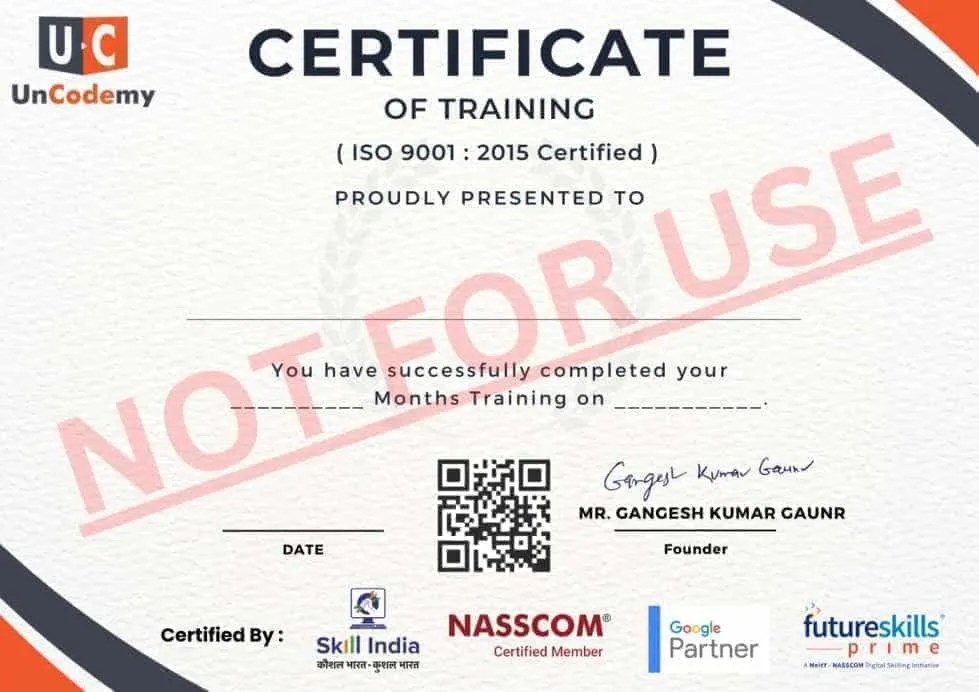
After all 13 modules, the assignments and the Enterprise RAG capstone project are completed, you are awarded the Uncodemy RAG Engineering Program Certificate. This certificate records the program name, duration, tools covered and completion date. It can be verified online at certificate.uncodemy.com and serves as a record of successful completion of the Uncodemy RAG Engineering program.

The certificate is tied to the practical work performed during the program — including hands-on RAG pipeline work, retrieval evaluation and the 20-hour Enterprise RAG capstone project. Learners work with Python, OpenAI APIs, Hugging Face, LangChain, LlamaIndex, LangGraph, FAISS, ChromaDB, Pinecone, PostgreSQL/pgvector, Elasticsearch/OpenSearch, FastAPI, Docker, Git/GitHub and cloud deployment tools.

Key Benefits of Our RAG Engineering Certification:

  • Program Completion :Provides a record of successful completion of the RAG Engineering program.
  • Online Verification :Certificate is verifiable online at certificate.uncodemy.com.
  • Practical Learning :Training includes hands-on RAG pipelines, retrieval evaluation and an enterprise capstone.

This is an independent Uncodemy certificate. It is not affiliated with, endorsed by, or a credential of OpenAI, Pinecone or any other RAG/vendor provider whose tools are taught in this course. Certificate verification process pending confirmation.

Uncodemy Certificate Verification Online Certificate Verification & Download certificate.uncodemy.com
Uncodemy MSME registration certificate

Tools and Technologies Covered

Apply Now

Introducing Uncodemy


Portfolio/capstone project review:Your hands-on RAG pipelines, retrieval evaluation work and enterprise RAG capstone are reviewed and refined into a portfolio an interview will find credible.

Resume & LinkedIn:We build your resume around RAG engineering keywords and measurable outcomes, and align your LinkedIn profile to match.

Interview preparation:Retrieval pipeline design questions, chunking-strategy trade-offs, evaluation-metric discussions and RAG engineering case studies specific to AI hiring.

Mock interviews:Sessions with industry trainers, followed by written feedback on what to fix.

Opportunity sharing:Relevant openings are shared with you, with support through the application and interview process.

Continued support:This is active assistance, not a guarantee of employment — no training institute can honestly promise a job. Support continues after your program ends for learners who stay engaged with the process.


Instructors

The people who actually teach this course

Most institutes merge two roles into one; Uncodemy keeps them separate. The live sessions are conducted by trainers. The task of verifying that the curriculum is technically accurate and current rests with domain reviewers — independent specialists who are not part of the teaching batch. For this program, curriculum and technical content are reviewed by Mr. Irshad, with additional review by Mr. Upendra Kumar Tiwari. The implication is straightforward: the person teaching a course is not the sole person checking whether its content is correct.

Every trainer and domain reviewer associated with Uncodemy is published by name, with their domain and background — you can look them up before you enrol rather than after.

Mumbai guide

Retrieval over filings, research and rules: RAG work in Mumbai

Mumbai is where India's listed companies report to the market. The securities regulator SEBI and the National Stock Exchange are both headquartered in Bandra Kurla Complex, the BSE sits on Dalal Street, and around them work research desks, wealth managers, rating analysts, corporate law firms and the technology teams that serve all of them. Their raw material is text: annual reports, quarterly results, earnings-call transcripts, circulars and contracts. This page looks at retrieval engineering through that material, and at how Mumbai learners take the course live online.

Document piles

The text a Mumbai analyst or lawyer reads every week

A retrieval system is only as good as its understanding of the corpus. In this city three kinds of corpus come up again and again, and each one stresses a different part of the pipeline.

Market disclosures

Annual reports, quarterly results, investor presentations, shareholding patterns and, for many listed companies, transcripts of earnings calls. Thousands of issuers, four reporting cycles a year, heavy on tables.

Deal and legal files

Corporate law firms and in-house legal teams handle share purchase agreements, offer documents, board resolutions and Bombay High Court judgments, where a single defined term can change the meaning of a clause.

Property and civic rules

Developers, architects and housing societies work with the city's development control regulations, project registrations on the MahaRERA portal and society bye-laws, all amended over time.

Read moreRead less

These are kinds of work common in Mumbai, not a list of employers or partners. Uncodemy has no hiring tie-up with any regulator, exchange, firm or developer named or described on this page.

Metadata first

Which company, which quarter? Filtering before similarity

Ask a naive RAG demo about 'Q3 margins' and it will happily blend three companies and two years, because dozens of transcripts contain almost identical sentences about margins. Semantic similarity cannot tell them apart. The fix is to attach structured fields to every chunk at ingestion and filter on them before any vector search runs.

  • Issuer identity: store the exchange symbol or ISIN, not just a name. Group companies with near-identical names are common, and a fuzzy name match will pull the wrong subsidiary.
  • Fiscal period: Indian companies report on an April–March year, so 'Q3 FY26' means October–December 2025. Normalise every way of writing a period into one field.
Read moreRead less
  • Standalone or consolidated: annual reports carry both sets of financial statements; tag each table so an answer never mixes them.
  • Restatements: a later filing may restate an earlier figure. Keep both, mark which supersedes which, and decide which one the user asked about.
  • Query parsing: before retrieval, extract the company and period from the question, and ask a follow-up if either is missing rather than guessing.

The vector database module covers metadata filtering and index design; the advanced retrieval module adds query rewriting. On disclosure data, this step often moves accuracy more than changing the embedding model.

Access control

Information barriers: when some users must never see some chunks

Investment banks, brokers and law firms keep information barriers between teams: the people advising on a confidential transaction cannot share what they know with research or trading staff. An internal assistant that indexes everything into one vector store and answers anyone breaks that rule the first time a deal document becomes the most similar chunk.

Read moreRead less
  1. Carry permissions into the index. Each chunk stores the groups allowed to read its source document, copied at ingestion and refreshed when access changes.
  2. Filter inside the search, not after it. Pass the user's groups as a filter to the vector query; with PostgreSQL/pgvector this can sit alongside row-level security on the same rows.
  3. Keep caches per permission set. A cached answer built from restricted chunks must not be served to someone outside that group.
  4. Test for leakage. Write questions that only a restricted document can answer, run them as an unprivileged user, and fail the build if any restricted source appears in the retrieved set or the citations.

None of this needs exotic tools, only discipline. It is also the topic Mumbai panels in banking and legal technology are most likely to press on, because the cost of getting it wrong is regulatory, not cosmetic.

Property rules

Development regulations: a retrieval problem from Mumbai's skyline

Greater Mumbai's Development Control and Promotion Regulations 2034 decide how much can be built on a plot, and they are read daily by architects, developers, redevelopment consultants and society committees. They are a good public corpus for practice because they are long, cross-referenced and amended through later notifications.

Read moreRead less
  • Cross-references: one regulation points to another and to tables elsewhere; retrieving the cited part along with the clause gives the model the full rule.
  • Amendments: a notification may change one sub-clause; store the effective date with each chunk and prefer the version in force on the date asked about.
  • Definitions: terms such as built-up area or floor space index have specific meanings; index the definitions section separately and retrieve it whenever a defined term appears in the question.

Any assistant over building rules must present itself as a reading aid, cite the exact regulation and tell users to confirm with a licensed architect or the planning authority. Build that disclaimer into the answer template, not just the README.

Studying

Joining the live batch from Mumbai

Uncodemy does not run a Mumbai classroom. In-person batches are held only in Noida (Sector 1) and Delhi (Shakarpur Extension, Laxmi Nagar); learners in Mumbai and its suburbs attend the same instructor-led classes online, with recordings kept for revision.

  • Duration5–6 months
  • Content140+ hours
  • Live classes90+ live sessions
  • Fee₹17,500 + GST
  • EMIfrom ₹4,032 a month
Read moreRead less

The 13 modules cover Python, OpenAI APIs, Hugging Face, LangChain, LlamaIndex, LangGraph, FAISS, ChromaDB, Pinecone, PostgreSQL/pgvector, Elasticsearch/OpenSearch, FastAPI, Docker, Git/GitHub and cloud deployment tools. Results season matters if you work in research, ratings or investor relations: the weeks after each quarter closes are the busiest of your year, so look at the batch calendar against those weeks before you enrol and plan to catch up from recordings. Developers in product and bank technology teams usually find the weekend batch easier to protect. If you are deciding between this and the broader LLM course, sit in on a free demo class and ask how much time goes on retrieval and evaluation.

Panel questions

What retrieval interviews in Mumbai tend to ask

For roles that touch financial or legal documents, the technical screen is usually followed by a design conversation grounded in the employer's own data. Expect prompts like these:

  • 'Our analysts want to ask questions across five years of filings for 500 companies. Sketch the ingestion, the index and the filters.'
  • 'How do you stop the assistant quoting a figure from the wrong year or the standalone statements?'
  • 'A user without deal access asks a question whose best answer is in a restricted file. Walk me through what your system does.'
Read moreRead less
  • 'How do you know retrieval got better after a change? Which metrics, on what test set?'
  • 'The compliance team asks for every answer's sources six months later. What do you store?'

Answer with what you measured in your own project: context precision and recall, faithfulness, and how many leakage tests passed. Interviewers here are used to auditors; specific numbers carry more weight than confident adjectives. For broader ML rounds, the Mumbai machine learning interview questions page is useful practice.

Salary bands

Indicative pay for retrieval-focused roles in Mumbai

BackgroundRole you might apply forIndicative range
Graduate with a measured RAG projectAI application developer, GenAI analyst₹5–9 LPA
2–4 years in backend, data or searchRAG engineer, search and retrieval engineer₹11–22 LPA
Domain specialist who codes (research, legal tech)Knowledge AI engineer, research technology₹12–25 LPA
5+ years leading AI deliveryLead AI engineer, retrieval platform lead₹24–40 LPA
Read moreRead less

Rough, indicative bands drawn from the general market, not figures from Uncodemy learners and not offers. Foreign banks' technology centres, domestic financial firms, consultancies and startups pay very differently for similar titles, and your interview and prior experience decide the actual number.

Capstone idea

Project: an earnings-call research assistant with access rules

Download the annual reports and published earnings-call transcripts of fifteen listed companies from two sectors, covering three financial years. Everything you use must be public.

Read moreRead less
  1. Ingest with structure: tag every chunk with symbol, fiscal period, document type and, for tables, standalone or consolidated.
  2. Build hybrid retrieval: keyword search catches exact line items and names; vectors catch paraphrased management commentary. Rerank the merged list.
  3. Simulate a barrier: mark a few invented 'internal notes' as restricted to one user group and make sure other users can never retrieve them.
  4. Evaluate with RAGAS: 150 questions you wrote and answered yourself, including period traps and company-name traps; report context precision, context recall and faithfulness before and after metadata filtering.
  5. Serve it: a FastAPI endpoint in Docker that returns the answer, every cited page and the filters applied.

The before-and-after table is what makes this project persuasive. Add a short section on what you would change for a real firm, such as on-premise models or retention of query logs.

Good fit

Mumbai profiles this course suits, and one it does not

  • Developers in financial technology teams who keep receiving 'can we search our documents with AI?' requests.
  • Analysts and researchers who code a little, at brokerages, rating agencies or fund houses, and want to build the research tools rather than only use them.
  • Legal-tech and knowledge-management staff at law firms who already understand document structure and confidentiality.
  • Engineering and IT students from University of Mumbai colleges aiming at AI application roles.
Read moreRead less

Programming fundamentals help but are not mandatory: Python is taught from Module 2 onward and basic LLM concepts are built up in Module 3. Less suited: anyone who only needs to use a ready-made AI search product at work; that is a tooling skill, and a short workshop will serve you better than 5–6 months of engineering.

Explore

More for Mumbai learners

Frequently Asked Questions

1. Can I attend RAG engineering classes in person in Mumbai?▼

No. There is no Uncodemy centre in Mumbai, so learners here join the live online batches. Classroom teaching happens only in Noida (Sector 1) and Delhi (Shakarpur Extension, Laxmi Nagar).

2. What is the fee for Mumbai learners?▼

It is the same in every city: ₹17,500 + GST, which comes to ₹20,650 including GST. You can pay in instalments, with EMI from ₹4,032 a month.

3. How long is the course and what does it teach?▼

It runs for 5–6 months with 140+ hours of content and 90+ live sessions, spread over 13 modules: Python, LLM APIs, document ingestion, chunking, embeddings, vector databases, RAG, reranking, hybrid search, evaluation and deployment, ending with hands-on RAG projects plus a 20-hour enterprise RAG capstone.

4. Will it help me build search over company filings and transcripts?▼

Yes, the techniques apply directly: metadata filtering, hybrid search for exact line items, reranking and evaluation. Use public filings for practice, never your employer's confidential data.

5. Does the course cover permission-aware or access-controlled retrieval?▼

Metadata filtering and secure deployment are part of the vector database and production modules. Applying them to information barriers, as described on this page, is a good capstone extension.

6. I work in equity research, not software. Can I manage?▼

Possibly, if you are willing to learn Python properly. Programming fundamentals help but are not mandatory: Python is taught from Module 2 onward and basic LLM concepts are built up in Module 3. Expect several hours of practice a week outside class.

7. Which Mumbai employers hire for RAG skills?▼

Bank and broker technology teams, global capability centres, fintech and legal-tech companies, consultancies and AI startups. Uncodemy has no hiring tie-up with any of them; check current openings yourself.

8. Is a job guaranteed after completing it?▼

No. Uncodemy offers resume reviews, mock interviews and job-application support (placement assistance, not a job guarantee). The outcome depends on your projects and interviews.

Why Trust This Page? Discover Why Students Choose Uncodemy

How we maintain this page

  • Content written by:Mr. Rahul
  • Content rechecked and verified by: Mr. Irshad
  • Course curriculum verified by:Mr. Irshad
  • Technical content verified by: Mr. Irshad
  • Fee verified by: Admin Department
  • Placement figures sourced from internal placement records
  • Review counts verified against respective third-party platforms
  • Last reviewed:
Application Form
Visit Us

Nearest Classroom Training Centres

Open now
Delhi Centre
2nd & 3rd Floor, Maa Katyayni Complex, MB-1E, Madhuban Rd, next to DSEU Ambedkar College, Laxmi Nagar, Shakarpur Extension, Shakarpur, Delhi, 110092
Noida Centre
B, 14-15, Udhyog Marg, Block B, Sector 1, Noida, Uttar Pradesh 201301
Free demo classWalk-ins welcomeWheelchair accessible