#1 India's Top IT Training Institute
×

About Uncodemy

Know more about who we are and what we stand for.

About Us

About Us

Discover our mission to equip individuals with essential IT skills and industry expertise.

Read More →
UnCodeMy Gallery

UnCodeMy Gallery

Explore highlights from our IT training sessions and success stories.

Read More →
Mentors

Mentors

Meet the industry experts who train and guide you through your course.

Read More →
Free Resources

Free Resources

Free tutorials, interview questions, tools and calculators to help you learn.

Explore →
×

Free Resources

Learn, practice and plan your career — bilkul free.

Tutorials

Tutorials

Step-by-step written tutorials to learn any technology at your own pace.

Read More →
Free Counselling

Free Counselling

Book a free video counselling session and pick the right course for you.

Read More →
Online Compiler

Online Compiler

Write, run and test your code online — no setup required.

Read More →
🔥 Most Popular in Pune

RAG Engineering Training Course in Pune by Uncodemy

Learners in Pune can join Uncodemy's 5–6 month instructor-led live online RAG Engineering program. The syllabus covers document ingestion & chunking, embeddings, vector databases, retrieval pipelines, hybrid search and production RAG deployment. Designed for developers, data scientists/ML engineers and aspiring AI engineers, the program includes 13 modules, 90+ live sessions, 140+ hours and an enterprise RAG capstone. Fee: ₹17,500 + 18% GST, total ₹20,650. EMI starting from ₹4,032/month.

⚡SPECIAL LIMITED TIME OFFER

Special Offer: RAG Engineering Program

Now Pay Only
₹17,500/-
+ 18% GST
No Hidden Charges
100% Transparent
Total ₹20,650
Incl. 18% GST
EMI AVAILABLE
Starting ₹4,032/M*
Fill Your Details
🔒 Your information is safe and secure.

Expert Trainers

Learn from 8+ years experienced professionals

Hands-on Automation Projects

Build real Playwright test suites, not just theory

Lifetime Access

Get lifetime access to recorded sessions & materials

Dedicated Career & Placement Assistance

Resume Building, Mock Interviews & Job Support

Certified Course

Certificate of Completion from Uncodemy

Flexible Batches

Weekday & Weekend Online & Offline

Online & Offline Classes
Weekend & Weekday Batches
100% Practical Training
Affordable Fees
EMI Options Available
Dedicated Support

Program Details

RAG Engineering Course — Live Online Program Hands-on learning focused on practical RAG engineering skills and interview preparation.
A comprehensive 5–6 month instructor-led live online program covering embeddings, vector databases, retrieval pipelines, hybrid search, and production RAG deployment with practical projects, mentoring and career support.
📚 Learning:
140+ Hours of Learning
⏱️ Program Duration:
5–6 Months
🎓 Live Training:
90+ Live Sessions
🛠️ Technology Coverage:
15+ Tools & Technologies
💼 Practical Learning:
Hands-on RAG Projects & Enterprise AI Case Studies
💰 Program Fee:
₹17,500 + 18% GST
💰 Total Fee:
₹20,650
💳 EMI:
Starting From ₹4,032/Month*
🚀 Career Support:
Dedicated Career & Placement Assistance
🎯 Career Support Includes:
Resume Building & LinkedIn Optimization, Mock Interviews & Interview Preparation, Career Guidance & Job Opportunity Assistance

RAG Engineering Course in Pune — Quick Facts

🎓 Course:
RAG Engineering
🏢 Provider:
Uncodemy Edutech Pvt. Ltd.
📚 Total Learning:
140+ Hours of Learning
📖 Curriculum:
13 Modules
💼 Projects:
Hands-on RAG Projects + Enterprise RAG Capstone
🛠️ Tools:
Python, OpenAI APIs, LangChain, LlamaIndex, Vector Databases
🌐 Modes:
Live Online (offline only at Delhi & Noida centres; Pune learners join live online)
✅ Prior Coding:
Programming fundamentals helpful; Python taught from Module 2 onward. Basic LLM concepts built up in Module 3.
📜 Certificate:
Uncodemy RAG Engineering Program Certificate (verifiable online)
🗓️ Last Reviewed:
11 November 2026

What is RAG Engineering?

RAG Engineering (Retrieval-Augmented Generation) is the discipline of combining large language models with external knowledge retrieval so that responses are grounded in real, up-to-date enterprise data rather than relying on the model's training data alone. It involves document ingestion, chunking, embeddings, vector databases and retrieval pipelines that feed relevant context into an LLM at query time — reducing hallucination and enabling AI systems to answer questions about private, domain-specific or frequently changing information.

What does a RAG engineer do? A RAG engineer handles document ingestion and chunking, builds embeddings and manages vector databases, designs retrieval pipelines, implements hybrid search, evaluates RAG accuracy, and deploys production RAG systems. Daily work involves Python scripting, working with frameworks like LangChain and LlamaIndex, tuning chunking and retrieval strategies, measuring relevance and faithfulness, and exposing RAG-powered APIs that applications can consume.

RAG Engineering vs LLM Engineering vs Generative AI

RAG Engineering focuses on building retrieval-grounded AI systems on enterprise knowledge, while LLM Engineering covers LLM-powered applications broadly and Generative AI emphasises autonomous agents.

Aspect RAG Engineering LLM Engineering Generative AI
Core focus Building retrieval-grounded AI systems on enterprise knowledge Building, fine-tuning & deploying LLM-powered applications broadly Building GenAI apps + autonomous AI agents
Coding depth High High Moderate to High
Typical entry salary ₹5–9 LPA (Entry-Level RAG Engineer) ₹6–10 LPA (per LLM Engineering course sheet) [CONFIRM per GenAI course sheet]
Uncodemy program duration 5–6 months 5–6 months ~3–4 months (indicative)

Salary ranges are indicative and vary by role, skills, experience, location and employer.

Course Overview

The RAG Engineering course is a 5–6 month live online program delivered across 90+ live sessions and 140+ hours of learning. It is structured in 13 modules that progress from RAG & enterprise knowledge AI foundations through Python for RAG engineering, LLM fundamentals & API integration, document processing & data ingestion, text chunking & document transformation, embeddings & semantic search, vector databases & indexing, RAG, advanced retrieval & reranking, hybrid search & knowledge retrieval, RAG evaluation & optimization, production RAG APIs & deployment, and a 20-hour enterprise RAG capstone. Every module includes practical exercises with real tools, and the program closes with hands-on RAG projects and an enterprise capstone. The program is delivered fully live online for Pune and nationwide learners.

Who should join this course:

  • Developers wanting to specialise in retrieval-grounded AI systems and enterprise knowledge assistants.
  • Data scientists and ML engineers upskilling into RAG engineering and vector search.
  • Aspiring AI engineers looking to build production-ready RAG applications.
  • Working professionals moving into GenAI/RAG roles from software or analytics backgrounds.
  • Pune-based learners who want instructor-led live online training with hands-on projects.

Eligibility: Programming fundamentals are helpful but not mandatory — Python is taught from Module 2 onward. Familiarity with basic LLM concepts is a plus but built up in Module 3. A laptop with stable internet is required for practical sessions.

Upcoming RAG Engineering Course Batches for Pune Learners

Choose a batch timing that fits your schedule. Live online batches, IST timings. Book a free demo class first-hand, or join our upcoming weekend and weekday live batches — designed for both working professionals and students, with flexible timings and hands-on training.

Weekdays

Date Time Trainer Seats Left
16oct 07:30 PM – 08:30 PM Mr. Irshad Khan 01Seat
22oct 02:00 PM – 03:00 PM Mr. Upendra Kumar Tiwari 02Seats
26oct 10:30 AM – 11:30 AM Mr. Irshad Khan 01Seat
30oct 12:00 PM – 01:00 PM Mr. Upendra Kumar Tiwari 02Seats

Weekends

Date Time Trainer Seats Left
27oct 03:00 PM – 05:00 PM Mr. Irshad Khan 02Seats

8+ new batches start every month. All timings are in IST. Seats are limited and updated daily.

Curriculum for RAG Engineering Training Course in Pune

RAG Engineering Course Syllabus in Pune

The syllabus is organised into 13 modules covering 140 hours. The order follows how RAG engineering actually works: foundations → Python → LLM fundamentals & API integration → document processing & chunking → embeddings & semantic search → vector databases → RAG → advanced retrieval/reranking → hybrid search → evaluation → production deployment → capstone. Each module includes practical exercises with real tools, and the program closes with hands-on RAG projects and an enterprise RAG capstone.

Module 1: RAG & Enterprise Knowledge AI Foundations — 8 Hours

  • Introduction to RAG and enterprise knowledge AI
  • How RAG differs from fine-tuning and prompt-only approaches
  • Enterprise knowledge sources: documents, databases, APIs
  • RAG architecture overview: ingestion, retrieval, generation
  • Use cases: knowledge assistants, enterprise search, AI copilots
  • Challenges: accuracy, freshness, privacy and scale

Module 2: Python for RAG Engineering — 10 Hours

  • Python syntax, data structures and control flow
  • Functions, modules and packages
  • Working with APIs, JSON and environment variables
  • Virtual environments and dependency management
  • File I/O and handling document formats
  • Error handling and debugging for RAG applications

Module 3: LLM Fundamentals & API Integration — 10 Hours

  • LLM basics: tokens, context windows, temperature
  • Overview of LLM APIs (OpenAI/Gemini/Claude-style)
  • Authentication, rate limits and error handling
  • Streaming responses and async calls
  • Prompt basics for RAG-grounded answers
  • Building reusable API wrappers in Python

Module 4: Document Processing & Data Ingestion — 8 Hours

  • Document formats: PDF, HTML, DOCX, Markdown, CSV
  • Text extraction and cleaning pipelines
  • Metadata extraction and enrichment
  • Handling tables, images and structured content
  • Incremental ingestion and update strategies
  • Hands-on: building a document ingestion pipeline

Module 5: Text Chunking & Document Transformation — 8 Hours

  • Chunking strategies: fixed-size, recursive, semantic
  • Overlap, chunk size and their impact on retrieval
  • Document transformation and normalization
  • Metadata tagging for filtered retrieval
  • Handling multi-document and hierarchical content
  • Hands-on: comparing chunking strategies

Module 6: Embeddings & Semantic Search — 10 Hours

  • Text embeddings and semantic similarity
  • Embedding models: OpenAI, Hugging Face, open-source
  • Similarity metrics: cosine, dot product, Euclidean
  • Building and querying a semantic search index
  • Evaluating embedding quality for retrieval
  • Hands-on: building a semantic search pipeline

Module 7: Vector Databases & Indexing — 10 Hours

  • Vector databases: FAISS, ChromaDB, Pinecone, pgvector
  • Index types: flat, IVF, HNSW and trade-offs
  • Upserting, updating and deleting vectors
  • Metadata filtering and namespaces
  • Performance, scaling and cost considerations
  • Hands-on: building a vector search index

Module 8: Retrieval-Augmented Generation (RAG) — 12 Hours

  • RAG architecture: retriever, context builder, generator
  • Building end-to-end RAG pipelines with LangChain
  • Building RAG pipelines with LlamaIndex
  • Prompt design for grounded answers
  • Handling citations and source attribution
  • Hands-on: building a production-style RAG application

Module 9: Advanced Retrieval & Reranking — 10 Hours

  • Multi-query and query rewriting strategies
  • Reranking with cross-encoders and LLMs
  • Context compression and window expansion
  • Handling multi-hop and comparative queries
  • Retrieval fallback and error handling
  • Hands-on: adding reranking to a RAG pipeline

Module 10: Hybrid Search & Knowledge Retrieval — 10 Hours

  • Combining keyword (BM25) and vector search
  • Reciprocal rank fusion and score normalization
  • Elasticsearch/OpenSearch for hybrid retrieval
  • Metadata filters and structured queries
  • Knowledge graph integration basics
  • Hands-on: building a hybrid search system

Module 11: RAG Evaluation, Accuracy & Optimization — 12 Hours

  • Retrieval metrics: recall, precision, MRR, nDCG
  • Generation metrics: faithfulness, answer relevance
  • Building evaluation datasets for RAG
  • Automated evaluation with LLM-as-judge
  • Diagnosing and fixing retrieval failures
  • Hands-on: evaluating a RAG pipeline end-to-end

Module 12: Production RAG, APIs & Deployment — 12 Hours

  • Exposing RAG pipelines as APIs with FastAPI
  • Latency, caching and throughput optimization
  • Cost management for embeddings and LLM calls
  • Containerization and deployment with Docker
  • Monitoring, logging and observability for RAG
  • Hands-on: deploying a RAG API to the cloud

Module 13: Enterprise RAG Projects & Capstone — 20 Hours

  • End-to-end RAG application design and architecture
  • Ingestion + embeddings + vector DB + retrieval integration
  • Evaluation and optimization of the capstone application
  • Code review and portfolio preparation
  • Presentation and documentation of capstone project
  • Interview preparation around capstone work
# Module Hours Tools
1 RAG & Enterprise Knowledge AI Foundations 8 Python, LLM APIs
2 Python for RAG Engineering 10 Python, Git
3 LLM Fundamentals & API Integration 10 OpenAI APIs, Hugging Face
4 Document Processing & Data Ingestion 8 Python, LlamaIndex
5 Text Chunking & Document Transformation 8 LangChain, LlamaIndex
6 Embeddings & Semantic Search 10 Hugging Face, OpenAI Embeddings
7 Vector Databases & Indexing 10 FAISS, ChromaDB, Pinecone, pgvector
8 Retrieval-Augmented Generation (RAG) 12 LangChain, LlamaIndex, Vector DBs
9 Advanced Retrieval & Reranking 10 LangChain, Cross-Encoders
10 Hybrid Search & Knowledge Retrieval 10 Elasticsearch/OpenSearch, LangChain
11 RAG Evaluation, Accuracy & Optimization 12 RAGAS, LangSmith, Python
12 Production RAG, APIs & Deployment 12 FastAPI, Docker, Cloud Deployment Tools
13 Enterprise RAG Projects & Capstone 20 All tools
Total 140 Hours 15+ tools

Contacted by

IR

Mr. Irshad Khan

Curriculum & Technical Reviewer

[8+ Years Of Experience]

Specialization: RAG Engineering, Generative AI, Retrieval Systems

Get Your RAG Engineering Certification In Pune

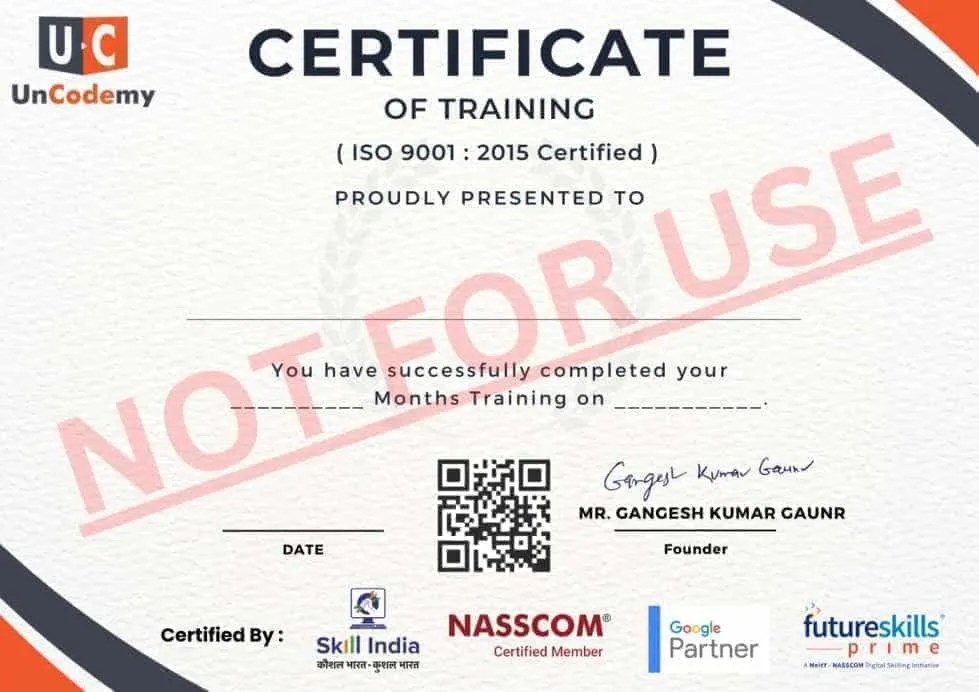
On completing all 13 modules, the assignments and the Enterprise RAG capstone project, you receive the Uncodemy RAG Engineering Program Certificate. The certificate records the program name, duration, tools covered and completion date. It is verifiable online at certificate.uncodemy.com and provides a record of successful completion of the Uncodemy RAG Engineering program.

The certificate is tied to the practical work completed during the program — including hands-on RAG pipeline work, retrieval evaluation and the 20-hour Enterprise RAG capstone project. Learners work with Python, OpenAI APIs, Hugging Face, LangChain, LlamaIndex, LangGraph, FAISS, ChromaDB, Pinecone, PostgreSQL/pgvector, Elasticsearch/OpenSearch, FastAPI, Docker, Git/GitHub and cloud deployment tools.

Key Benefits of Our RAG Engineering Certification:

  • Program Completion :Provides a record of successful completion of the RAG Engineering program.
  • Online Verification :Certificate is verifiable online at certificate.uncodemy.com.
  • Practical Learning :Training includes hands-on RAG pipelines, retrieval evaluation and an enterprise capstone.

This is an independent Uncodemy certificate. It is not affiliated with, endorsed by, or a credential of OpenAI, Pinecone or any other RAG/vendor provider whose tools are taught in this course. Certificate verification process pending confirmation.

Uncodemy Certificate Verification Online Certificate Verification & Download certificate.uncodemy.com
Uncodemy MSME registration certificate

Tools and Technologies Covered

Apply Now

Introducing Uncodemy


Portfolio/capstone project review:Your hands-on RAG pipelines, retrieval evaluation work and enterprise RAG capstone are reviewed and refined into a portfolio an interview will find credible.

Resume & LinkedIn:We build your resume around RAG engineering keywords and measurable outcomes, and align your LinkedIn profile to match.

Interview preparation:Retrieval pipeline design questions, chunking-strategy trade-offs, evaluation-metric discussions and RAG engineering case studies specific to AI hiring.

Mock interviews:Sessions with industry trainers, followed by written feedback on what to fix.

Opportunity sharing:Relevant openings are shared with you, with support through the application and interview process.

Continued support:This is active assistance, not a guarantee of employment — no training institute can honestly promise a job. Support continues after your program ends for learners who stay engaged with the process.

Instructors

The people who actually teach this course

Irshad Khan, Senior Trainer at Uncodemy, leads this program, bringing 8+ years across Data Science, Data Analytics, SQL, Power BI, Python and Generative AI. He's also the one who reviewed and approved the curriculum you see here.

Most institutes blur two jobs into one; Uncodemy keeps them apart. Trainers handle the live teaching. A separate group of domain reviewers — specialists — check that the curriculum stays accurate and up to date. Upendra Kumar Tiwari reviews the technical content for this program, so the person teaching it isn't the only one vouching for it.

Uncodemy publishes every trainer and domain reviewer by name, along with their area of focus and background — so you can check them out before enrolling, not afterward.

Pune guide

From keyword search to hybrid retrieval: RAG work in Pune

A lot of Pune's software work is enterprise software: global capability centres in Kharadi and Hinjewadi, banking technology teams, automotive engineering services and mid-size product companies in Baner and Balewadi. Many of these teams already run a search system, often Elasticsearch, over manuals, tickets and policies. The current wave of retrieval-augmented generation in the city is less about building chatbots from scratch and more about upgrading that search: adding vectors, rerankers and grounded answers without breaking what works. This page explains that work, the skills it needs, and how Pune learners take the course.

Upgrade path

What 'adding RAG' usually means for an existing Pune search system

Few enterprise teams start on a blank page. A typical project inherits a keyword index that users already rely on, with known weaknesses: it misses synonyms, cannot answer questions, and returns twenty links instead of an answer.

Read moreRead less
  1. Keep the keyword index and measure its recall on a set of real queries; this becomes the baseline.
  2. Add dense vectors for the same documents, either inside Elasticsearch/OpenSearch or in a separate vector database.
  3. Fuse results with reciprocal rank fusion and compare recall against the baseline.
  4. Add a reranker on the top results and check the latency cost.
  5. Generate an answer only from the reranked passages, with citations, and keep the old result list visible for users who prefer it.

Each step is covered in the course modules on embeddings, vector databases, advanced retrieval, hybrid search and evaluation. The order above is how teams de-risk the change.

Who builds it

The kinds of Pune teams doing retrieval work

Capability centres

Global companies' Pune centres build internal assistants over policies, engineering wikis and support tickets for colleagues worldwide.

Engineering services

Automotive and industrial engineering-services firms deal with standards, test reports and design documents, where exact retrieval of clause numbers matters.

Product companies

SaaS firms add 'ask the docs' features to their products and need retrieval that works across many customers' data.

Read moreRead less

These are descriptions of team types common in Pune, not a list of hiring partners. Uncodemy has no hiring tie-up with any Pune company. Check current openings yourself on job portals and company career pages.

Automotive docs

Automotive standards: a Pune-flavoured retrieval challenge

Pune is a centre of India's automotive industry, and the Automotive Research Association of India is based here. Vehicle regulations and automotive industry standards run to thousands of pages with clauses, annexures, amendments and test procedures.

Read moreRead less
  • Questions often name a clause or standard number exactly, which favours keyword search.
  • Others are conceptual ('what are the test conditions for this braking requirement?'), which favours dense retrieval.
  • Amendments mean the newest applicable text must outrank older versions.
  • Answers usually need a table of values, so table-aware parsing matters.

Use only publicly available standards and notifications for any portfolio work, and say in your README which versions you indexed.

Ticket search

Support tickets: the other big document set in Pune offices

Beyond manuals and policies, many Pune teams sit on years of resolved support and incident tickets. Engineers want 'has anyone fixed this before?' answered in seconds. Tickets behave differently from documents, so the pipeline has to change.

  • Thread structure: a ticket is a conversation; the useful part is usually the final resolution, not the first complaint. Chunk by resolution and keep the problem summary attached.
  • Noise: signatures, auto-replies and pasted logs need stripping during ingestion.
Read moreRead less
  • Recency and product version: a fix from three releases ago may be wrong today; store version as metadata and prefer recent resolutions.
  • Privacy: customer names and account details must be masked before anything is embedded.
  • Duplicates: the same issue appears hundreds of times; cluster near-duplicates so the top results are not ten copies of one answer.

If your current job gives you access to a ticketing system, you already understand this data better than most candidates. Just never take real tickets out of the company; build your portfolio on public issue trackers of open-source projects instead.

Weekly plan

A weekly rhythm for working professionals in Pune

The course runs 5–6 months, which is long enough that rhythm matters more than intensity. Learners with full-time jobs in the city typically settle into a pattern like this:

  1. Weekend live sessions: attend live, ask questions, and note one experiment to try during the week.
  2. Two weekday evenings: 60–90 minutes each on assignments and the experiment, before the commute tires you out.
  3. One short review slot: rewatch any part of the recording you did not follow.
Read moreRead less

From the vector database modules onward, start your capstone in parallel rather than waiting for the last month. Learners who leave the project to the end usually ship a demo without evaluation numbers, which is the weakest kind of portfolio piece for Pune interviews.

Study setup

Taking the course from Pune

Uncodemy has no Pune centre. Classroom batches run only in Noida (Sector 1) and Delhi (Shakarpur Extension, Laxmi Nagar); Pune learners join the live online batch, taught in real time by the same trainers, with recordings of every session.

  • Duration5–6 months
  • Content140+ hours
  • Live classes90+ live sessions
  • Fee₹17,500 + GST
  • EMIfrom ₹4,032 a month
Read moreRead less
  • Working in Hinjewadi or Kharadi? Long evening commutes make weekday live classes hard for many; the weekend batch plus recordings is the usual choice.
  • Students: evening slots work around SPPU-affiliated college timetables, with recordings for exam weeks.
  • Before paying: attend a free demo class and ask how the trainer approaches hybrid search.
Interviews

How retrieval roles are interviewed in Pune

Interview loops vary, but candidates for GenAI and search roles in Pune commonly report a similar shape: an online coding test, a technical round on Python and data structures, a system-design discussion of a retrieval pipeline, and a deep dive into one project.

Read moreRead less
  • Design round: 'Design an assistant over 50,000 internal documents with access control.' Expect questions on chunking, index choice, permission filters, evaluation and cost.
  • Project deep dive: your numbers. Recall before and after hybrid search, how you built the test set, what failed.
  • Practical round: some teams give a small repository and ask you to improve retrieval quality within an hour.

Capability centres tend to stress design and reliability; product companies tend to probe how you would ship and measure a feature.

Pay

Indicative pay for retrieval and GenAI roles in Pune

ExperienceTypical titleIndicative range
0–1 year, strong projectsGenAI engineer, AI application developer₹5–10 LPA
1–3 yearsRAG engineer, search engineer₹9–17 LPA
3–6 yearsSenior AI engineer₹16–28 LPA
Developer switching with 4+ years elsewhereAI engineer (lateral move)Often close to current pay at first
Read moreRead less

Indicative market ranges based on public listings, not offers or guarantees. Pay depends on employer type, interviews and the depth of your project; capability centres and product companies usually pay more than services firms at the same level.

Capstone

Project: a measured search upgrade

Take a public documentation set large enough to be realistic, such as an open-source project's full documentation or a collection of public standards. Index it in Elasticsearch or OpenSearch as a keyword baseline.

Read moreRead less

Then add vectors, fusion and a reranker one at a time, measuring recall at 10 and latency after each step on 100 questions you wrote. Finish with grounded answer generation and a faithfulness score. The final README should read like an engineering change proposal: baseline, each change, its gain, its cost, and your recommendation. That is exactly the conversation a Pune hiring manager wants to have.

Who joins

Who in Pune usually takes this course

  • Java and .NET developers in services and capability centres who keep getting asked about GenAI features.
  • Search and data engineers who already run Elasticsearch and want to add vector and hybrid retrieval properly.
  • Final-year students from Pune's engineering colleges who want a specific, demonstrable specialisation.
Read moreRead less

Programming fundamentals help but are not mandatory: Python is taught from Module 2 onward and basic LLM concepts are built up in Module 3. Developers coming from other languages should get comfortable with Python packaging and virtual environments early; it saves time in the deployment modules.

Frequently Asked Questions

1. Is there an Uncodemy classroom in Pune?▼

No. Pune learners join live online classes. Uncodemy's classrooms are only in Noida (Sector 1) and Delhi (Shakarpur Extension, Laxmi Nagar).

2. What does the RAG engineering course cost in Pune?▼

The same as everywhere: ₹17,500 + GST, i.e. ₹20,650 with GST. EMI is available from ₹4,032 a month.

3. What will I learn, and how long does it take?▼

5–6 months, 140+ hours, 90+ live sessions, 13 modules: Python, LLM APIs, document processing, chunking, embeddings, vector databases, RAG, reranking, hybrid search, evaluation and deployment, finishing with hands-on RAG projects plus a 20-hour enterprise RAG capstone.

4. Does the course cover Elasticsearch and hybrid search?▼

Yes. The hybrid search module combines BM25 keyword search with vector search, covers rank fusion and uses Elasticsearch/OpenSearch for hybrid retrieval.

5. I work long hours in Hinjewadi. Can I keep up?▼

Most working learners choose the weekend batch and use recordings for missed sessions. Plan for several hours of practice a week beyond class.

6. Which Pune employers hire for RAG skills?▼

Capability centres, engineering-services firms, banking technology teams and product companies across the city. Uncodemy has no hiring tie-up with them; check current listings yourself.

7. Is this course right for an experienced Java developer?▼

Yes, it is a common switch. Programming fundamentals help but are not mandatory: Python is taught from Module 2 onward and basic LLM concepts are built up in Module 3. Your production experience will help in the deployment and reliability parts.

8. Is a job guaranteed after the course?▼

No. Uncodemy provides resume reviews, mock interviews and job-application support (placement assistance, not a job guarantee).

Why Trust This Page? Discover Why Students Choose Uncodemy

How we maintain this page

  • Content written by:Mr. Rahul
  • Content rechecked and verified by: Mr. Irshad Khan
  • Course curriculum verified by:Mr. Irshad Khan
  • Technical content verified by: Mr. Irshad Khan
  • Fee verified by: Admin Department
  • Placement figures sourced from internal placement records
  • Review counts verified against respective third-party platforms
  • Last reviewed:
Application Form
Visit Us

Nearest Classroom Training Centres

Open now
Delhi Centre
2nd & 3rd Floor, Maa Katyayni Complex, MB-1E, Madhuban Rd, next to DSEU Ambedkar College, Laxmi Nagar, Shakarpur Extension, Shakarpur, Delhi, 110092
Noida Centre
B, 14-15, Udhyog Marg, Block B, Sector 1, Noida, Uttar Pradesh 201301
Free demo classWalk-ins welcomeWheelchair accessible