#1 India's Top IT Training Institute
Browse categories
×

About Uncodemy

Know more about who we are and what we stand for.

About Us

About Us

Discover our mission to equip individuals with essential IT skills and industry expertise.

Read More →
UnCodeMy Gallery

UnCodeMy Gallery

Explore highlights from our IT training sessions and success stories.

Read More →
×

Free Resources

Learn, practice and plan your career — bilkul free.

Tutorials

Tutorials

Step-by-step written tutorials to learn any technology at your own pace.

Read More →
Free Counselling

Free Counselling

Book a free video counselling session and pick the right course for you.

Read More →
Online Compiler

Online Compiler

Write, run and test your code online — no setup required.

Read More →

Home › Courses › Software Testing Course in Hubballi-Dharwad

Verified by: Mr. Gangesh Gaunr, Director at Uncodemy · Last reviewed: 31 October 2026

Software Testing Course in Hubballi-Dharwad with Gen AI: Manual, Selenium, Playwright & API Testing

At 7:10 every morning, thousands of parents across Vidyanagar, Gokul Road and Saptapur glance at a phone to see where the school bus is. The app shows a moving dot, an arrival estimate and an alert if the child was not scanned on board. When it lies, a parent waits at a corner in the rain or, worse, assumes a child is safe when they are not. Software like that is built and tested by people, and Hubballi-Dharwad produces many of them. KLE Technological University, SDM College of Engineering, IIT Dharwad, IIIT Dharwad, Karnatak University and a long list of colleges graduate engineers and science students each year, and most of them take the overnight bus to Bengaluru or Pune for their first job. Some of that work is now coming back: the twin cities have an IT park, a lively startup network grown around the Deshpande Startups ecosystem, the South Western Railway headquarters, bus and auto-component makers, banks and hospitals, and remote QA roles are open to anyone with the right portfolio. This course builds that portfolio from home. Over six months, 100+ live classes and roughly 165 hours, manual technique is taught first, from reading requirements and writing cases to Jira reporting and SQL verification, and programming, Selenium, Playwright, API testing, AI for QA and Jenkins follow in turn. The capstone is that school-bus tracking app. Uncodemy runs physical classes only in Noida and Delhi, so those trainers teach your batch live. ₹20,650 in total (₹17,500 + 18% GST), EMI from ₹3,442, placement assistance included.

Enquire now See the syllabus

  • Google 4.7/5 500+
  • Justdial 4.7/5 500+
  • Sulekha 5/5 30+
  • MouthShut 4/5 130+
  • Trustindex 5/5 54+
  • Facebook 5/5 reviews*
  • 14+Years of training
  • 54,000+Learners trained
  • 850+Companies in hiring network
  • 200+Corporate associations
  • 14+Group companies
  • 30+Industry trainers & mentors
  • 15+Tools & technologies
  • DedicatedCareer & placement assistance

Why choose Uncodemy in Hubballi-Dharwad?

From Hubballi or Dharwad you get a live timetabled batch, the same faculty our Noida and Delhi classrooms use, doubts handled in real time, and the hiring network Uncodemy has gathered through 14+ years and 54,000+ learners.

What is included

  • Industry TrainersInstructors who are QA practitioners, with 10+ years of corporate training*.
  • Live Online for Hubballi-DharwadSign in from Vidyanagar, Keshwapur, Gokul Road, Navanagar, Saptapur or Malmaddi; recordings after each class.
  • Hands-on ProjectsYour GitHub fills up as you go, with written cases, browser scripts in two frameworks, service tests, AI-supported work and finally the bus-tracking capstone.
  • Career & Placement AssistancePlacement help for Bengaluru, Pune, twin-city and remote openings.
  • CertificateA certificate whose ID any employer can verify online.
  • Flexible BatchesGroups at dawn, midday, evening and weekends; 8+ new batches monthly*.

Software Testing Course in Hubballi-Dharwad — quick facts

Learning
165+ hours
Duration
6 months
Live training
100+ live sessions
Technology
15+ tools & technologies
Practical work
Testing projects, automation frameworks & GenAI case studies
Program fee
₹17,500 + 18% GST
Total fee
₹20,650
EMI
From ₹3,442/month for 6 months*
Career support
Resume & LinkedIn, mock interviews, job opportunity assistance
Hiring network
850+ companies
Mode
Live online (instructor-led) in Hubballi-Dharwad
Classrooms
Sector 1, Noida & Shakarpur Extension, Delhi
Prior coding
Not required
Certificate
Uncodemy Software Testing Program Certificate, verifiable online
Last reviewed
1 Nov 2026

What is software testing?

Software testing means collecting evidence that an application keeps the promises it makes to users and to the business, and finding the places where it breaks them before it matters. Think of a GPS tracking app that a Dharwad school uses for its buses. A tester confirms that the arrival estimate updates as the bus moves, that an alert fires when the bus leaves its approved route by more than the set distance, that a child scanned at the gate is marked present and one never scanned triggers a message to parents, that drivers cannot start a trip without a vehicle checklist, and that the system copes at 7:30 a.m. when every bus and every parent is online at once.

The method behind those checks is simple to state. Work out which failures would harm children, parents or the school most. Write each case clearly enough that someone else could follow it. Execute it by hand or by script. When it fails, keep the evidence (screenshot, data, steps) and check again after the fix. Testing operates at unit, integration, system and acceptance levels; location and mobile apps also need performance, security, device and network-condition testing. On Agile teams this happens inside every sprint, and automated regression fires each time code is merged.

Types of testing you will practise

Type What it checks Covered in
Functional testing Features behave as the requirement states Modules 1–2
Smoke & sanity testing A new build is stable enough for deeper testing Module 2
Regression testing Recent changes have not broken existing features Modules 2, 6, 7
Cross-browser testing Consistent behaviour across Chrome, Firefox, Edge and WebKit Modules 6–7
Database testing Stored and returned data is correct Module 4
API & integration testing Services exchange data correctly Modules 8–9
Exploratory testing Unexpected behaviour scripts would miss Module 2 and capstone

What a software tester does

In a Bengaluru product company, a Pune services firm or a startup on Hubballi's Gokul Road, a tester's normal week includes clarifying stories with developers and product owners, writing scenarios and test data, verifying each build, logging Jira defects with proof and retesting fixes. Automation testers also maintain the Selenium or Playwright suite, add API checks and investigate failed pipeline runs. Mobile and location products add device labs and field testing.

Course overview: who should join

Six months hold thirteen modules: 165+ hours in 100+ live sessions. Testing fundamentals come first (principles, manual design, Agile, SQL), after which you learn a language and both browser frameworks, test services by hand and by script, spend two modules on AI for testers, assemble a Jenkins framework and close with a 20-hour capstone.

Who should join

  • Students and graduates of KLE Technological University, SDM College of Engineering, IIT Dharwad, IIIT Dharwad, Karnatak University and colleges across the twin cities.
  • Staff at railway, bank, hospital or manufacturing units in Hubballi-Dharwad hoping to move into software QA.
  • Manual testers at twin-city startups or Bengaluru firms who want automation and API skills.
  • Learners in Gadag, Haveri, Kalghatgi, Navalgund or Koppal who want live classes without relocating.
  • Developers wanting a clear base in test design, frameworks and CI.

After the program you should be able to

  • Break a rule such as a route alert into scenarios, cases and data covering limits and invalid values.
  • Check records with SQL and log defects a developer can reproduce at once.
  • Automate browser journeys with Selenium or Playwright on several browsers.
  • Test APIs in Postman and script them against varied data.
  • Apply AI with care and let Jenkins run your suite with Allure dashboards.

Eligibility: any graduate or final-year student; prior coding is not needed (see eligibility). An 8 GB RAM laptop and good internet make the labs smoother.

Upcoming live online batches for Hubballi-Dharwad

Slots are listed in IST. Once you have attended the free demo, pick whichever suits around college, work or business hours; recordings cover anything you miss.

Weekdays

Start date Time (IST) Trainer Seats left
04 Nov 2026 07:00 AM – 08:00 AM Mr. Ravi Prakash 02 Seats
11 Nov 2026 12:30 PM – 01:30 PM Mr. Rishi Raj 01 Seat
18 Nov 2026 06:30 PM – 07:30 PM Mr. Fahim 02 Seats
25 Nov 2026 08:30 PM – 09:30 PM Mr. Satyendra Bind 02 Seats

Weekends

Start date Time (IST) Trainer Seats left
14 Nov 2026 10:00 AM – 12:00 PM Mr. Rishi Raj 02 Seats
28 Nov 2026 02:30 PM – 04:30 PM Mr. Ravi Prakash 01 Seat

Seats are limited and updated daily. 8+ new batches start every month*.

Software testing course syllabus in Hubballi-Dharwad

Thirteen modules form the 165 hours, in the order a tester's responsibilities expand: manual work, SQL checks, browser automation, API testing, AI help and CI. Each closes with practice, and the last is a complete QA engagement on the bus-tracking app.

Module 1: Software Testing Fundamentals & SDLC/STLC 10 h

Class one opens on a rainy July morning in Dharwad. A parent is told the bus is "2 minutes away" for twenty minutes, because the app cached a stale location when the driver's phone lost signal near Toll Naka, and nobody had tested what happens offline. From there the module covers the purpose of testing, its seven principles, the route from a coding slip to something a parent sees, the way Waterfall, V-Model and Agile teams organise delivery, and where each STLC phase meets unit, integration, system and acceptance testing.

Module 2: Manual Testing, Test Cases & Bug Reporting 12 h

Your design lab is the route-and-alert configuration. Geofence radius, delay threshold and pickup-time windows give boundaries; user roles (parent, driver, school admin, transport head) and trip types form equivalence classes; alert rules for late, off-route, overspeed and missed scan fill a decision table; and a trip moving from scheduled to started, at stop, delayed, completed or aborted becomes a state model. Exploration, smoke and sanity passes, and regression cycles follow, and every bug you log carries both a severity and a priority.

Module 3: Agile, Scrum & Test Management 8 h

Agile in a twin-city startup: sprint planning, stand-ups, a review where a school principal watches the demo, and a retro, each story judged by its acceptance criteria. Jira gets a board, status flow, saved filters and a dashboard for the app, and your test plan is written where child-safety alerts outrank everything cosmetic.

Module 4: SQL & Database Testing 10 h

SQL over students, buses, routes, trips and scan_events. Keys and constraints, then filters, sorting, grouped counts, joins and subqueries, used to create realistic data or to prove that every child scanned on board was also scanned off.

Module 5: Programming Fundamentals with Python or Java 15 h

Programming starts here for absolute beginners, in Python or Java: data types, if-else, loops, functions, classes, inheritance and handling errors. Its closing exercise is a loader for CSV, JSON and Excel files of routes and students, so one test can replay a whole school's morning run.

Module 6: Selenium WebDriver & Automation Fundamentals 15 h

With Selenium WebDriver you drive the school admin portal: IDs, CSS and XPath to find fields, explicit waits rather than sleeps, pop-up dialogs, embedded frames, extra windows, route pickers and lengthy trip grids, all organised as PyTest or TestNG suites for Chrome, Firefox and Edge.

Module 7: Playwright Automation with JavaScript/TypeScript 15 h

Module 7 opens with enough TypeScript to be dangerous and then switches to Playwright: locators by role and label, retrying assertions, fixtures, a once-saved login, a GPS feed deliberately cut off to see how the portal reacts, driver-licence uploads, parallel execution and trace files for diagnosis.

Module 8: API Testing with Postman & REST APIs 12 h

The portal and app share REST services. Their building blocks, request verbs, URLs, headers, response codes and JSON, come first; then Postman collections with environment variables, token login and schema assertions put them to the test.

Module 9: API Automation & Integration Testing 12 h

Postman becomes code: response assertions, a trip ID chained through several calls, tokens refreshed automatically and payloads from data files. Integration tests then feed a trip through the API, a simulated GPS stream and the database together, scheduled with the UI tests.

Module 10: GenAI for Test Case Generation & Test Data 10 h

The school asks for a new rule, an alert if a bus idles at one stop for too long, and you test it with Gen AI. You prompt for scenarios and corner cases, have the model invent sample trips, then check its answer for gaps and errors, and learn why children's names, locations and parents' numbers stay out of any public chatbot.

Module 11: AI-Assisted Automation, Debugging & Test Maintenance 12 h

ChatGPT and GitHub Copilot as automation helpers: drafting tests, suggesting refactors, explaining inherited code, decoding stack traces and fixing brittle locators. Each suggestion is executed and understood before commit.

Module 12: Framework Design, Git, CI/CD & Test Reporting 14 h

Module 12 turns loose scripts into an engineered framework, with page classes, external data files, branch-and-review Git habits, Jenkins jobs triggered per commit and Allure summaries that a school's transport head can understand.

Module 13: End-to-End Testing Project & Capstone 20 h

Capstone. You own the tracking app's quality: test plan, execution, UI and API automation, and a Jenkins job tied to GitHub. The closing hours cover job hunting: a sharpened résumé and LinkedIn, a practised ten-minute demo of your GitHub, and mock panels.

List of placed students trained by Uncodemy

Leaving the track, learners know how to decide what a release must have tested, how to use SQL to see what the system actually kept, and how to automate checks on pages and services. These cards feature learners and employers from Uncodemy's placement records. Each outcome is individual, shaped by skills, interview performance, education and the particular role an employer wants filled. Role-wise numbers are on the placement page.

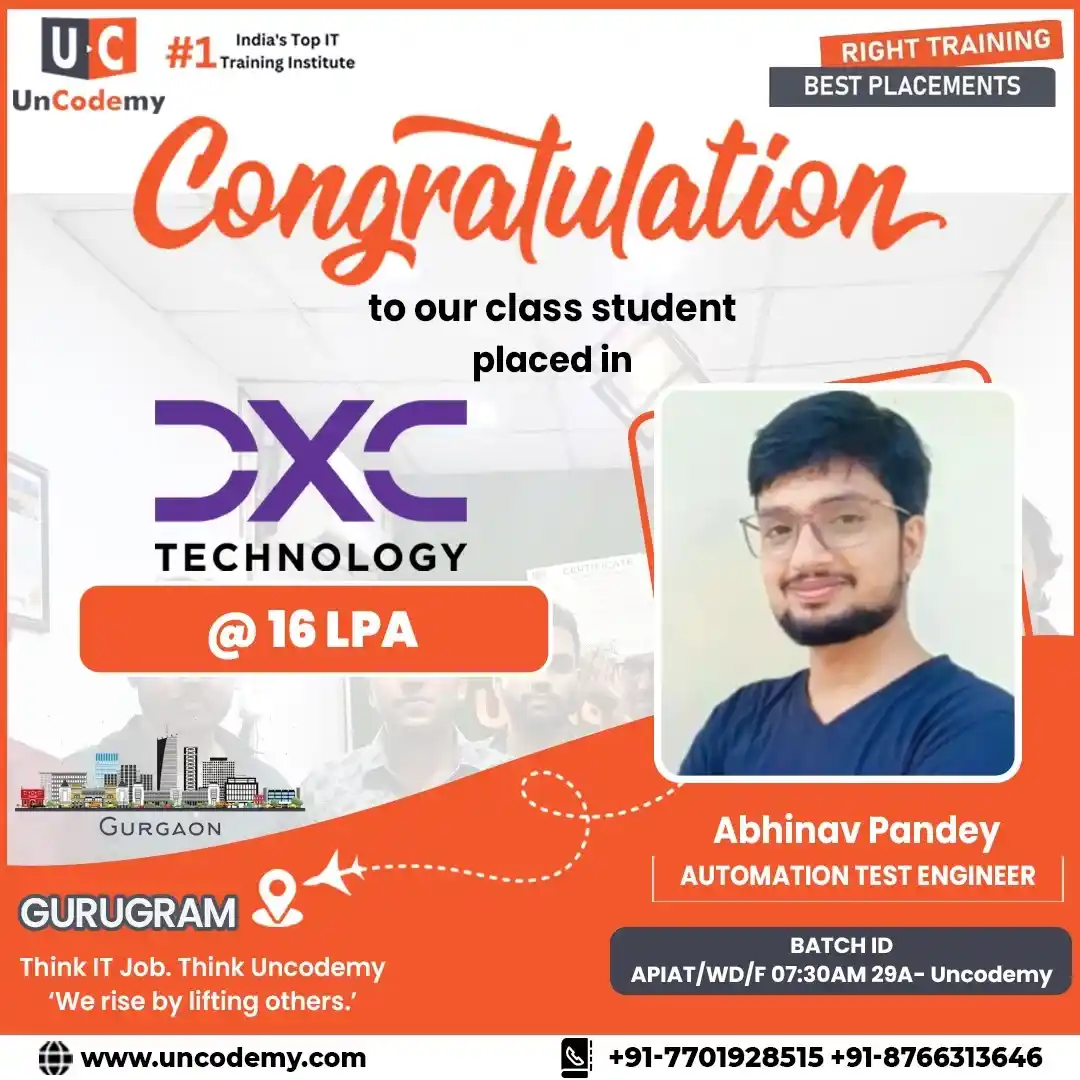
Abhinav Pandey
16 LPA
Gurugram

Abhinav Pandey

Automation Test Engineer

Placed at:DXC Technology

Automation Testing Batch
Batch: APIAT/WD/F 07:30AM 29A
Read placement record
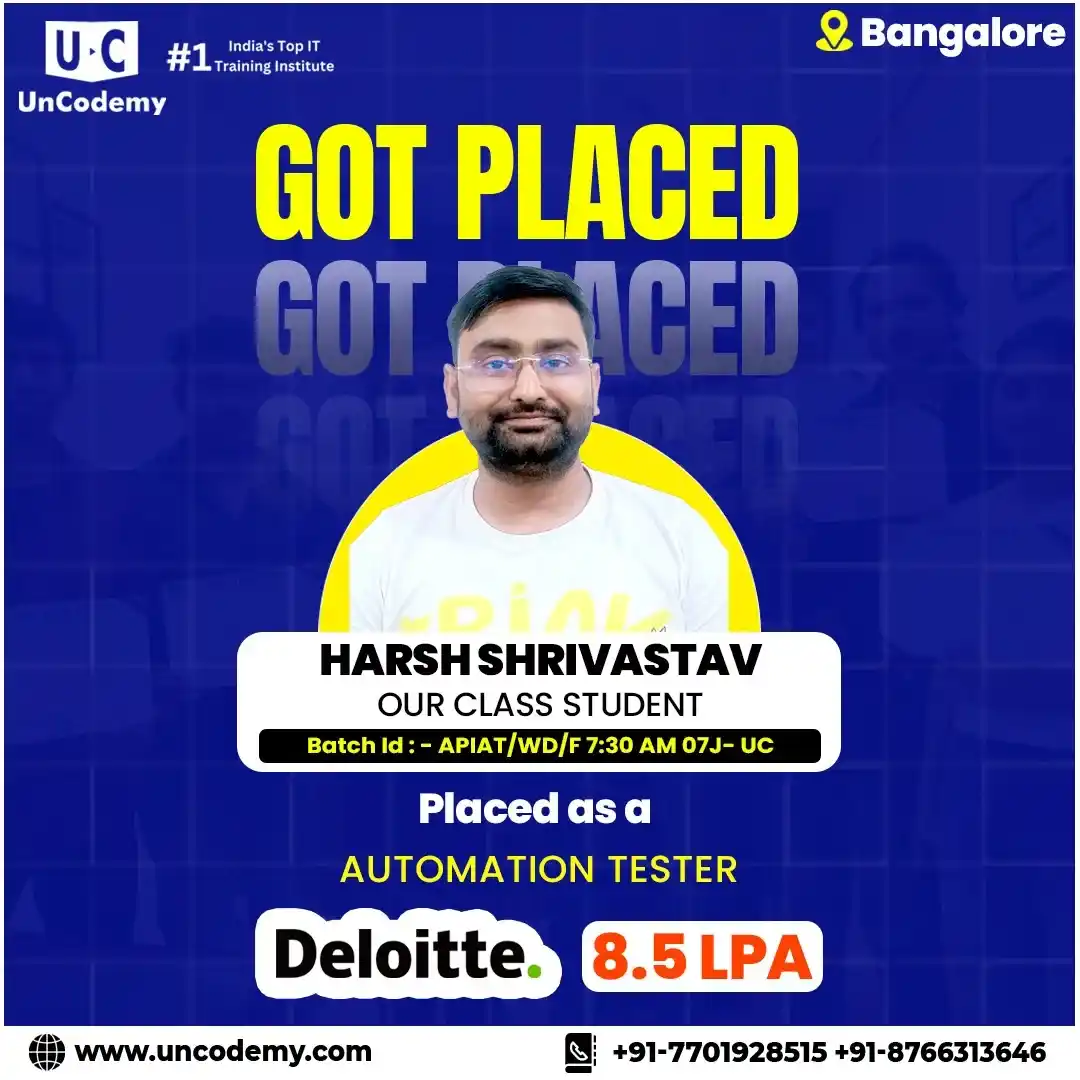
Harsh Shrivastav
8.5 LPA
Bangalore

Harsh Shrivastav

Automation Tester

Placed at:Deloitte

Automation Testing Batch
Batch: APIAT/WD/F 7:30 AM 07J- UC
Read placement record
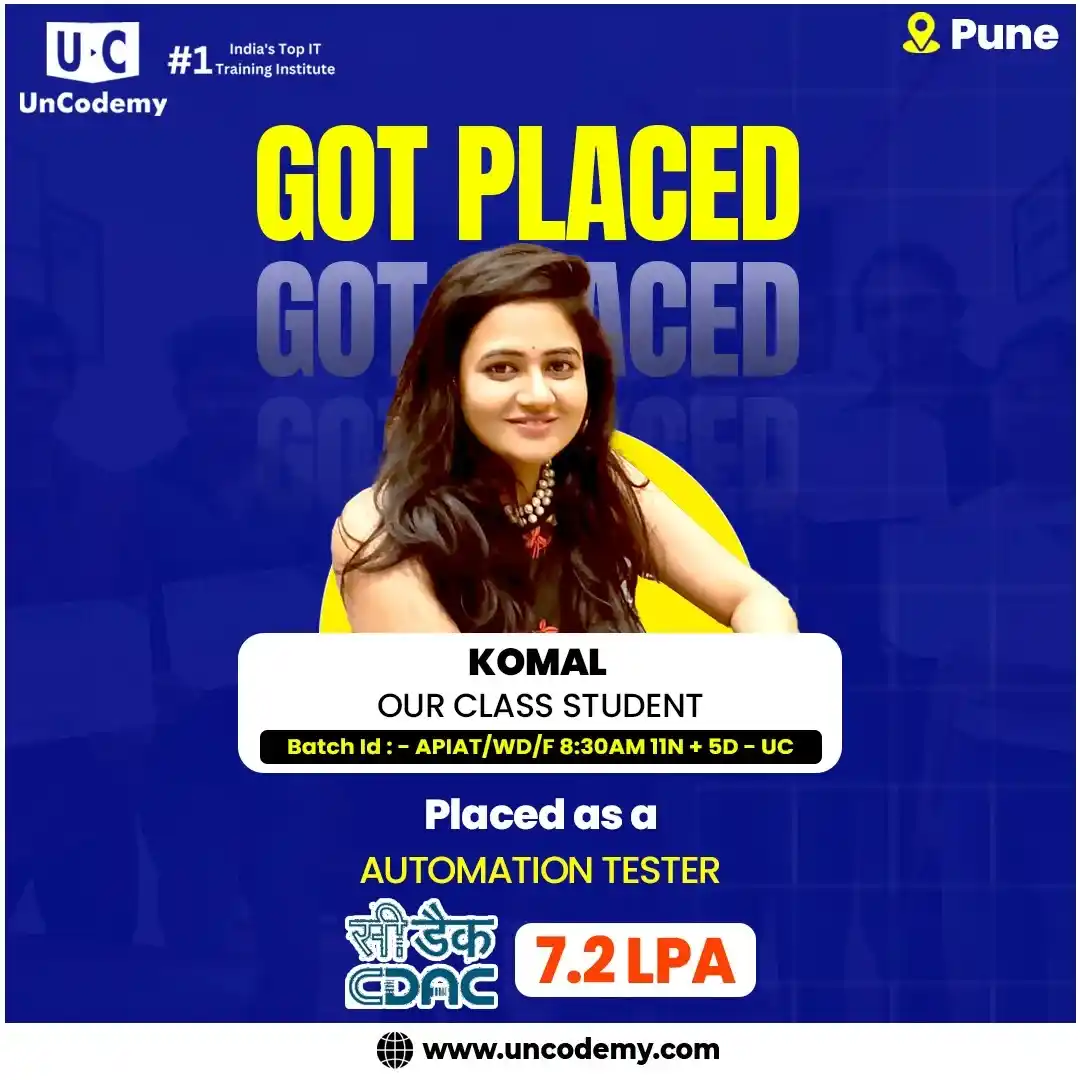
Komal
7.2 LPA
Pune

Komal

Automation Tester

Placed at:C-DAC

Automation Testing Batch
Batch: APIAT/WD/F 8:30AM 1TN + 5D - UC
Read placement record
Aditya
9 LPA
Noida

Aditya

Automation Tester

Placed at:HCLTech

Automation Testing Batch
Batch: APIAT/WD/F 07:30AM 29A
Read placement record
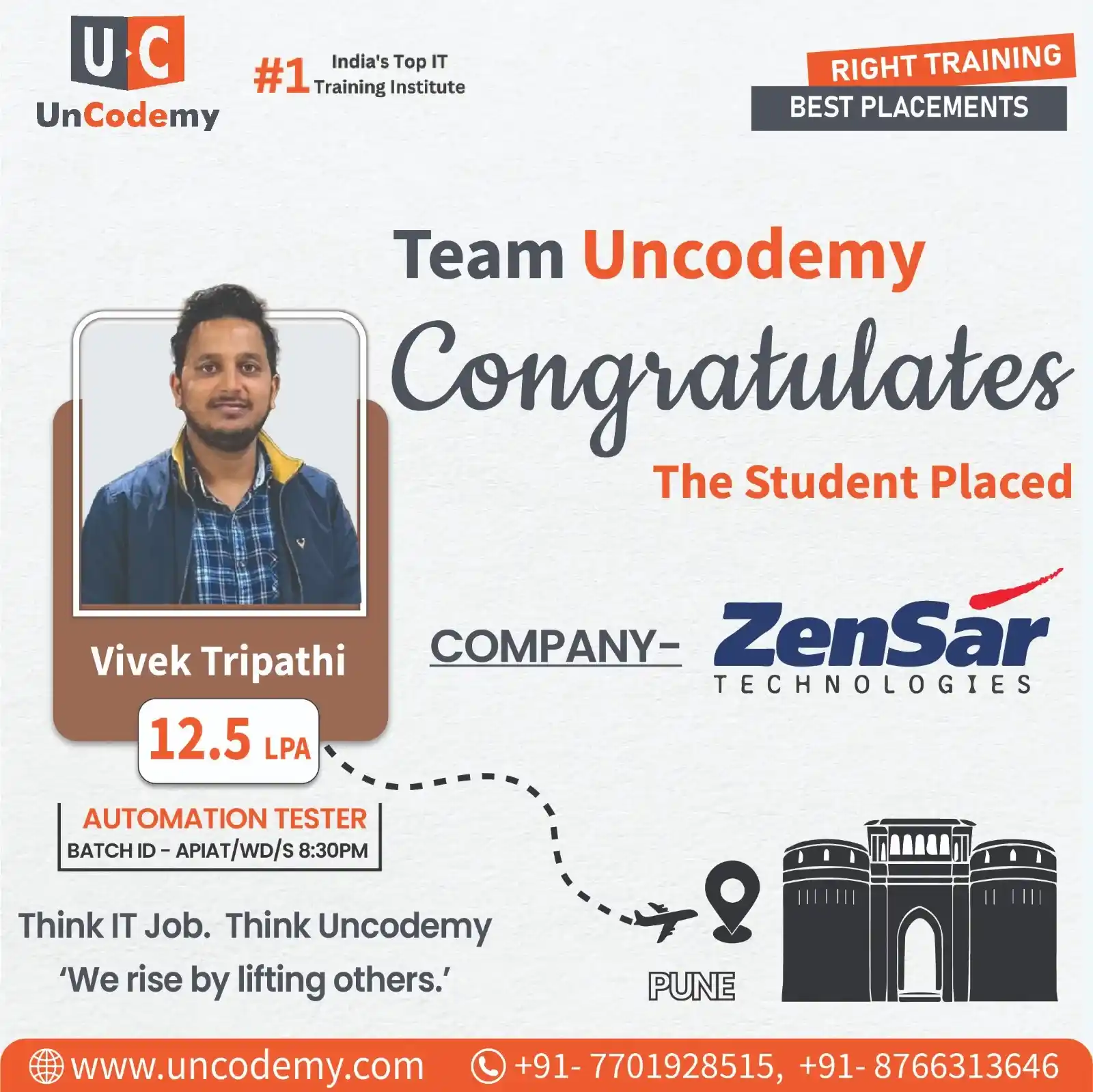
Vivek Tripathi
12.5 LPA
India

Vivek Tripathi

Automation Tester

Placed at:Zensar Technologies

Automation Testing Batch
Batch: APIAT/WD/F 07:30AM 29A
Read placement record
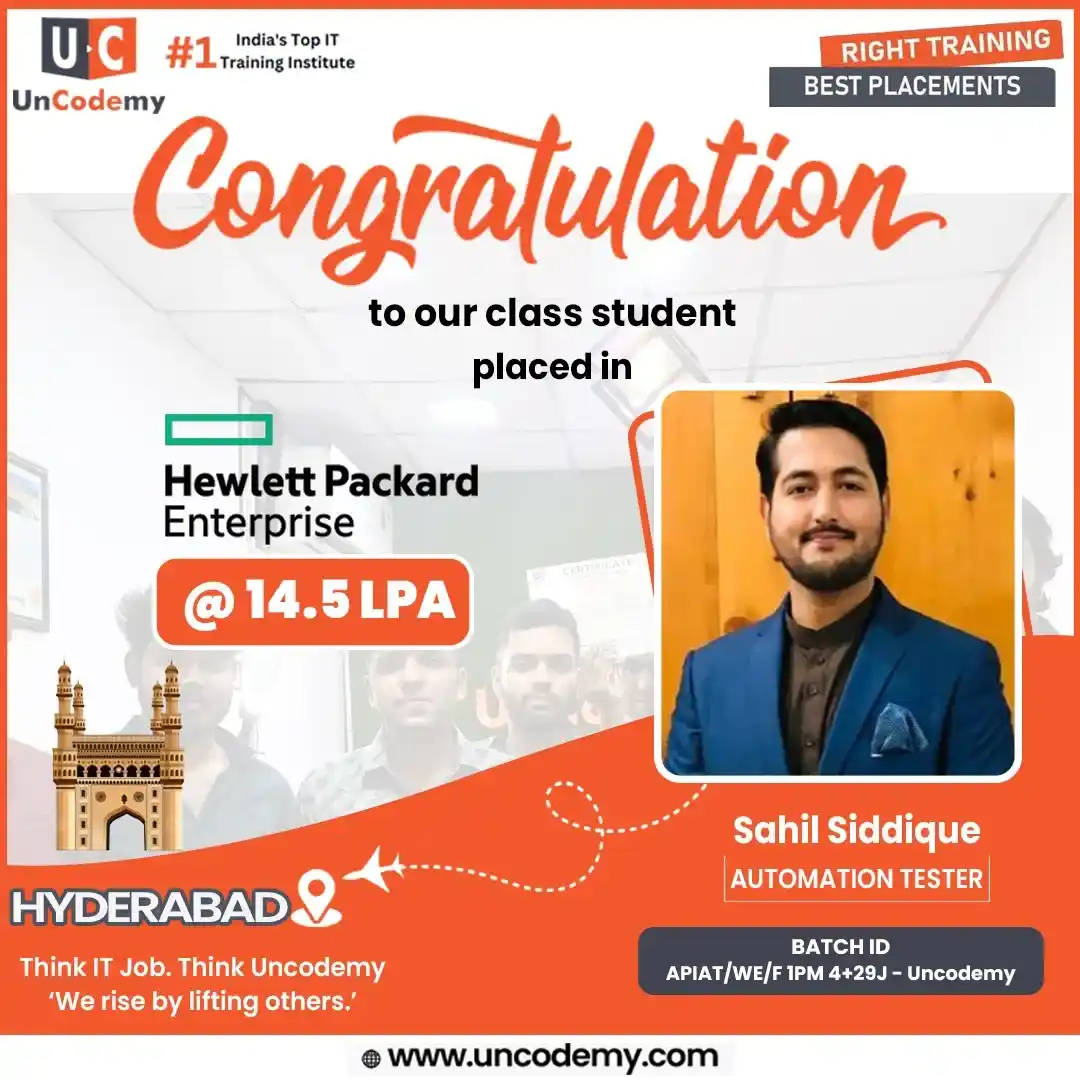
Sahil Siddique
14.5 LPA
Hyderabad

Sahil Siddique

Automation Tester

Placed at:Hewlett Packard Enterprise

Automation Testing Batch
Batch: APIAT/WD/F 07:30AM 29A
Read placement record
Nandini Nivas Kamble
8.0 LPA
Pune

Nandini Nivas Kamble

Automation Tester

Placed at:UST Global

Automation Testing Batch
Batch: APIAT/WD/F 07:30AM 29A
Read placement record
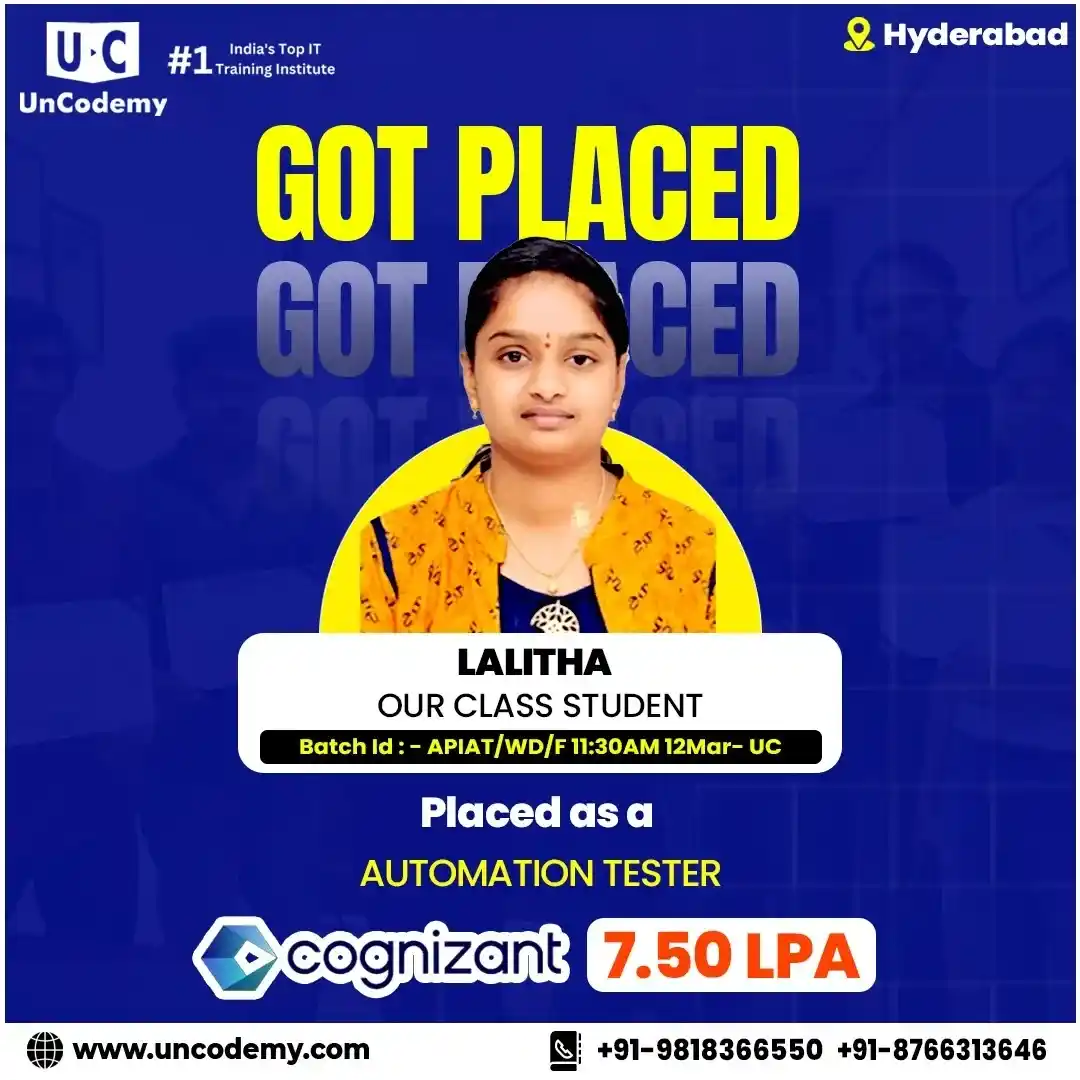
Lalitha
7.5 LPA
Hyderabad

Lalitha

Automation Tester

Placed at:Cognizant

Automation Testing Batch
Batch: APIAT/WD/F 11:30AM 12Mar- UC
Read placement record
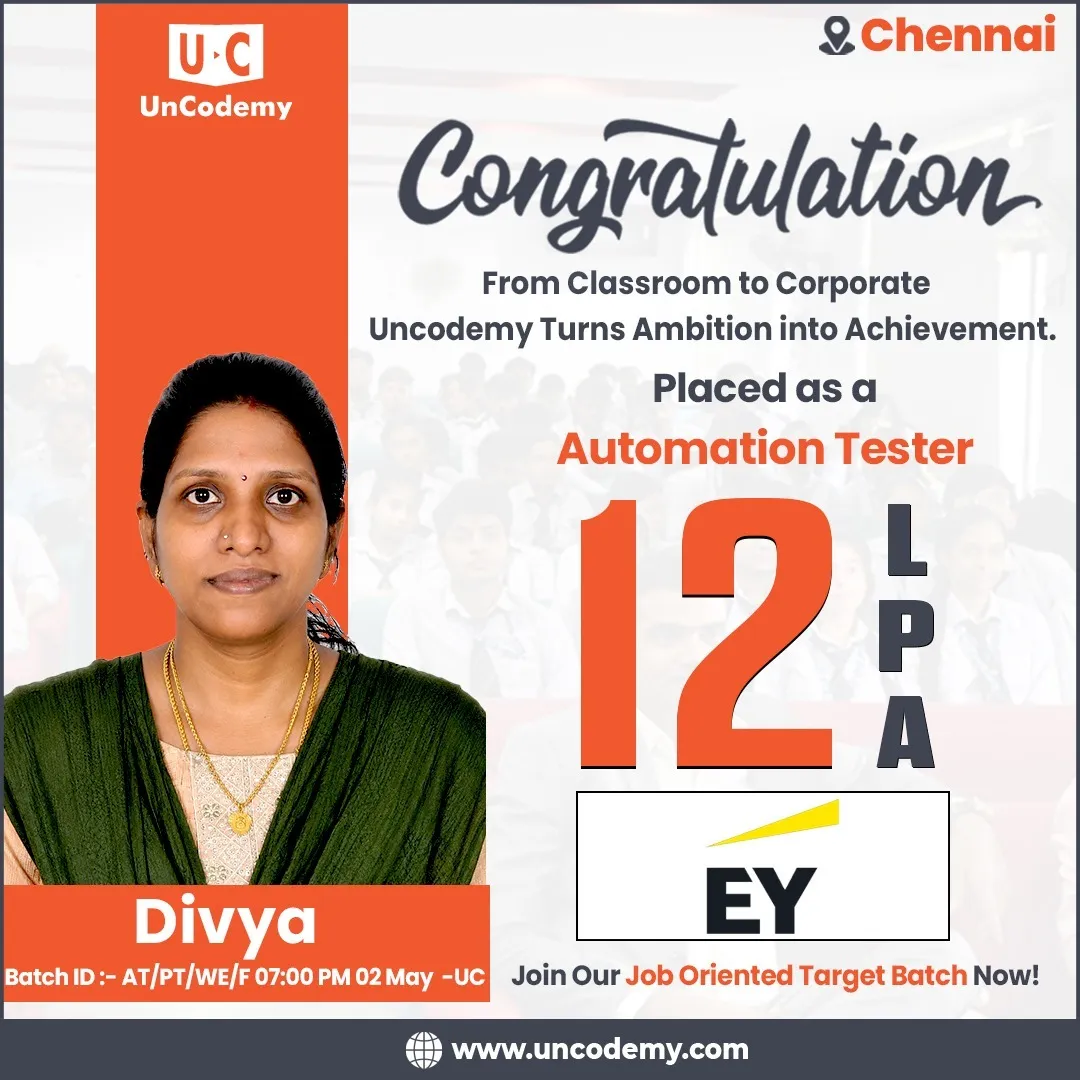
Divya
12 LPA
Chennai

Divya

Automation Tester

Placed at:EY

Automation Testing Batch
Batch: APIAT/WD/F 07:30AM 29A
Read placement record

Cards show learners and employers from Uncodemy’s placement records. Outcomes are individual; no placement or salary is guaranteed.

Instructors

Each batch is taught by a tester currently employed in industry and drawn from Uncodemy's 30+ mentor pool. Course content goes through an independent technical audit, and the syllabus is signed off by a reviewer outside the faculty. Trainer cards state years of experience.

Student projects in software testing

Every project is modelled on a genuine QA brief and lands on GitHub. Your trainer then reads it with a Bengaluru lead's eyes: is some risk left untouched, would an off-route bus that never raised an alert slip through, is the structure clean enough for a colleague to add tests, does Jenkins pass, and do the setup steps in your README actually work?

Certification, tools and ISTQB

Uncodemy's Software Testing Program Certificate is issued once the final module, its assignments and the bus-tracking capstone are signed off. It records the program, the six-month duration, the tool stack and your finishing date, and an HR team in Bengaluru or Hubballi can confirm the ID at certificate.uncodemy.com. An online learner in Dharwad receives the very certificate printed for a Noida classroom learner. Interviewers will still ask to see your work, so the tracking app's test cases, the framework, API suite and a green pipeline are published on your GitHub.

  • Program Completion: Given only after the complete six months.
  • Online Verification: ID checkable on uncodemy.com.
  • Practical Proof: Accompanied by public GitHub work.

Is the course ISTQB aligned?

ISTQB is a separate certification body; what you receive here is Uncodemy's credential. Bengaluru firms sometimes list ISTQB as a plus, and because Modules 1 and 2 cover its Foundation Level syllabus thoroughly, that exam becomes far less daunting if you attempt it.

Tools & technologies covered

Purpose Tools
Test management & defects Jira
Database testing SQL
Programming Python, Java, JavaScript/TypeScript
UI automation Selenium, Playwright
Test runners PyTest/TestNG
API testing Postman, REST APIs
Version control & CI/CD Git, GitHub, Jenkins
Reporting Allure Reports
Generative AI ChatGPT, GitHub Copilot

Introducing Uncodemy

Uncodemy Edutech Pvt. Ltd. has been training IT learners for over 14 years, 54,000+ in total. Hubballi and Dharwad students take part, live, in the batches taught at Sector 1, Noida and Shakarpur Extension, Delhi. The teaching mirrors a working QA team: read the requirement closely, design tests that expose real faults, automate where the payoff is clear and report so a developer can act straight away.

Placement help is offered under specific terms; see our placement eligibility page and read it before you enrol.

  • Portfolio review: Your trainer reviews each project until it can stand up to a Bengaluru technical interview.
  • Resume & LinkedIn: CV and LinkedIn rebuilt to show outcomes, turning railway, bank, school or factory experience into domain value.
  • Interview preparation: Practice on the questions Bengaluru panels like: designing tests live, SQL, framework structure, API scenarios.
  • Mock interviews: Mock interviews with trainers and written notes afterwards.
  • Opportunity sharing: QA leads from 850+ partners in Bengaluru, Pune, the twin cities and remote teams, passed to you as they open.
  • Continued support: The career desk stays available after the course while you remain active; it cannot promise a job.

How Hubballi-Dharwad learners attend

Take Raghav, a mechanical graduate living near Unkal Lake, as an example. His day job at an engineering unit on the Gokul Road side ends at 5:30. By 6:30 he is logged into the live batch, the same one learners in Noida are sitting in. When his geofence test misbehaves, he shares his screen and the trainer fixes it in front of everyone, which helps the whole class. His assignment is on GitHub before eight. During Ganesh Chaturthi week he watches recordings instead. And when a cousin's wedding took him to Delhi, his counsellor booked him into the Noida classroom for a day, without any change in trainer, syllabus or cost.

A typical week in your batch

Weekday batches meet for about an hour from Monday to Friday; weekend batches meet for two longer sessions. Each week has concept-and-demo classes, labs in which the trainer reviews code live, and a slot for doubts. Assignments are pushed to GitHub from Module 5, and the day's recording goes up the same evening.

Some twin-city learners pair this with our online Automation Testing course; others choose analytics, data science, BA or full stack. To judge the depth first, open the free manual testing syllabus or our blog piece, the automation tester roadmap.

Software testing jobs and career scope in Hubballi-Dharwad

QA opportunities for twin-city learners come from three places. Bengaluru, a night's journey away, is India's largest testing market, and Pune is close behind; both now hire heavily for hybrid and remote QA roles. Locally, Hubballi-Dharwad has an IT park and a startup community centred on Gokul Road and Vidyanagar, the South Western Railway zone headquarters, bus-body and engineering manufacturers, banks, hospitals and a dense network of schools and colleges, all running software that needs testing. And fully remote companies across India and abroad hire testers based anywhere. KLE Tech, SDM, IIT Dharwad and IIIT Dharwad turn out capable engineers every year, so a fresher whose repositories already hold working automation and service tests rises up the shortlist.

Remote and hybrid QA roles

Increasingly, Hubballi-Dharwad testers keep their home in Navanagar or Saptapur and work for Bengaluru, Pune or overseas teams, travelling only for occasional sprint planning. A live online batch rehearses that life: daily video stand-ups, debugging over a shared screen, reviewed pull requests and planning your own time. Remote hiring managers often look at GitHub before the CV, and your coursework is all there.

Job roles after this course

Graduates typically begin in the roles below. Each builds on the same testing base; mobile and location products also prize device and field-testing awareness.

Role Core tools
Software Tester Jira, test case design, SQL
Manual QA Engineer Jira, SQL, Postman
Automation Test Engineer Selenium, Playwright, PyTest/TestNG, Git
API Test Engineer Postman, REST APIs, API automation
Playwright / Selenium Automation Engineer Playwright, Selenium, JavaScript/TypeScript, Java/Python
AI Software Testing Engineer ChatGPT, GitHub Copilot, automation frameworks

Bengaluru fresher titles are usually Software Tester, QA Engineer or Automation Test Engineer. After two to four years of real automation, many move up to Senior QA Automation Engineer or SDET; product companies also open routes into mobile, performance and security testing.

Software tester salary in Hubballi-Dharwad, role-wise

QA pay for twin-city learners usually tracks the national bands below; Bengaluru product companies and remote teams sit toward the upper end, and proven scripting or API skill moves you further up.

Role Indicative salary range (India)
Entry-Level Software Tester ₹3–5 LPA
Manual QA Engineer ₹3–6 LPA
Automation Test Engineer ₹4–8 LPA
API Test Engineer ₹5–10 LPA
Playwright / Selenium Automation Engineer ₹6–12 LPA
AI Software Testing Engineer ₹6–14 LPA
Senior QA Automation Engineer ₹12–22 LPA
SDET / Quality Engineering Lead ₹15–30 LPA

Sources reviewed: Instahyre, AmbitionBox, Glassdoor, Indeed and Uncodemy placement records. Reviewed: October 2026. These are indicative national ranges. Actual pay depends on experience, coding ability, employer and specialisation; Uncodemy guarantees no salary or placement.

Top hiring sectors

Within our 850+ partner network, twin-city learners have most often started in:

  • Bengaluru and Pune IT companies: Hybrid and remote QA roles in Karnataka's and Maharashtra's tech hubs
  • Twin-city startups and IT park firms: Product and service teams on Gokul Road and in Vidyanagar
  • Railways and transport: Ticketing, freight and fleet systems around the SWR zone
  • Education, healthcare and banking: School, hospital and branch platforms across north Karnataka
  • Remote-first employers: Indian and overseas companies hiring north Karnataka testers

Anchor your capstone in one of these, the bus-tracking app or a railway parcel system, and a panel in Hubballi or on Bengaluru's ORR will relate to it immediately.

Manual vs automation vs API testing

Bengaluru and Pune employers hiring from north Karnataka now expect testers comfortable with all three. Here is the difference.

Aspect Manual testing Automation testing API testing
What it checks Features as a user sees them Repeated UI and regression checks via scripts Business logic and data exchange behind the UI
Main tools Jira, test case sheets, browser dev tools Selenium, Playwright, PyTest/TestNG Postman, REST APIs
Coding needed None Moderate (Python, Java or JavaScript/TypeScript) Low to moderate
Best for Exploratory, usability, new features Regression, cross-browser, CI/CD runs Fast, stable checks of services
Indicative salary (India) ₹3–6 LPA (Manual QA Engineer) ₹4–8 LPA (Automation Test Engineer) ₹5–10 LPA (API Test Engineer)

Salary ranges are indicative India ranges and are not guaranteed placement outcomes.

How this program compares with other courses

A handful of institutes near Hubballi's Old Bus Stand and Dharwad's Jubilee Circle offer brief manual-testing batches, and video courses abound online. This table compares what each kind contains.

Factor This program
Duration 6 months
Learning hours 165+ hours
Live sessions 100+
Tools covered 15+
Automation Selenium and Playwright (15 hours each)
API testing 24 hours across two modules
Gen AI 22 hours across two dedicated modules
Capstone 20-hour end-to-end project
Career support Resume, LinkedIn, mock interviews, 850+ company hiring network
Total fee ₹20,650 (₹17,500 + 18% GST)

On fees: a manual-only or video-only course is cheaper and serves as a top-up. Choose this program if the goal is changing careers: every lab is live, Selenium and Playwright are both taught, APIs fill two modules, and the placement team stays involved after the last class. Please read the refund policy before paying.

How to become a software tester, step by step

Like the road from Dharwad to Hubballi, the path has fixed stops in a fixed order.

  1. Learn testing fundamentals begin with how software gets made and checked: life cycles, the four levels of testing and the test types that matter most.
  2. Master manual test design sharpen design on apps on your own phone, a cab-booking app or the KSRTC reservation site, applying limits, partitions and rule tables, and file Jira bugs exact enough to reproduce first time.
  3. Learn SQL pick up enough SQL to check data independently.
  4. Pick one programming language stay with one language, Python or Java, until it feels natural; Playwright will introduce TypeScript later.
  5. Automate the UI script the user paths that carry the most risk, in Selenium before Playwright.
  6. Test and automate APIs explore services by hand in Postman, then convert those calls into code.
  7. Use AI tools responsibly let AI speed you up while you check all it produces.
  8. Build a framework and pipeline shape your scripts into page objects inside a Git repo, hand them to Jenkins and share the Allure output.
  9. Publish a portfolio and prepare make your GitHub presentable, align résumé and LinkedIn with it, and rehearse interviews, first in Kannada with friends, then in English.

Time required: about six months of steady effort, a few hours on most days.

Is software testing a good career in 2026, with AI?

Yes, as long as you keep learning. Assistants now draft test cases and code within seconds, so roles built purely on repetitive checks are shrinking. Teams instead pay for testers who choose where to look, automate with judgement, examine services and the links between systems, keep test code healthy and notice when the AI is wrong, because a tracking app that misplaces a child's bus is never a minor defect. A person who understands the users still carries responsibility for quality, which is why automation and AI here sit on top of manual skill.

Choosing how to attend

Live online or classroom?

Studying from Hubballi or Dharwad over a live link costs you nothing that matters. The class is a genuine Noida or Delhi batch in progress, and your microphone is open for questions. When Dasara, semester exams or a trip to Belagavi get in the way, the recording is waiting. Faculty, syllabus, projects, certificate, placement team and fee are the same in every format. A classroom desk only pays off if you are living in NCR for a while, and changing formats where a seat exists does not cut the six months short.

Is this course right for you?

Which line describes you?

If you want… Recommendation
Want nothing more than a manual-testing recap Pick any brief course
A north Karnataka graduate picking QA This program
A twin-city manual tester without automation This program, cover to cover
Drawn more to coding products than checking them Full Stack Development
Fine learning from pre-recorded videos A video course

Frequently asked questions

What is the duration of the Software Testing course in Hubballi-Dharwad?

Short answer: six months. In detail, that means 100+ live sessions and over 165 teaching hours, run as weekday or weekend online groups so a Vidyanagar student and a Keshwapur shop-owner can both fit it in.

What is the fee for the Software Testing course in Hubballi-Dharwad?

Short answer: ₹20,650. That is ₹17,500 of tuition plus 18% GST, the same amount a Noida classroom learner pays, with an optional plan of six monthly instalments at ₹3,442*.

Is there an Uncodemy centre in Hubballi or Dharwad?

Short answer: no. Uncodemy teaches in person at just two addresses, in Noida and in Delhi. Hubballi and Dharwad learners join those classes live over the internet, with the same trainers, syllabus and fee.

Can I learn software testing without a coding background?

Short answer: yes. Karnatak University BSc and BCom graduates regularly start from zero. There is no programming until Module 5; the first four modules are testing ideas, case design, Agile and SQL, and coding is then taught from the first line.

Is manual testing still in demand in 2026?

Short answer: as a starting point only. Bengaluru and Pune QA adverts now nearly always add Selenium, Playwright or API testing to the manual basics, so the course carries you from manual work into automation, service testing and AI-assisted QA.

Should I learn manual testing or automation testing first?

Short answer: manual. Automation simply runs a well-designed manual test as code, so test design is the first habit to build.

Which is better to learn: Selenium or Playwright?

Short answer: both, fifteen hours each. Older enterprise suites in Bengaluru mostly run Selenium WebDriver; newer product teams frequently prefer Playwright. Showing both on GitHub helps.

Does the course include API testing?

Short answer: two full modules. Module 8 gives 12 hours to Postman and REST, and Module 9 another 12 to coded API and integration tests with token login. Tracking, ticketing and banking apps depend on APIs, so interviewers probe this.

Does the course cover Generative AI in software testing?

Short answer: yes, 22 hours. Module 10 is prompting AI for scenarios and invented records; Module 11 brings ChatGPT and Copilot in while you build and debug automation. Checking their work is always your responsibility.

Will AI replace software testers?

Short answer: no. AI changes where a tester's effort goes. It drafts quickly, but someone who understands parents, passengers or customers still has to judge whether a test proves anything and approve a release.

Is this course ISTQB certified?

Short answer: Uncodemy's own. A good portion of ISTQB Foundation Level is already taught in Modules 1–2, and some Bengaluru employers like that badge, but that exam is booked and paid for separately.

What is the salary of a software tester in Hubballi-Dharwad?

Short answer: it depends. As a national guide, freshers see about ₹3–5 LPA, automation test engineers ₹4–8 LPA and SDETs or QE leads ₹15–30 LPA. Your own offer turns on skills, employer and experience, and Uncodemy promises no figure.

Can a fresher or non-IT graduate get a software testing job in Hubballi-Dharwad?

Short answer: yes. Freshers with BE, BSc, BCA or BCom degrees are taken on by Bengaluru and Pune companies, twin-city startups and remote teams. Expect a test-design exercise, some SQL, questions on one automation tool and a look at your GitHub; each is rehearsed in class, though the hiring call is the company's.

What job roles can I apply for after this course?

Short answer: tester and automation roles. Typical fresher titles are QA Trainee, Software Test Engineer, Automation Tester and API Tester, plus vacancies whose skill list says Selenium or Playwright. SDET titles usually come later.

Are the classes live or recorded?

Short answer: live. Each class is taught by a trainer at its scheduled time, and its recording is available afterwards for revision.

Do you provide placement assistance to learners in Hubballi-Dharwad?

Short answer: yes. The Noida placement desk also works with twin-city learners: résumé and LinkedIn edits, practice interviews, coaching and vacancies from 850+ partner companies. It cannot guarantee employment.

Is a free demo class available before I enrol?

Short answer: yes. A free online demo lets you watch a live class and question the trainer, and the current offer adds two trial classes before you pay.

Can I attend at the Noida or Delhi branch if I visit NCR?

Short answer: yes, if a seat is spare. Every format uses one syllabus, so a few days in the capital can include a classroom session at Sector 1 or Shakarpur. Tell your counsellor before you go.

Enrol in our software testing training in Hubballi-Dharwad today

From Dharwad pedha country to a QA desk: live classes, GitHub projects and interview preparation for ₹20,650, the classroom fee exactly. Start with the free demo and two trial classes.


Enquire now See the syllabus

Why trust this page?

Named reviewers have checked each part of this page; their roles and the latest review date are listed below.

  • Course curriculum verified by Mr. Satyendra Bind.
  • Technical content verified by Mr. Fahim.
  • Content rechecked and verified by Mr. Rishi Raj.
  • Fee verified by Admin Department.
  • Placement figures sourced from internal placement records.
  • Review counts verified against respective third-party platforms.
  • Last reviewed: 1 Nov 2026

Written by: Mr. Chandra Shekhar · Reviewed by: Mr. Satyendra Bind · Final editorial check: Mr. Gangesh Gaunr, Director at Uncodemy

Our training centres and how learners in Hubballi-Dharwad join

There is no third campus. Every class streamed to Hubballi and Dharwad originates in one of these two rooms, taught by one faculty to one syllabus.

Centre Address
Noida B, 14-15, Udhyog Marg, Block B, Sector 1, Noida, Uttar Pradesh 201301 (near Noida Sector-15 Metro Station)
Delhi 2nd & 3rd Floor, Maa Katyayni Complex, MB-1E, Madhuban Rd, next to DSEU Ambedkar College, Laxmi Nagar, Shakarpur Extension, Shakarpur, Delhi 110092
PanIndia Live online, instructor-led classes

Phone: +91 9818366550 · Email: info@uncodemy.com